

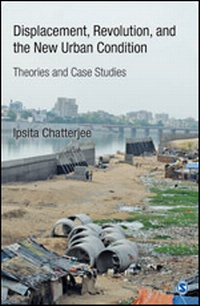
Displacement, Revolution, and the New Urban Condition
Theories and Case Studies
1st Edition
Published on 30. April 2014
Book
Paperback/Softback
176 pages
978-93-5388-027-9 (ISBN)
Description
Displacement, Revolution, and the New Urban Condition provides a window into the global urban contradiction through the lens of a Third World city. It is not a book on urban India, or a book on Ahmedabad city, or even a book on the Sabarmati River Front Development (SRFD) project, but it is a book that uses all these lenses to conceptualize urban exploitation.
The author develops a dialectical praxis of theory transfer that takes us from the First World to the Third World and back again. In the process, the arrow of theory transfer is not reversed, because theory cannot be transferred by simply changing the direction of the arrow; instead, an attempt is made to (re)produce and (re)inform different conceptual worlds by juxtaposing it with the SRFD project in Ahmedabad city.
This book is, therefore, as much about the poor people of Ahmedabad as it is about global urban displacement and the politics of resettlement and resistance-theory and practice are always inflected, and the chapters demonstrate this inflection deeply and clearly. The point is to change the world, and to do so we must relentlessly struggle to better the concepts that we use to understand it with. This book is such a struggle.
The author develops a dialectical praxis of theory transfer that takes us from the First World to the Third World and back again. In the process, the arrow of theory transfer is not reversed, because theory cannot be transferred by simply changing the direction of the arrow; instead, an attempt is made to (re)produce and (re)inform different conceptual worlds by juxtaposing it with the SRFD project in Ahmedabad city.
This book is, therefore, as much about the poor people of Ahmedabad as it is about global urban displacement and the politics of resettlement and resistance-theory and practice are always inflected, and the chapters demonstrate this inflection deeply and clearly. The point is to change the world, and to do so we must relentlessly struggle to better the concepts that we use to understand it with. This book is such a struggle.
Reviews / Votes
An insight into various problems and challenges that displaced people face throughout their lives. Rehabilitation and resettlement of displaced persons pose major challenges for the government and citizens....this book has lucidly interfaced the theories revolving around urban policies and development by studying the Sabarmati River Front Development (SRFD) and the people of Ahemdabad. It would help geographers, planners, policy makers to internalize that urban change is not a simple process of renewing idle spaces but it is at the same time an exploitative mechanism to displace people and their labouring landscape. -- Social Action, Vol 65 The book informs "new urban politics"- a policy shift in urban governance that challenges the notion of the city as a place for redistributive justice by appealing to entrepreneurial capital, through two mutually inclusive concepts....This book can also be read as a people's history of development in Gujarat, whose characteristics have been replicated in large-scale development projects all over India...It is a gleaming of entrepreneurial urbanism, marking a shift from social urbanism. -- Economic & Political Weekly, 1 August 2015 This is a valuable book that grapples with differing narratives of development, resistance and community present in the SFRD project. Chatterjee's work is most powerful when she challenges homogenous narratives of resistance and lends a theoretical gaze to the aftermath of resettlement. Her account, though at times dense, also importantly links theory exchange between the Global North and the Global South, demonstrating how the SFRD is not just about a riverfront community in Ahmedabad, but about global urban displacement. -- Kavita Ramakrishnan, University of East Anglia "Chatterjee's book is an ambitious project for providing a comprehensive theory of contemporary urban transformation, in short compass.... Chatterjee's strength lies in showing how urban exploitation destroys the landscapes and lifescapes of labor but "reproduces the landscapes and lifescapes of accumulation"." -- Pacific Affairs, December, 2016 This book is recommended for whoever is interested in urban development or non-secular urban governance and especially for students, as Chatterjee provides, apart from her own interesting analysis, her lucid readings of crucial theories and concepts...her book is a creative and politically important theoretical undertaking and should find a broad audience in this capacity. -- Social Change, * Vol 46 (Issue 4), December 2016 *More details
Edition
First Edition
Language
English
Place of publication
New Delhi
India
Target group
College/higher education
Professional and scholarly
Dimensions
Height: 216 mm
Width: 140 mm
Weight
232 gr
ISBN-13
978-93-5388-027-9 (9789353880279)
Copyright in bibliographic data and cover images is held by Nielsen Book Services Limited or by the publishers or by their respective licensors: all rights reserved.
Schweitzer Classification
Person
Ipsita Chatterjee is an Associate Professor in the Department of Geography, University of North Texas. She has also served as an assistant professor at the Department of Geography and the Environment, University of Texas at Austin, from 2009 to 2013, and a visiting assistant professor at the Department of Geography, Pennsylvania State University. Chatterjee's research focuses on the political, economic, and cultural dimensions of globalization, displacement, violence, and class/ identity-based urban exclusions. She has authored articles in Urban Studies, Transactions of the Institute of British Geographers, Geoforum, Gender, Place and Culture, among others.
Content
Acknowledgments
Preface
Introduction
New Urban Politics
Accumulation, Estrangement, and Displacement
Resettlement and the Territorialization of Exploitation
Of Unruly Practices and Resistance
Reversing the Arrow? Theory Transfer and Theory-building
Bibliography
Index
Preface
Introduction
New Urban Politics
Accumulation, Estrangement, and Displacement
Resettlement and the Territorialization of Exploitation
Of Unruly Practices and Resistance
Reversing the Arrow? Theory Transfer and Theory-building
Bibliography
Index