

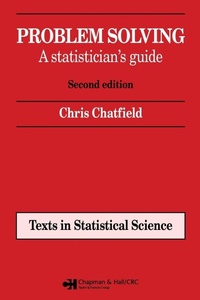
Problem Solving
A statistician's guide, Second edition
2nd Edition
Published on 11. May 1995
Book
Paperback/Softback
325 pages
978-0-412-60630-4 (ISBN)
Description
This book illuminates the complex process of problem solving, including formulating the problem, collecting and analyzing data, and presenting the conclusions.
More details
Series
Edition
2nd edition
Language
English
Place of publication
Oxford
United Kingdom
Publishing group
Taylor & Francis Ltd
Target group
College/higher education
Professional and scholarly
Professional
Dimensions
Height: 234 mm
Width: 156 mm
Thickness: 18 mm
Weight
521 gr
ISBN-13
978-0-412-60630-4 (9780412606304)
Copyright in bibliographic data and cover images is held by Nielsen Book Services Limited or by the publishers or by their respective licensors: all rights reserved.
Schweitzer Classification
Other editions
Additional editions
Book
08/2017
2nd Edition
CRC Press
€282.26
Shipment within 10-20 days
E-Book
05/1995
2nd Edition
Chapman & Hall/CRC
€165.99
Available for download
E-Book
05/1995
2nd Edition
Chapman and Hall
€165.99
Available for download
Person
Chatfield, Chris
Content
Part One: The General Principles Involved in Tackling Real-life Statistical Problems; 1: Introduction; 2: The stages of a statistical investigation; 3: Formulating the problem; 4: Collecting the data; 5: Analysing the data - 1: General strategy; 6: Analysing the data - 2: The initial examination of data; 7: Analysing the data - 3: The definitive' analysis; 8: Using resources - 1: The computer; 9: Using resources - 2: The library; 10: Communication - 1: Effective statistical consulting; 11: Communication - 2: Effective report writing; 12: Numeracy; Summary; Part Two: Exercises; A: Descriptive statistics; B: Exploring data; C: Correlation and regression; D: Analysing complex large-scale data sets; E: Analysing more structured data; F: Time-series analysis; G: Miscellaneous; H: Collecting data; Part Three: Appendices; Appendix A: A digest of statistical techniques; Appendix B: Minitab and Glim; Appendix C: Some useful addresses; Appendix D: Statistical tables