

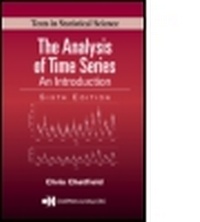
The Analysis of Time Series
An Introduction, Sixth Edition
6th Edition
Published on 29. July 2003
Book
Paperback/Softback
352 pages
978-1-58488-317-3 (ISBN)
Description
Since 1975, The Analysis of Time Series: An Introduction has introduced legions of statistics students and researchers to the theory and practice of time series analysis. With each successive edition, bestselling author Chris Chatfield has honed and refined his presentation, updated the material to reflect advances in the field, and presented interesting new data sets.
The sixth edition is no exception. It provides an accessible, comprehensive introduction to the theory and practice of time series analysis. The treatment covers a wide range of topics, including ARIMA probability models, forecasting methods, spectral analysis, linear systems, state-space models, and the Kalman filter. It also addresses nonlinear, multivariate, and long-memory models. The author has carefully updated each chapter, added new discussions, incorporated new datasets, and made those datasets available for download from www.crcpress.com. A free online appendix on time series analysis using R can be accessed at http://people.bath.ac.uk/mascc/TSA.usingR.doc.
Highlights of the Sixth Edition:
A new section on handling real data
New discussion on prediction intervals
A completely revised and restructured chapter on more advanced topics, with new material on the aggregation of time series, analyzing time series in finance, and discrete-valued time series
A new chapter of examples and practical advice
Thorough updates and revisions throughout the text that reflect recent developments and dramatic changes in computing practices over the last few years
The analysis of time series can be a difficult topic, but as this book has demonstrated for two-and-a-half decades, it does not have to be daunting. The accessibility, polished presentation, and broad coverage of The Analysis of Time Series make it simply the best introduction to the subject available.
The sixth edition is no exception. It provides an accessible, comprehensive introduction to the theory and practice of time series analysis. The treatment covers a wide range of topics, including ARIMA probability models, forecasting methods, spectral analysis, linear systems, state-space models, and the Kalman filter. It also addresses nonlinear, multivariate, and long-memory models. The author has carefully updated each chapter, added new discussions, incorporated new datasets, and made those datasets available for download from www.crcpress.com. A free online appendix on time series analysis using R can be accessed at http://people.bath.ac.uk/mascc/TSA.usingR.doc.
Highlights of the Sixth Edition:
A new section on handling real data
New discussion on prediction intervals
A completely revised and restructured chapter on more advanced topics, with new material on the aggregation of time series, analyzing time series in finance, and discrete-valued time series
A new chapter of examples and practical advice
Thorough updates and revisions throughout the text that reflect recent developments and dramatic changes in computing practices over the last few years
The analysis of time series can be a difficult topic, but as this book has demonstrated for two-and-a-half decades, it does not have to be daunting. The accessibility, polished presentation, and broad coverage of The Analysis of Time Series make it simply the best introduction to the subject available.
More details
Series
Edition
6th New edition
Language
English
Place of publication
United States
Publishing group
Taylor & Francis Inc
Target group
College/higher education
Professional and scholarly
Senior undergraduate and graduate-level students of statistics
Edition type
New edition
Illustrations
44 s/w Abbildungen, 3 s/w Tabellen
3 Tables, black and white; 44 Illustrations, black and white
Dimensions
Height: 235 mm
Width: 156 mm
Weight
531 gr
ISBN-13
978-1-58488-317-3 (9781584883173)
Copyright in bibliographic data and cover images is held by Nielsen Book Services Limited or by the publishers or by their respective licensors: all rights reserved.
Schweitzer Classification
Other editions
New editions
Book
05/2019
7th Edition
Chapman & Hall/CRC
€113.10
Shipment within 15-20 days
Additional editions

Book
07/2003
6th Edition
CRC Press
€147.07
The article will not be published
Previous edition
The Analysis of Time Series
An Introduction, Sixth Edition
Book
04/1996
5th Edition
Chapman & Hall/CRC
€39.60
Article exhausted; check for reprint
Person
Content
INTRODUCTION
Some Representative Time Series
Terminology
Objectives of Time-Series Analysis
Approaches to Time-Series Analysis
Review of Books of Time Series
SIMPLE DESCRIPTIVE TECHNIQUES
Types of Variation
Stationary Time Series
The Time Plot
Transformation
Analysing Series that Contain a Trend
Analysing Series that Contain Seasonal Variation
Autocorrelation and the Correlogram
Other Tests of Randomness
Handling Real Data
PROBABILITY MODELS FOR TIME SERIES
Stochastic Processes and their Properties
Stationary Processes
Some Properties of the Autocorrelation Function
Some Useful Models
The Wold Decomposition Theorem
FITTING TIME-SERIES MODELS (IN THE TIME DOMAIN)
Estimating the Autocovariance and Autocorrelation Functions
Fitting an Autoregressive Process
Fitting a Moving Average Process
Estimating the Parameters of an ARMA Model
Estimating the Parameters of an ARIMA Model
The Box-Jenkins Seasonal (SARIMA) Model
Residual Analysis
General Remarks on Model Building
FORECASTING
Introduction
Univariate Procedures
Multivariate Procedures
A Comparative Review of Forecasting Procedures
Some Examples
Prediction Theory
STATIONARY PROCESSES IN THE FREQUENCY DOMAIN
Introduction
The Spectral Distribution Function
The Spectral Density Function
The Spectrum of a Continuous Process
Derivation of Selected Spectra
SPECTRAL ANALYSIS
Fourier Analysis
A Simple Sinusoidal Model
Periodogram Analysis
Spectral Analysis: some Consistent Estimation Procedures
Confidence Intervals for the Spectrum
A Comparison of Different Estimation Procedures
Analysing a Continuous Time Series
Examples and Discussion
BIVARIATE PROCESSES
The Cross-Covariance and Cross-Correlation Functions
The Cross-Spectrum
LINEAR SYSTEMS
Introduction
Linear systems in the Time Domain
Linear Systems in the Frequency Domain
Identification of Linear Systems
STATE-SPACE MODELS AND THE KALMAN FILTER
State-Space Models
The Kalman Filter
NON-LINEAR MODELS
Introduction
Some Models with Nonlinear Structure
Models for Changing Variance
Neural Networks
Chaos
Concluding Remarks
Bibliography
MULTIVARIATE TIME-SERIES MODELLING
Introduction
Single Equation Models
Vector Autoregressive Models
Vector ARMA Models
Fitting VAR and VARMA Models
Co-integration
Bibliography
SOME MORE ADVANCED TOPICS
Model Identification Tools
Modelling Non-Stationary Series
Fractional Differencing and Long-Memory Models
Testing for Unit Roots
The Effect of Model Uncertainty
Control Theory
Miscellanea
EXAMPLES AND PRACTICAL ADVICE
General Comments
Computer Software
Examples
More on the Time Plot
Concluding Remarks
Data Sources and Exercises
APPENDICES
The Fourier, Laplace, and z-Transforms
The Dirac Delta Function
Covariance and Correlation
Some MINITAB and S-PLUS Commands
ANSWERS TO EXERCISES
REFERENCES
Some Representative Time Series
Terminology
Objectives of Time-Series Analysis
Approaches to Time-Series Analysis
Review of Books of Time Series
SIMPLE DESCRIPTIVE TECHNIQUES
Types of Variation
Stationary Time Series
The Time Plot
Transformation
Analysing Series that Contain a Trend
Analysing Series that Contain Seasonal Variation
Autocorrelation and the Correlogram
Other Tests of Randomness
Handling Real Data
PROBABILITY MODELS FOR TIME SERIES
Stochastic Processes and their Properties
Stationary Processes
Some Properties of the Autocorrelation Function
Some Useful Models
The Wold Decomposition Theorem
FITTING TIME-SERIES MODELS (IN THE TIME DOMAIN)
Estimating the Autocovariance and Autocorrelation Functions
Fitting an Autoregressive Process
Fitting a Moving Average Process
Estimating the Parameters of an ARMA Model
Estimating the Parameters of an ARIMA Model
The Box-Jenkins Seasonal (SARIMA) Model
Residual Analysis
General Remarks on Model Building
FORECASTING
Introduction
Univariate Procedures
Multivariate Procedures
A Comparative Review of Forecasting Procedures
Some Examples
Prediction Theory
STATIONARY PROCESSES IN THE FREQUENCY DOMAIN
Introduction
The Spectral Distribution Function
The Spectral Density Function
The Spectrum of a Continuous Process
Derivation of Selected Spectra
SPECTRAL ANALYSIS
Fourier Analysis
A Simple Sinusoidal Model
Periodogram Analysis
Spectral Analysis: some Consistent Estimation Procedures
Confidence Intervals for the Spectrum
A Comparison of Different Estimation Procedures
Analysing a Continuous Time Series
Examples and Discussion
BIVARIATE PROCESSES
The Cross-Covariance and Cross-Correlation Functions
The Cross-Spectrum
LINEAR SYSTEMS
Introduction
Linear systems in the Time Domain
Linear Systems in the Frequency Domain
Identification of Linear Systems
STATE-SPACE MODELS AND THE KALMAN FILTER
State-Space Models
The Kalman Filter
NON-LINEAR MODELS
Introduction
Some Models with Nonlinear Structure
Models for Changing Variance
Neural Networks
Chaos
Concluding Remarks
Bibliography
MULTIVARIATE TIME-SERIES MODELLING
Introduction
Single Equation Models
Vector Autoregressive Models
Vector ARMA Models
Fitting VAR and VARMA Models
Co-integration
Bibliography
SOME MORE ADVANCED TOPICS
Model Identification Tools
Modelling Non-Stationary Series
Fractional Differencing and Long-Memory Models
Testing for Unit Roots
The Effect of Model Uncertainty
Control Theory
Miscellanea
EXAMPLES AND PRACTICAL ADVICE
General Comments
Computer Software
Examples
More on the Time Plot
Concluding Remarks
Data Sources and Exercises
APPENDICES
The Fourier, Laplace, and z-Transforms
The Dirac Delta Function
Covariance and Correlation
Some MINITAB and S-PLUS Commands
ANSWERS TO EXERCISES
REFERENCES