

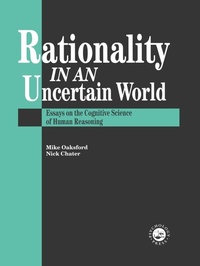
Rationality In An Uncertain World
Essays In The Cognitive Science Of Human Understanding
Published on 30. April 1998
Book
Paperback/Softback
348 pages
978-0-86377-534-5 (ISBN)
Description
This book brings together an influential sequence of papers that argue for a radical re-conceptualisation of the psychology of inference, and of cognitive science more generally. The papers demonstrate that the thesis that logic provides the basis of human inference is central to much cognitive science, although the commitment to this view is often implicit. They then note that almost all human inference is uncertain, whereas logic is the calculus of certain inference. This mismatch means that logic is not the appropriate model for human thought.
Oaksford and Chater's argument draws on research in computer science, artificial intelligence and philosophy of science, in addition to experimental psychology. The authors propose that probability theory, the calculus of uncertain inference, provides a more appropriate model for human thought. They show how a probabilistic account can provide detailed explanations of experimental data on Wason's selection task, which many have viewed as providing a paradigmatic demonstration of human irrationality. Oaksford and Chater show that people's behaviour appears irrational only from a logical point of view, whereas it is entirely rational from a probabilistic perspective. The shift to a probabilistic framework for human inference has significant implications for the psychology of reasoning, cognitive science more generally, and forour picture of ourselves as rational agents.
Oaksford and Chater's argument draws on research in computer science, artificial intelligence and philosophy of science, in addition to experimental psychology. The authors propose that probability theory, the calculus of uncertain inference, provides a more appropriate model for human thought. They show how a probabilistic account can provide detailed explanations of experimental data on Wason's selection task, which many have viewed as providing a paradigmatic demonstration of human irrationality. Oaksford and Chater show that people's behaviour appears irrational only from a logical point of view, whereas it is entirely rational from a probabilistic perspective. The shift to a probabilistic framework for human inference has significant implications for the psychology of reasoning, cognitive science more generally, and forour picture of ourselves as rational agents.
Reviews / Votes
'The authors compile their case, sometimes wittily, and invariably with scholarship.' - D.W. Green, University College, London in Quarterly Journal of Experimental Psycholog, 2000More details
Language
English
Place of publication
Hove
United Kingdom
Publishing group
Taylor & Francis Ltd
Target group
College/higher education
Professional and scholarly
Dimensions
Height: 280 mm
Width: 210 mm
Thickness: 19 mm
Weight
857 gr
ISBN-13
978-0-86377-534-5 (9780863775345)
Copyright in bibliographic data and cover images is held by Nielsen Book Services Limited or by the publishers or by their respective licensors: all rights reserved.
Schweitzer Classification
Other editions
Additional editions
Nick Chater | Mike Oaksford
Rationality In An Uncertain World
Essays In The Cognitive Science Of Human Understanding
Book
02/2019
1st Edition
Routledge
€74.10
Shipment within 10-20 days
Nick Chater | Mike Oaksford
Rationality In An Uncertain World
Essays In The Cognitive Science Of Human Understanding
E-Book
08/2004
Routledge
€61.99
Available for download
Nick Chater | Mike Oaksford
Rationality In An Uncertain World
Essays In The Cognitive Science Of Human Understanding
E-Book
08/2004
Routledge
€61.99
Available for download
Persons
Nick Chater, Mike Oaksford
Content
Part I: problems with logicism; autonomy, implementation and cognitive architecture - a reply to Fodor and Pylyshyn; connectionism, classical cognitive science, and experimental psychology; against logicist cognitive science I - the core argument; against logicist cognitive science II - objections and replies; reasoning theories and bounded rationality; bounded rationlity in taking risks and drawing inferences; logicism and everyday reasoning - mental methods and mental logic; the falsity of folk theories - implications for psychology and philosophy. Part II: the probablistic approach; a rational analysis of the selection task I - optimal data selection; a rational analysis of the selection task II - abstract materials; a rational analysis of the selection task III - thematic materials; a rational analysis of the selection task IV - implications; rational explanation of the selection task; information gain explains relevance, which explains the selection; current developments and future directions.