

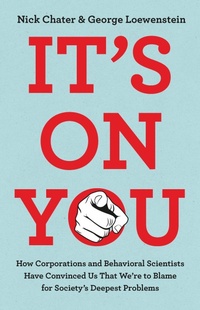
It's on You
How Corporations and Behavioral Scientists Have Convinced Us That We're to Blame for Society's Deepest Problems
Will be published approx. on 27. January 2026
Book
Hardback
368 pages
978-1-5417-0011-6 (ISBN)
Description
Two leading behavioral scientists argue we should reject “nudge” policies and stop blaming personal failure for society’s failures
"Excellent. A master class on how to blend individual psychology with institutions, so that people are encouraged to get involved and develop solutions to our urgent problems via the democratic process." —Daron Acemoglu, Nobel Laureate and author of Power and Progress
Two decades ago, behavioral economics burst from academia to the halls of power, on both sides of the Atlantic, with the promise that correcting individual biases could help transform society. The hope was that governments could deploy a new approach to addressing society’s deepest challenges, from inadequate retirement planning to climate change—gently, but cleverly, nudging people to make choices for their own good and the good of the planet.
It was all very convenient, and false. As behavioral scientists Nick Chater and George Loewenstein show in It’s on You, nudges rarely work, and divert us from policies that do. For example, being nudged to switch to green energy doesn’t cut carbon, and it distracts from the real challenge of building a low-carbon economy.
It’s on You shows how the rich and powerful have repeatedly used a clever sleight of hand: blaming individuals for social problems, with behavioral economics an unwitting accomplice, while lobbying against the systemic changes that could actually help. Rather than trying to “fix” the victims of bad policies, real progress requires rewriting the social and economic rulebook for the common good.
"Excellent. A master class on how to blend individual psychology with institutions, so that people are encouraged to get involved and develop solutions to our urgent problems via the democratic process." —Daron Acemoglu, Nobel Laureate and author of Power and Progress
Two decades ago, behavioral economics burst from academia to the halls of power, on both sides of the Atlantic, with the promise that correcting individual biases could help transform society. The hope was that governments could deploy a new approach to addressing society’s deepest challenges, from inadequate retirement planning to climate change—gently, but cleverly, nudging people to make choices for their own good and the good of the planet.
It was all very convenient, and false. As behavioral scientists Nick Chater and George Loewenstein show in It’s on You, nudges rarely work, and divert us from policies that do. For example, being nudged to switch to green energy doesn’t cut carbon, and it distracts from the real challenge of building a low-carbon economy.
It’s on You shows how the rich and powerful have repeatedly used a clever sleight of hand: blaming individuals for social problems, with behavioral economics an unwitting accomplice, while lobbying against the systemic changes that could actually help. Rather than trying to “fix” the victims of bad policies, real progress requires rewriting the social and economic rulebook for the common good.
More details
Language
English
Place of publication
United States
Product notice
sewn/stitched
Cloth over boards
Dimensions
Height: 238 mm
Width: 154 mm
Thickness: 33 mm
Weight
542 gr
ISBN-13
978-1-5417-0011-6 (9781541700116)
Copyright in bibliographic data and cover images is held by Nielsen Book Services Limited or by the publishers or by their respective licensors: all rights reserved.
Schweitzer Classification
Other editions
Additional editions
Nick Chater | George Loewenstein
It's on You
How Corporations and Behavioral Scientists Have Convinced Us That We're to Blame for Society's Deepest Problems
E-Book
01/2026
PublicAffairs
€15.99
Available for download
Persons
Nick Chater is a professor of behavioral science at the Warwick Business School. George Loewenstein is the Herbert A. Simon University Professor of Economics and Psychology at Carnegie Mellon University. Both have written and edited a number of books in their respective fields. Chater resides in Oxford, UK, and Loewenstein resides in Pittsburgh, Pennsylvania.