

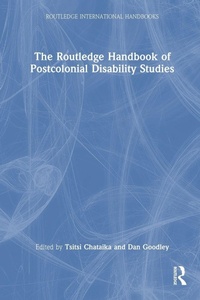
The Routledge Handbook of Postcolonial Disability Studies
1st Edition
Published on 29. March 2024
Book
Hardback
360 pages
978-1-032-31649-9 (ISBN)
Description
This book centres and explores postcolonial theory, which looks at issues of power, economics, politics, religion and culture and how these elements work in relation to colonial supremacy. It argues that disability is a constitutive material presence in many postcolonial societies and that progressive disability politics arise from postcolonial concerns. By drawing these two subjects together, this handbook challenges oppression, voicelessness, stereotyping, undermining, neo-colonisation and postcolonisation and bridges binary debate between global North and the global South.
The book is divided into eight sections
Setting the Scene
Decolonising Disability Studies
Postcolonial Theory, Inclusive Development
Postcolonial Disability Studies and Disability Activism
Postcolonial Disability and Childhood Studies
Postcolonial Disability Studies and Education
Postcolonial Disability Studies, Gender, Race and Religion
Conclusion
And comprised of 27 newly written chapters, this book leads with postcolonial perspectives - closely followed by an engagement with critical disability studies - with the explicit aim of foregrounding these contributions; pulling them in from the edges of empirical and theoretical work where they often reside in mainstream academic literature.
The book will be of interest to all scholars and students of disability studies and postcolonial studies as well as those working in sociology, literature and development studies.
The book is divided into eight sections
Setting the Scene
Decolonising Disability Studies
Postcolonial Theory, Inclusive Development
Postcolonial Disability Studies and Disability Activism
Postcolonial Disability and Childhood Studies
Postcolonial Disability Studies and Education
Postcolonial Disability Studies, Gender, Race and Religion
Conclusion
And comprised of 27 newly written chapters, this book leads with postcolonial perspectives - closely followed by an engagement with critical disability studies - with the explicit aim of foregrounding these contributions; pulling them in from the edges of empirical and theoretical work where they often reside in mainstream academic literature.
The book will be of interest to all scholars and students of disability studies and postcolonial studies as well as those working in sociology, literature and development studies.
More details
Series
Language
English
Place of publication
London
United Kingdom
Publishing group
Taylor & Francis Ltd
Target group
College/higher education
Postgraduate
Illustrations
6 s/w Abbildungen, 4 s/w Photographien bzw. Rasterbilder, 3 s/w Tabellen, 2 s/w Zeichnungen
3 Tables, black and white; 2 Line drawings, black and white; 4 Halftones, black and white; 6 Illustrations, black and white
Dimensions
Height: 260 mm
Width: 183 mm
Thickness: 25 mm
Weight
915 gr
ISBN-13
978-1-032-31649-9 (9781032316499)
Copyright in bibliographic data and cover images is held by Nielsen Book Services Limited or by the publishers or by their respective licensors: all rights reserved.
Schweitzer Classification
Other editions
Additional editions
Tsitsi Chataika | Dan Goodley
The Routledge Handbook of Postcolonial Disability Studies
Book
01/2026
1st Edition
Routledge
€71.80
Shipment within 10-20 days
Tsitsi Chataika | Dan Goodley
The Routledge Handbook of Postcolonial Disability Studies
E-Book
03/2024
1st Edition
Taylor & Francis
€68.49
Available for download
Tsitsi Chataika | Dan Goodley
The Routledge Handbook of Postcolonial Disability Studies
E-Book
03/2024
1st Edition
Taylor & Francis
€68.49
Available for download
Persons
Tsitsi Chataika is the Disability Inclusion Advisor for CBM-Global Disability Inclusion (Zimbabwe). She is also Associate Professor of Inclusive Education and Disability Inclusion on Leave of Absence in the Department of Educational Foundations at the University of Zimbabwe.
Dan Goodley is a Professor of disability studies and education at the School of Education, University of Sheffield. Dan co-directs iHuman, which includes a community of Critical Disability Studies researchers.
Dan Goodley is a Professor of disability studies and education at the School of Education, University of Sheffield. Dan co-directs iHuman, which includes a community of Critical Disability Studies researchers.
Content
Part I - Setting the Scene. 1.Unpacking Postcolonial Disability Studies. Part II - Decolonising Disability Studies. 2.The Coloniality of Disability: Analysing Intersectional Colonialities and Subaltern Resistance. 3.A Latin American Decolonial Thought on Disability? Approaches to a field under construction. 4.Using the Perspective of 'Peopleship' to Conceptualise Disability in China. 5.Decolonising of the Global: Reflections on constructing local emancipatory projects and influence of western epistemology of disability. 6.Learning from Postcolonial Studies, Decolonial Theory and Indigenous Studies in Disability Studies: A scoping review. Part III - Postcolonial Theory and Inclusive Development. 7.Decolonising Disability-Inclusive Development: The USAID and DFID as case studies. 8.Rethinking the Smart City as Postcolonial Technology: The case of the Smart Nation of Singapore. 9.Africanising Neurodiversity: A postcolonial view. Part IV - Postcolonial Disability Studies and Disability Activism. 10.'But I never think of you like that': An autoethnographic exploration of difference, deviance and defiance as a disabled psychologist. 11.Some Faces of Power and of Those Who Face With Them: Thoughts and Narratives on the Perpetuity of Being Disabled, Enabled and Empowered in Post/Colonial Times. 12.'Who Am I to Write This?': An approach to the field of feminist disability studies in Latin America. 13.Changing Religio-Cultural Identities of South Asian Disabled Youth: Accessibility, Assimilation and Discrimination. Part V - Postcolonial Theory and Childhood Studies. 14.The Four Stories: The production and maintenance of indigenous childhood disability and illness on Turtle Island. 15.Traditional Children's Games in India: Unlearning the attributes of subordination. Part VI - Postcolonial Disability Studies and Education. 16."There is no Lack of Knowledge of What Could and Should Be Done...": The Ambivalence of Special Education in Late Colonial and Postcolonial India. 17.Decolonising Inclusive Education: New approaches for disability education policy and practices. 18.Disabling Postcolonialism by Decolonising Deaf Education in Zimbabwe. 19.Interrogating Postcolonial Disability Studies to Inform the Education of Persons With Disabilities and Promoting Social Justice in Post-Independent Zimbabwe. 20.Postcolonial Disability, Childhood, and Education Studies Inclusive Education in a Post-Soviet Context: A Case of Azerbaijan. 21.Advancing Indigenous Inclusive Practices in a Postcolonial Education Milieu. Part VII - Postcolonial Disability Studies, Gender, Race and Religion. 22.Race, Genetics and Disablement: Colonial longings for racial certainty. 23.'Alternative Explanations': Literary representations of disability in sub-Saharan Africa. 24.Accessibility and The Common: Decolonising disability and constructing crip/care in Senegalese urban arts. 25.Blindness in Postcolonial Literature: Coetzee, Mehta and Recognition. 26.Filipino Deaf Culture Through Postcolonial Perspectives: Colonisation of the Senses and the Hegemony of Language. Part VIII - Conclusions. 27.Conclusions: Towards decolonisation and depathologisation.