

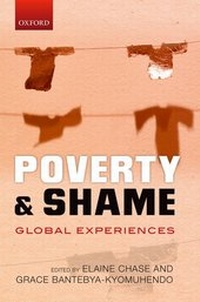
Poverty and Shame
Global Experiences
Published on 4. December 2014
Book
Hardback
336 pages
978-0-19-968672-8 (ISBN)
Description
Poverty and Shame: Global Experiences explores Nobel laureate Amartya Sen's contention that shame lies at the absolutist core of poverty. It draws on a wealth of empirical evidence to demonstrate how paying greater attention to the psychological and social consequences of poverty provides new insights into how poverty is perpetuated. Based on research in seven very different global contexts, it reveals how, irrespective of whether people live above or below a designated poverty line, in cultures as diverse as rural India, Uganda and Pakistan, urban/suburban UK, China, Norway and South Korea, the ability to participate in society as a full and recognised citizen is largely contingent on having the material resources deemed normal for that society. When such means are not available, the common response is to feel inadequate and to save face by withdrawing to varying degrees from society. Such a response further limits opportunities to exit poverty and arguably results in perpetuating its cycle. Yet society in turn plays a fundamental role in what we term the poverty-shame nexus, by persistently evaluating others against dominant norms and expectations and prioritising certain explanations of poverty over others. Hence shame in relation to poverty is co-constructed, a dynamic interaction of internally felt inadequacies and externally inflicted judgements.
This book, together with the companion volume The Shame of Poverty by Robert Walker invites readers to question conventional understandings about poverty and its impact. In so doing, the volumes provide a foundation for a more satisfactory global conversation about the phenomenon of poverty than that which has hitherto been frustrated by disagreement about whether poverty is best conceptualised in absolute or relative terms.
This book, together with the companion volume The Shame of Poverty by Robert Walker invites readers to question conventional understandings about poverty and its impact. In so doing, the volumes provide a foundation for a more satisfactory global conversation about the phenomenon of poverty than that which has hitherto been frustrated by disagreement about whether poverty is best conceptualised in absolute or relative terms.
More details
Language
English
Place of publication
Oxford
United Kingdom
Target group
College/higher education
Dimensions
Height: 238 mm
Width: 163 mm
Thickness: 25 mm
Weight
654 gr
ISBN-13
978-0-19-968672-8 (9780199686728)
Copyright in bibliographic data and cover images is held by Nielsen Book Services Limited or by the publishers or by their respective licensors: all rights reserved.
Schweitzer Classification
Other editions
Additional editions
E-Book
12/2014
1st Edition
OUP eBook
€56.99
Available for download
Persons
Elaine Chase is a Research Fellow at the Department of Social Policy and Green Templeton College, University of Oxford Her research interests include the sociological dimensions of poverty, migration, social exclusion, rights and wellbeing. She has conducted research and written widely on these themes from a UK and international perspective and with a particular focus on young people and communities most likely to face marginalisation and disadvantage.
Grace Bantebya-Kyomuhendo is a Professor in the School of Women and Gender Studies at Makerere University, Uganda, and is a distinguished social anthropologist and an experienced trainer/lecturer, researcher and advocate for gender equality and social transformation. Grace has done extensive research in poverty and social exclusion , gender poverty and social transformation, Reproductive Health, in particular maternal health, HIV/AIDs in conflict situation. She has also researched on women and ICT and Gender and climate change. She has published widely, most recent being a co-authored book entitled Women, Work and Domestic Virtue in Uganda which got an award from African Studies Association.
Grace Bantebya-Kyomuhendo is a Professor in the School of Women and Gender Studies at Makerere University, Uganda, and is a distinguished social anthropologist and an experienced trainer/lecturer, researcher and advocate for gender equality and social transformation. Grace has done extensive research in poverty and social exclusion , gender poverty and social transformation, Reproductive Health, in particular maternal health, HIV/AIDs in conflict situation. She has also researched on women and ICT and Gender and climate change. She has published widely, most recent being a co-authored book entitled Women, Work and Domestic Virtue in Uganda which got an award from African Studies Association.
Content
1. Introduction ; Section 1: Cultural conceptions of poverty and shame: Preface ; 2. Oral Tradition and Literary Portrayals of Poverty; the Evolution of Poverty Shame in Uganda ; 3. The Wealth of Poverty-induced Shame in Urdu Literature ; 4. Film and literature as social commentary in India ; 5. Poverty and shame in Chinese literature ; 6. Poverty and shame: seeking cultural cues within British literature and film ; 7. Disclosing the poverty-shame nexus within popular films in South Korea ( 1975-2010) ; 8. 'Then' and 'now': Literary representatio nof shame, poverty and social exclusion in Norway ; Section 2 : Experiences of poverty and shame in seven countries: Preface ; 9. 'Needy and vulnerable, but poverty is not my identity': Experiences of people in poverty in Uganda ; 10. Tales of inadequacey from Pakistan ; 11. 'I am not alone' : Experience sof poverty induced shame in a moral economy ; 12. Experiences of poverty and shame in urban China ; 13. The 'shame' of shame: experiences of people living in poverty in Britain ; 14. Social isolation and poverty in South Korea: A manifestation of the poverty-shame nexus ; 15. Relative poverty in a rich, egalitarian welfare state: Experiences from Norway ; Section 3: The role of media and society in the construction of poverty-related shame : Preface ; 16. Poverty the invisible and inseparable 'shadow': Reflections from the media and the better off in rural Uganda ; 17. How best to shame those in poverty: Perspectives from Pakistan ; 18. Persistence of shaming in hierarchical society: The case of India ; 19. Society and shaming: General public and media perceptions of poverty in urban China ; 20. Constructing reality?: The 'discursive truth' of poverty in Britain and how it frames the experience of shame ; 21. 'No one should be poor': Social Shaming in Norway ; 22. Poverty and shame: the future