

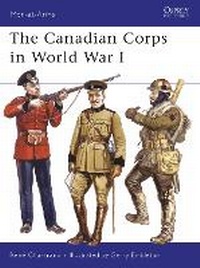
The Canadian Corps in World War I
Published on 6. June 2007
Book
Paperback/Softback
48 pages
978-1-84603-186-1 (ISBN)
Description
This book describes the organization, lists the units and illustrates the uniforms and equipment of the four Canadian divisions which earned an elite reputation on the Western Front in 1915-18. Canada's 600,000 troops-of whom more than 66,000 died and nearly 150,000 were wounded- represented an extraordinary contribution to the British Empire's struggle. On grim battlefields from the Ypres Salient to the Somme, and from their stunning victory at Vimy Ridge to the final triumphant 'Hundred Days' advance of autumn 1918, Canada's soldiers proved themselves to be a remarkable army in their own right, founding a national tradition.
More details
Series
Language
English
Place of publication
United Kingdom
Publishing group
Bloomsbury Publishing PLC
Product notice
Paperback (trade)
Unsewn / adhesive bound
Illustrations
40 b/w; 8 col
Dimensions
Height: 241 mm
Width: 186 mm
Thickness: 5 mm
Weight
168 gr
ISBN-13
978-1-84603-186-1 (9781846031861)
Copyright in bibliographic data and cover images is held by Nielsen Book Services Limited or by the publishers or by their respective licensors: all rights reserved.
Schweitzer Classification
Other editions
Additional editions
Rene Chartrand
The Canadian Corps in World War I
E-Book
12/2012
1st Edition
Osprey Publishing
€12.49
Available for download
Rene Chartrand
The Canadian Corps in World War I
E-Book
12/2012
1st Edition
Osprey Publishing
€12.49
Available for download
Persons
Rene Chartrand was born in Montreal and educated in Canada, the United States and the Bahamas. A senior curator with Canada's National Historic Sites for nearly three decades, he is now a freelance writer and historical consultant. He has written numerous articles and books including over 30 Osprey titles. He lives in Gatineau, Quebec, with his wife and two sons.
Gerry Embleton has been a leading illustrator and researcher of historical costume since the 1970s, and has illustrated and written Osprey titles on a wide range of subjects over more than 20 years. He is an internationally respected authority on 15th and 18th century costumes in particular. He lives in Switzerland, where since 1988 he has also become well known for designing and creating life-size historical figures for museums.
Gerry Embleton has been a leading illustrator and researcher of historical costume since the 1970s, and has illustrated and written Osprey titles on a wide range of subjects over more than 20 years. He is an internationally respected authority on 15th and 18th century costumes in particular. He lives in Switzerland, where since 1988 he has also become well known for designing and creating life-size historical figures for museums.
Content
Introduction
Formation of Canadian Expeditionary Force
Canadians in the trenches: first gas attacks, April 1915 - formation of Canadian Corps - outstanding tactical skill of Gen Arthur Currie - growing combat experience - Vimy Ridge, 1917, and its great significance to Canadian nation - Canadian Corps spearhead victorious advance in Belgium, summer 1918
Canadian naval and air force contributions
Uniforms & equipment
Formation of Canadian Expeditionary Force
Canadians in the trenches: first gas attacks, April 1915 - formation of Canadian Corps - outstanding tactical skill of Gen Arthur Currie - growing combat experience - Vimy Ridge, 1917, and its great significance to Canadian nation - Canadian Corps spearhead victorious advance in Belgium, summer 1918
Canadian naval and air force contributions
Uniforms & equipment