

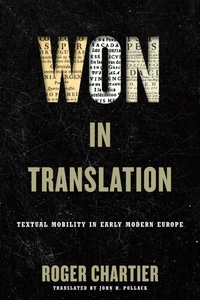
Won in Translation
Textual Mobility in Early Modern Europe
Published on 24. May 2022
Book
Hardback
192 pages
978-0-8122-5383-2 (ISBN)
Description
In Won in Translation Roger Chartier, one of the world's leading historians of books, publishing, and reading, considers the mobility of the early modern text and the plurality of circulating versions of the same work. The agent for both is translation, for through their lexical, aesthetic, and cultural decisions, translators always assign new meaning or new status to what they translate.
Won in Translation proceeds by way of four case studies, three dedicated to works originally in Spanish, the fourth to a Portuguese dramatic adaptation of Don Quixote. BartolomE de Las Casas' BrevIsima relaciOn de la destrucciOn de las Indias, first printed in 1552, was a powerful instrument for the construction of what was later called the "black legend" of Spanish monarchy. Baltasar GraciAn's OrAculo Manual, published in 1647, became the most famous courtier's manual in Europe. Both traveled more widely and were translated more often than any other books of their era. For Chartier they illustrate the great power of translation, which allowed Las Casas' account to be placed in multiple and successive contexts and enabled GraciAn's book to take on a range of meanings it had not originally had. Chartier's next two chapters are devoted to plays, one by Lope de Vega, the other by AntOnio JosE da Silva. In the case of Lope's Fuente Ovejuna, the "translation" was one from historical chronicle to dramatic performance. In AntOnio JosE da Silva's Vida do Grande D. Quixote, the textual migration is twofold, as Cervantes' hero moves from Spanish to Portuguese and from novel to play.
In an Epilogue, Chartier moves three centuries forward to consider the paradox that it is the absolute immobility of the text, "reinvented" word for word, that creates its mobility in Jorge Luis Borges' fiction "Pierre Menard, Author of the Quixote." Works are transformed through changes of genre or language, to be sure; but even when the texts remain fixed, their readers give them different or inverted meaning.
Won in Translation proceeds by way of four case studies, three dedicated to works originally in Spanish, the fourth to a Portuguese dramatic adaptation of Don Quixote. BartolomE de Las Casas' BrevIsima relaciOn de la destrucciOn de las Indias, first printed in 1552, was a powerful instrument for the construction of what was later called the "black legend" of Spanish monarchy. Baltasar GraciAn's OrAculo Manual, published in 1647, became the most famous courtier's manual in Europe. Both traveled more widely and were translated more often than any other books of their era. For Chartier they illustrate the great power of translation, which allowed Las Casas' account to be placed in multiple and successive contexts and enabled GraciAn's book to take on a range of meanings it had not originally had. Chartier's next two chapters are devoted to plays, one by Lope de Vega, the other by AntOnio JosE da Silva. In the case of Lope's Fuente Ovejuna, the "translation" was one from historical chronicle to dramatic performance. In AntOnio JosE da Silva's Vida do Grande D. Quixote, the textual migration is twofold, as Cervantes' hero moves from Spanish to Portuguese and from novel to play.
In an Epilogue, Chartier moves three centuries forward to consider the paradox that it is the absolute immobility of the text, "reinvented" word for word, that creates its mobility in Jorge Luis Borges' fiction "Pierre Menard, Author of the Quixote." Works are transformed through changes of genre or language, to be sure; but even when the texts remain fixed, their readers give them different or inverted meaning.
More details
Series
Language
English
Place of publication
Pennsylvania
United States
Target group
College/higher education
Product notice
Paper over boards
Illustrations
10 halftones
Dimensions
Height: 234 mm
Width: 155 mm
Thickness: 18 mm
Weight
386 gr
ISBN-13
978-0-8122-5383-2 (9780812253832)
Copyright in bibliographic data and cover images is held by Nielsen Book Services Limited or by the publishers or by their respective licensors: all rights reserved.
Schweitzer Classification
Other editions
Additional editions
E-Book
05/2022
1st Edition
University of Pennsylvania Press
from
€132.99
Available for download
Persons
Roger Chartier is Emeritus Professor at the College de France and Annenberg Visiting Professor at the University of Pennsylvania. He is the author of many books, among them Forms and Meanings: Texts, Performances, and Audiences from Codex to Computer and Inscription and Erasure: Literature and Written Culture from the Eleventh to the Eighteenth Century, both also published by the University of Pennsylvania Press. John H. Pollack is Curator for Research Services in the Kislak Center for Special Collections, Rare Books and Manuscripts at the University of Pennsylvania Libraries.