

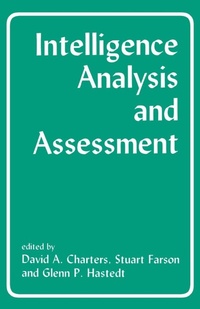
Intelligence Analysis and Assessment
Published on 30. June 1996
Book
Paperback/Softback
240 pages
978-0-7146-4249-9 (ISBN)
Description
These essays cover: assessment systems now in place in Britain, the USA, Germany and Australia; the bureaucratic dynamics of analysis and assessment; the changing ground in intelligence; and the impact of new technologies and modes of communication on intelligence gathering and analysis.
More details
Series
Language
English
Place of publication
London
United Kingdom
Publishing group
Taylor & Francis Ltd
Target group
College/higher education
Professional and scholarly
Dimensions
Height: 216 mm
Width: 140 mm
Thickness: 13 mm
Weight
303 gr
ISBN-13
978-0-7146-4249-9 (9780714642499)
Copyright in bibliographic data and cover images is held by Nielsen Book Services Limited or by the publishers or by their respective licensors: all rights reserved.
Schweitzer Classification
Other editions
Additional editions
David Charters | Stuart Farson | Glenn P. Hastedt
Intelligence Analysis and Assessment
E-Book
11/2013
1st Edition
Routledge
€69.99
Available for download
David Charters | Stuart Farson | Glenn P. Hastedt
Intelligence Analysis and Assessment
E-Book
11/2013
1st Edition
Routledge
€69.99
Available for download
David Charters | Stuart Farson | Glenn P. Hastedt
Intelligence Analysis and Assessment
Book
06/1996
Routledge
€237.70
Shipment within 10-20 days
Persons
Charters, David; Farson, Stuart; Hastedt, Glenn P.
Content
Introduction: shifting paradigms and shifting gears - a perspective on why there is no post-Cold War intelligence agenda, Alan E. Goodman. National assessment systems: assessment machinery - British and American models, Michael Herman; the US Government's experience with intelligence analyses - pluses and minuses, Harold P. Ford; the German analysis and assessment system, Harald Nielsen; national intelligence assessment - Australia's experience, A.D. McLennan. The producer/user interface: American presidents and their intelligence communities, Christopher Andrew; organizational politics and the development of Britain's intelligence producer/consumer interface, Philip H.J. Davies; intelligence analyst/manager relations at the CIA, John A. Gentry. New analytical priorities: proliferation and arms control, Paula L. Scalingi; analysis and assessment for peacekeeping operations, Sir David Ramsbotham; security intelligence, the national interest and the global environment, Simon Dalby. The open source revolution: intelligence analysis in the age of electronic dissemination, Peter Sharfman; private enterprise intelligence - its potential contribution to national security, Robert David Steele.