

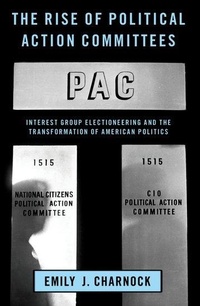
The Rise of Political Action Committees
Interest Group Electioneering and the Transformation of American Politics
Published on 27. July 2023
Book
Paperback/Softback
384 pages
978-0-19-768971-4 (ISBN)
Description
Political Action Committees (PACs) are a prominent and contentious feature of modern American election campaigns. As organizations that channel money toward political candidates and causes, their influence in recent decades has been widely noted and often decried. Yet, there has been no comprehensive history compiled of their origins, development, and impact over time.
In The Rise of Political Action Committees, Emily J. Charnock addresses this gap, telling a story with much deeper roots than contemporary commentators might expect. Documenting the first wave of PAC formation from the early 1940s to the mid-1960s, when major interest groups began creating them, she shows how PACs were envisaged from the outset as much more than a means of winning elections, but as tools for effecting ideological change in the two main parties. In doing so, Charnock not only locates the rise of PACs within the larger story of interest group electioneering--which went from something rare and controversial at the beginning of the 20th Century to ubiquitous today--but also within the narrative of political polarization. Throughout, she offers a full picture of PACs as far more than financial vehicles, showing how they were electoral innovators who pioneered strategies and tactics that came to pervade modern US campaigns and reshape American politics.
A broad-ranging political history of an understudied American campaign phenomenon, this book contextualizes the power and purpose of PACs, while revealing their transformative role within the American party system--helping to foster the partisan polarization we see today.
In The Rise of Political Action Committees, Emily J. Charnock addresses this gap, telling a story with much deeper roots than contemporary commentators might expect. Documenting the first wave of PAC formation from the early 1940s to the mid-1960s, when major interest groups began creating them, she shows how PACs were envisaged from the outset as much more than a means of winning elections, but as tools for effecting ideological change in the two main parties. In doing so, Charnock not only locates the rise of PACs within the larger story of interest group electioneering--which went from something rare and controversial at the beginning of the 20th Century to ubiquitous today--but also within the narrative of political polarization. Throughout, she offers a full picture of PACs as far more than financial vehicles, showing how they were electoral innovators who pioneered strategies and tactics that came to pervade modern US campaigns and reshape American politics.
A broad-ranging political history of an understudied American campaign phenomenon, this book contextualizes the power and purpose of PACs, while revealing their transformative role within the American party system--helping to foster the partisan polarization we see today.
More details
Series
Language
English
Place of publication
New York
United States
Target group
Professional and scholarly
Product notice
Paperback (trade)
Unsewn / adhesive bound
Dimensions
Height: 236 mm
Width: 157 mm
Thickness: 22 mm
Weight
553 gr
ISBN-13
978-0-19-768971-4 (9780197689714)
Copyright in bibliographic data and cover images is held by Nielsen Book Services Limited or by the publishers or by their respective licensors: all rights reserved.
Schweitzer Classification
Person
Emily J. Charnock is a political historian of the 20th Century United States and Director of the John F. Kennedy Memorial Trust in the United Kingdom. She is a former Keasbey Research Fellow in American Studies at Selwyn College, University of Cambridge, and holds degrees from the University of Virginia, American University, and the University of Oxford. She lives in the North East of England with her husband and daughters.
Content
Introduction: "Going into Politics"
1. "Interests" and Elections
2. "Pressure" as Prologue
3. A Tale of Two Leagues
4. Electoral Afterlives
5. Introducing P.A.C.
6. A Labor-Liberal Constellation
7. When Business is Not "Business-Like"
8. A Tale of Two PACS
Conclusion: The House that P.A.C. Built
Notes
Index
1. "Interests" and Elections
2. "Pressure" as Prologue
3. A Tale of Two Leagues
4. Electoral Afterlives
5. Introducing P.A.C.
6. A Labor-Liberal Constellation
7. When Business is Not "Business-Like"
8. A Tale of Two PACS
Conclusion: The House that P.A.C. Built
Notes
Index