

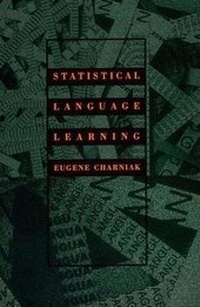
Statistical Language Learning
Published on 4. January 1994
Book
Hardback
190 pages
978-0-262-03216-2 (ISBN)
Description
Eugene Charniak breaks new ground in artificial intelligenceresearch by presenting
statistical language processing from an artificial intelligence point of view in a text for
researchers and scientists with a traditional computer science background.New, exacting empirical
methods are needed to break the deadlock in such areas of artificial intelligence as robotics,
knowledge representation, machine learning, machine translation, and natural language processing
(NLP). It is time, Charniak observes, to switch paradigms. This text introduces statistical language
processing techniques;word tagging, parsing with probabilistic context free grammars, grammar
induction, syntactic disambiguation, semantic wordclasses, word-sense disambiguation;along with the
underlying mathematics and chapter exercises.Charniak points out that as a method of attacking NLP
problems, the statistical approach has several advantages. It is grounded in real text and therefore
promises to produce usable results, and it offers an obvious way to approach learning: "one simply
gathers statistics."Language, Speech, and Communication
statistical language processing from an artificial intelligence point of view in a text for
researchers and scientists with a traditional computer science background.New, exacting empirical
methods are needed to break the deadlock in such areas of artificial intelligence as robotics,
knowledge representation, machine learning, machine translation, and natural language processing
(NLP). It is time, Charniak observes, to switch paradigms. This text introduces statistical language
processing techniques;word tagging, parsing with probabilistic context free grammars, grammar
induction, syntactic disambiguation, semantic wordclasses, word-sense disambiguation;along with the
underlying mathematics and chapter exercises.Charniak points out that as a method of attacking NLP
problems, the statistical approach has several advantages. It is grounded in real text and therefore
promises to produce usable results, and it offers an obvious way to approach learning: "one simply
gathers statistics."Language, Speech, and Communication
More details
Series
Language
English
Place of publication
Cambridge, Mass.
United States
Publishing group
MIT Press Ltd
Target group
College/higher education
Professional and scholarly
Illustrations
80
Dimensions
Height: 203 mm
Width: 127 mm
Thickness: 0 mm
Weight
0 gr
ISBN-13
978-0-262-03216-2 (9780262032162)
Copyright in bibliographic data and cover images is held by Nielsen Book Services Limited or by the publishers or by their respective licensors: all rights reserved.
Schweitzer Classification