

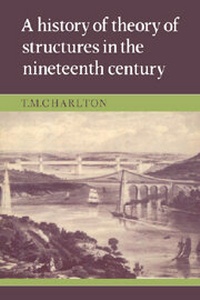
A History of the Theory of Structures in the Nineteenth Century
Published on 17. June 1982
Book
Hardback
200 pages
978-0-521-23419-1 (ISBN)
Description
The spectacular structures of today, such as large suspension bridges, are the result of scientific principles established during the new iron age of the nineteenth century. The book is concerned with a detailed and critical account of the development and application of those principles (including statics and elasticity) by people of remarkable talent in applied mathematics and engineering. They were, of course, mainly motivated by the demands of the railway, construction boom. Among the outstanding examples chosen by the author is Robert Stephenson's use of novel principles for the design and erection of the Britannia tubular iron bridge over the Menai Straits. A History of the Theory of Structures in the Nineteenth Century is a uniquely comprehensive account of a century of the development of the theory; an account which skilfully blends the personalities and the great works and which is enlivened by little-known accounts of friendship and controversy.
More details
Language
English
Place of publication
Cambridge
United Kingdom
Target group
College/higher education
Illustrations
Worked examples or Exercises
Dimensions
Height: 228 mm
Width: 152 mm
Thickness: 17 mm
Weight
452 gr
ISBN-13
978-0-521-23419-1 (9780521234191)
Copyright in bibliographic data and cover images is held by Nielsen Book Services Limited or by the publishers or by their respective licensors: all rights reserved.
Schweitzer Classification
Other editions
New editions
Book
07/2002
Cambridge University Press
€62.70
Shipment within 15-20 days
Additional editions
Book
07/2002
Cambridge University Press
€62.70
Shipment within 15-20 days
Content
Preface; 1. Introduction; 2. Beam systems; 3. Theory of the arch and suspension bridge; 4. Elementary theory of frameworks: graphical statics; 5. Theory of statically-indeterminate frameworks: the reciprocal theorem; 6. Levy's theory of frameworks and bridge girders; 7. Early developments of energy principles relating to theory of structures; 8. The later development and use of energy principles; 9. Applications of the least work principle: elastic theory of suspension bridges; 10. Aspects of the further development of theory of structures; 11. Secondary effects in structures; Appendices; Bibliography; Name index; Subject index.