

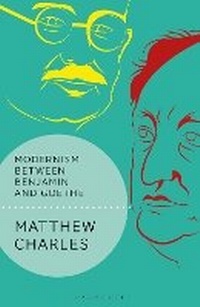
Modernism Between Benjamin and Goethe
Published on 12. December 2019
Book
Hardback
240 pages
978-1-350-01397-1 (ISBN)
Description
Widely regarded as one of the foremost cultural critics of the last century, Walter Benjamin's relation to Modernism has largely been understood in the context of his reception of the aesthetic theories of Early German Romanticism and his associated interest in avant-garde Surrealism. But this Romantic understanding only gives half the picture.
Running through Benjamin's thought is also a critique of Romanticism, developed in conjunction with a positive engagement with the philosophical, artistic and historical writings of J. W. von Goethe. In demonstrating the significance of these Goethean elements, this book challenges the dominant understanding of Benjamin's philosophy as essentially Romantic and instead proposes that Goethe's Classicism, conceived as the counterpoint to Romanticism, permits a corrective to the latter's deficiencies. Benjamin's Modernist concept of criticism, it is argued, is constituted in the movement between these polarities of Romanticism and Classicism.
Conversely, placing Goethe's Classicism in relation to Benjamin's practice of literary criticism reveals historical tensions with Romanticism that constitute the untimely - indeed, it will be argued, cinematic - Modernism of his work. Adopting a transcritical approach, this book alternates between Benjamin and Goethe in relation to the experiences of colour, language and technology, assembling a constellation of philosophical and artistic figures between them, including the writings of Kant, Nietzsche, Cohen, Deleuze, Koselleck, Klages, and the work of Gruenewald, Marees, Klee, Turner, Hulme, Eisenstein, Tretyakov, and Murnau.
Running through Benjamin's thought is also a critique of Romanticism, developed in conjunction with a positive engagement with the philosophical, artistic and historical writings of J. W. von Goethe. In demonstrating the significance of these Goethean elements, this book challenges the dominant understanding of Benjamin's philosophy as essentially Romantic and instead proposes that Goethe's Classicism, conceived as the counterpoint to Romanticism, permits a corrective to the latter's deficiencies. Benjamin's Modernist concept of criticism, it is argued, is constituted in the movement between these polarities of Romanticism and Classicism.
Conversely, placing Goethe's Classicism in relation to Benjamin's practice of literary criticism reveals historical tensions with Romanticism that constitute the untimely - indeed, it will be argued, cinematic - Modernism of his work. Adopting a transcritical approach, this book alternates between Benjamin and Goethe in relation to the experiences of colour, language and technology, assembling a constellation of philosophical and artistic figures between them, including the writings of Kant, Nietzsche, Cohen, Deleuze, Koselleck, Klages, and the work of Gruenewald, Marees, Klee, Turner, Hulme, Eisenstein, Tretyakov, and Murnau.
Reviews / Votes
Modernism Between Benjamin and Goethe is an exhilarating assembling of voices. At its core is Goethe speaking across a century to Benjamin. Poles apart, such tensity leads to attraction, expressed in multiple affinities; divided by time, while untimeliness transfers energy to the analysis. Matthew Charles symphonizes beautifully this convocation of the Romantic, the Classical and the Modern. * Esther Leslie, Professor of Political Aesthetics, Birkbeck, University of London, UK * In this well-informed and wide-ranging investigation, Matthew Charles presents a complex Goethean perspective for the reading of Walter Benjamin and for modernist studies generally. His is a Goethe who has passed through the afterlives of Romanticism, making possible a post-romantic classicism positioned beyond the classical antinomies. * Howard Eiland, Lecturer in Literature, Massachusetts Institute of Technology, USA *More details
Series
Language
English
Place of publication
London
United Kingdom
Publishing group
Bloomsbury Publishing PLC
Target group
College/higher education
Dimensions
Height: 234 mm
Width: 156 mm
Weight
517 gr
ISBN-13
978-1-350-01397-1 (9781350013971)
Copyright in bibliographic data and cover images is held by Nielsen Book Services Limited or by the publishers or by their respective licensors: all rights reserved.
Schweitzer Classification
Other editions
Additional editions
Matthew Charles
Modernism Between Benjamin and Goethe
E-Book
12/2019
1st Edition
Bloomsbury Academic
€36.49
Available for download
Person
Matthew Charles is a senior lecturer in cultural and critical theory at the University of Westminster, UK. He is the co-author of the Stanford Encyclopedia of Philosophy entry on Walter Benjamin and several articles and chapters on critical theory and education.
Content
Introduction: Perverse Antiques
1. Criticism, Transdisciplinarity and Transcriticism: Walter Benjamin and the Kantian Tradition
i. Literary Criticism and Aesthetic Judgement
ii. Transcriticism and Non-Synthetic Judgement
iii. Contingent Criticism and Teleological J--udgement
2. Weak Messianism in German Romanticism
i. Literary Criticism as Messianic Reflection
ii. Weak Messianism: Formalism, Affirmationism, Singularity
iii. Aestheticentricism and Problems of the Romantic Imagination
3. Strong Aesthetics in Goethe's Tender Empiricism
i. Aesthetics of Science: Critique of Sensibility
ii. Teleological Pessimism: Ephemerality and Multiplicity
4. Pure Content: the Ephemerality of Colour
i. Goethe's Colour Theory: Na--ture
ii. Benjamin's Colour Theory: Phantasy
iii. Expressionist Colour (I): Gruenewald and Marees
iv. Expressionist Colour (II): Klee and Turner
5. Pure Expression: the Violence of Criticism
i. Translating the Pure Word
ii. Expressionist Language (I): Goethe's Elective Affinities
iii. Expressionist Language (II): T. E. Hulme's Imagist poetry
6. Pure History: the Untimeliness of Technology
i. Goethe's Untimeliness: Nietzsche, Koselleck and Benjamin
ii. Expressionist Technology (I): Klages, Marx and the Soviet Avant-Garde
iii. Expressionist Technology (II): Cinematic Modernism in Goethe's Faust
Afterword: All that is ephemeral... becomes an Event
1. Criticism, Transdisciplinarity and Transcriticism: Walter Benjamin and the Kantian Tradition
i. Literary Criticism and Aesthetic Judgement
ii. Transcriticism and Non-Synthetic Judgement
iii. Contingent Criticism and Teleological J--udgement
2. Weak Messianism in German Romanticism
i. Literary Criticism as Messianic Reflection
ii. Weak Messianism: Formalism, Affirmationism, Singularity
iii. Aestheticentricism and Problems of the Romantic Imagination
3. Strong Aesthetics in Goethe's Tender Empiricism
i. Aesthetics of Science: Critique of Sensibility
ii. Teleological Pessimism: Ephemerality and Multiplicity
4. Pure Content: the Ephemerality of Colour
i. Goethe's Colour Theory: Na--ture
ii. Benjamin's Colour Theory: Phantasy
iii. Expressionist Colour (I): Gruenewald and Marees
iv. Expressionist Colour (II): Klee and Turner
5. Pure Expression: the Violence of Criticism
i. Translating the Pure Word
ii. Expressionist Language (I): Goethe's Elective Affinities
iii. Expressionist Language (II): T. E. Hulme's Imagist poetry
6. Pure History: the Untimeliness of Technology
i. Goethe's Untimeliness: Nietzsche, Koselleck and Benjamin
ii. Expressionist Technology (I): Klages, Marx and the Soviet Avant-Garde
iii. Expressionist Technology (II): Cinematic Modernism in Goethe's Faust
Afterword: All that is ephemeral... becomes an Event