


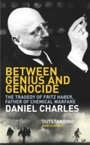
Between Genius And Genocide
The Tragedy of Fritz Haber, Father of Chemical Warfare
Published on 3. August 2006
Book
Paperback/Softback
336 pages
978-1-84413-092-4 (ISBN)
Description
In January 1934, as Hitler's shadow began to fall across Europe, a short, bald man carrying a German passport arrived at the Hotel Euler in Basle. He seemed haunted and restless, as though he urgently needed to be elsewhere.
Fritz Haber, Nobel laureate in chemistry, confidante of Albert Einstein and German war hero, had arrived in Basle a broken man and, three days later, he died leaving an uncertain legacy. For some, the great German chemist was a benefactor of humanity, winner of a Nobel prize for inventing a way to nourish farmers' fields with nitrogen captured from the air. For others, he was a war criminal who personally supervised the unleashing of chlorine clouds against British, French and Canadian troops in World War I.
Tragedy marked his life. A week after the first gas attack in 1915, Haber's wife took his pistol and shot herself. And in 1933, when Hitler came to power, 'the Jew Haber' was among the first scientists driven out of Germany. Within a year, Haber was dead - denied honour both in his homeland and abroad.
No life reveals the moral paradox of science - its capacity to create and destroy - more clearly than Fritz Haber's. Between Genius and Genocide is a story filled with ambition, patriotism, hubris and tragedy, set amidst huge technological advances, arms races, mounting imperialism and war.
Fritz Haber, Nobel laureate in chemistry, confidante of Albert Einstein and German war hero, had arrived in Basle a broken man and, three days later, he died leaving an uncertain legacy. For some, the great German chemist was a benefactor of humanity, winner of a Nobel prize for inventing a way to nourish farmers' fields with nitrogen captured from the air. For others, he was a war criminal who personally supervised the unleashing of chlorine clouds against British, French and Canadian troops in World War I.
Tragedy marked his life. A week after the first gas attack in 1915, Haber's wife took his pistol and shot herself. And in 1933, when Hitler came to power, 'the Jew Haber' was among the first scientists driven out of Germany. Within a year, Haber was dead - denied honour both in his homeland and abroad.
No life reveals the moral paradox of science - its capacity to create and destroy - more clearly than Fritz Haber's. Between Genius and Genocide is a story filled with ambition, patriotism, hubris and tragedy, set amidst huge technological advances, arms races, mounting imperialism and war.
Reviews / Votes
A study of one of the most talented chemists of the 20th century... Charles tells the story with clarity and vigour. -- Alan Cane * Financial Times * Compelling... Haber's story is a salutary tale for all who insist science is value-free, as Charles makes clear in his gripping and nuanced account... Fate has been kind to Haber in one regard. In Charles, he has a sophisticated biographer whose accessible style belies the depth of scholarship and research which underpins the work... The result is an outstanding work, and one which should be mandatory reading for critics and cheerleaders of science alike. * New Scientist * Haber's story is an enduring scientific tragedy, one that Charles tells with commendable clarity, style and brevity. -- Robert McKie * Observer * A deeply thoughtful study of Fritz Haber - a brilliant, fascinating and finally tragic figure - and his equivocal legacy... A book to make one ponder. -- Oliver SacksMore details
Language
English
Place of publication
London
United Kingdom
Publishing group
Vintage Publishing
Target group
Professional and scholarly
College/higher education
Illustrations
app 20 intergrated b/w photographs
Dimensions
Height: 216 mm
Width: 136 mm
Thickness: 24 mm
Weight
365 gr
ISBN-13
978-1-84413-092-4 (9781844130924)
Copyright in bibliographic data is held by Nielsen Book Services Limited or its licensors: all rights reserved.
Schweitzer Classification
Other editions
Additional editions
E-Book
03/2011
1st Edition
Vintage Digital
€10.99
Available for download
Person
Journalist Daniel Charles has worked for National Public Radio and for New Scientist. He has been a Science Journalism Fellow at the Massachusetts Institute of Technology and a German Academic Exchange Service Scholar in Bonn. He is the author of Lords of the Harvest: Biotechnology, Big Money, and the Future of Food. He lives in Washington, D. C.