

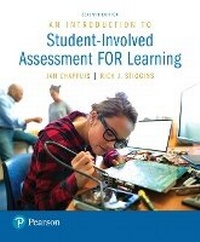
Introduction to Student-Involved Assessment FOR Learning, An with MyLab Education with Enhanced Pearson eText -- Access Card Package
7th Edition
Published on 16. May 2017
Book
Mixed media product
360 pages
978-0-13-343651-8 (ISBN)
Description
0133436519 / 9780133436518 Introduction to Student-Involved Assessment FOR Learning, An with MyEducationLab with Enhanced Pearson eText, Loose-Leaf Version -- Access Card Package 7/e
Package consists of:
0134450264 / 9780134450261 Introduction to Student-Involved Assessment FOR Learning, An, Loose-Leaf Version
0134493001 / 9780134493008 MyEducationLab with Pearson eText -- Access Card -- for An Introduction to Student-Involved Assessment FOR Learning
ALERT: Before you purchase, check with your instructor or review your course syllabus to ensure that you select the correct ISBN. Several versions of Pearson's MyLab & Mastering products exist for each title, including customized versions for individual schools, and registrations are not transferable. In addition, you may need a CourseID, provided by your instructor, to register for and use Pearson's MyLab & Mastering products.
Package consists of:
0134450264 / 9780134450261 Introduction to Student-Involved Assessment FOR Learning, An, Loose-Leaf Version
0134493001 / 9780134493008 MyEducationLab with Pearson eText -- Access Card -- for An Introduction to Student-Involved Assessment FOR Learning
ALERT: Before you purchase, check with your instructor or review your course syllabus to ensure that you select the correct ISBN. Several versions of Pearson's MyLab & Mastering products exist for each title, including customized versions for individual schools, and registrations are not transferable. In addition, you may need a CourseID, provided by your instructor, to register for and use Pearson's MyLab & Mastering products.
Reviews / Votes
From reviews of the text:"The text clearly lays out assessment design for beginners. It is clear and easy to read. . . . The overall clarity of the text makes this textbook an important tool in educating pre-service teachers."
Xyanthe Neider, Washington State University
"The overall theme of this text is that assessment is a deliberate, thoughtful process done on many levels that can enhance and guide the instructional process. The text moves students from the general (What is assessment?) to the specific (How do you create a multiple choice test that will provide valid and reliable data?), helping students understand the vital connection between instruction and assessment along the way. . . . The focus on assessment for learning . . . is an important way of considering assessment that most students do not think about. . . . As school districts begin using the Common Core standards, incorporating assessment for learning should become an important component of instruction. This text helps students understand the many facets of thinking about assessment this way and helps them learn how to design their assessments to be used in this way."
Leigh Ausband, UNC Charlotte
"This text is a valuable addition to . . . classroom assessment textbooks because of its focus on promoting assessment for learning. . . . [M]any existing textbooks do not use this terminology (assessment for, of, and as learning) rather [they] rely on more traditional notions of formative and summative assessment. The newer terminology brings with it more contemporary uses and conceptions of assessment that serve a mandate to support learning through integrated assessments. This message is made clear throughout the text. I also appreciate that the textbook draws on traditional teachings in assessment to establish that assessment for learning does not require a whole new set of assessment techniques. . . . [This text] advances an important (new) mission for educational assessment. I hope it is widely adopted, as I believe it has the capacity to reshape teacher candidates' conceptions of assessment as a central teaching and learning tool."
Christopher DeLuca, University of South Florida
More details
Product info
Time-limited license permitted subject to limit of 12 months.
Edition
7th edition
Language
English
Place of publication
United States
Publishing group
Pearson Education (US)
Target group
College/higher education
Dimensions
Height: 189 mm
Width: 232 mm
Thickness: 1 mm
Weight
564 gr
ISBN-13
978-0-13-343651-8 (9780133436518)
Schweitzer Classification
Other editions
Previous edition
Rick J. Stiggins | Jan Chappuis
An Introduction to Student-Involved Assessment FOR Learning
Book
06/2011
6th Edition
Pearson
€90.36
Article exhausted; check for reprint
Persons
Jan Chappuis, educator and author, joined Rick Stiggins at the Assessment Training Institute in Portland, Oregon in 2001. Prior to that she has been an elementary and secondary teacher as well as a curriculum developer in English/Language Arts, Mathematics, Social Studies, and World Languages.
For the past twenty years Chappuis has written books and developed workshops focused on classroom assessment literacy, presenting both nationally and internationally. She is recognized as a national thought leader in the area of formative assessment for her work in translating research into practical classroom applications. Chappuis is author of Seven Strategies of Assessment for Learning, 2e (2015) and Learning Team Facilitator Handbook (2007). She is co-author of Classroom Assessment for Student Learning: Doing It Right-- Using it Well, 2e (2012), Creating and Recognizing Quality Rubrics (2006), and Understanding School Assessment- A Parent and Community Guide to Helping Students Learn (2002).
Rick Stiggins, B.S., M.A., Ph.D., founded the Assessment Training Institute in Portland, Oregon, in 1992 to provide professional development for educators facing the challenges of day-to-day classroom assessment. In 2009, the Institute joined the Pearson Education team to extend its professional development services around the world.
Dr. Stiggins received his bachelor's degree in psychology from the State University of New York at Plattsburgh, master's degree in industrial psychology from Springfield (MA) College, and doctoral degree in education measurement from Michigan State University. Dr. Stiggins began his assessment work on the faculty of Michigan State before becoming a member of the faculty of educational foundations at the University of Minnesota, Minneapolis. In addition, he has served as director of test development for the ACT, Iowa City, Iowa; as a visiting scholar at Stanford University; as a Libra Scholar, University of Southern Maine; as director of the Centers for Classroom Assessment and Performance Assessment at the Northwest Regional Educational Laboratory, Portland, Oregon; and as a member of the faculty of Lewis and Clark College, Portland.
For the past twenty years Chappuis has written books and developed workshops focused on classroom assessment literacy, presenting both nationally and internationally. She is recognized as a national thought leader in the area of formative assessment for her work in translating research into practical classroom applications. Chappuis is author of Seven Strategies of Assessment for Learning, 2e (2015) and Learning Team Facilitator Handbook (2007). She is co-author of Classroom Assessment for Student Learning: Doing It Right-- Using it Well, 2e (2012), Creating and Recognizing Quality Rubrics (2006), and Understanding School Assessment- A Parent and Community Guide to Helping Students Learn (2002).
Rick Stiggins, B.S., M.A., Ph.D., founded the Assessment Training Institute in Portland, Oregon, in 1992 to provide professional development for educators facing the challenges of day-to-day classroom assessment. In 2009, the Institute joined the Pearson Education team to extend its professional development services around the world.
Dr. Stiggins received his bachelor's degree in psychology from the State University of New York at Plattsburgh, master's degree in industrial psychology from Springfield (MA) College, and doctoral degree in education measurement from Michigan State University. Dr. Stiggins began his assessment work on the faculty of Michigan State before becoming a member of the faculty of educational foundations at the University of Minnesota, Minneapolis. In addition, he has served as director of test development for the ACT, Iowa City, Iowa; as a visiting scholar at Stanford University; as a Libra Scholar, University of Southern Maine; as director of the Centers for Classroom Assessment and Performance Assessment at the Northwest Regional Educational Laboratory, Portland, Oregon; and as a member of the faculty of Lewis and Clark College, Portland.
Content
BRIEF TABLE OF CONTENTS
1. Classroom Assessment for Student Success
2. Why We Assess
3. What We Assess: Clear Learning Targets
4. Designing Quality Classroom Assessments
5. Selected Response Assessment
6. Written Response Assessment
7. Performance Assessment
8. Personal Communication as Assessment
9. Record Keeping: It's More Than Paperwork
10. Students Collecting and Reflecting on Evidence of Their Learning
11. Report Card Grading: Summarizing Achievement at a Point in Time
12. Effective Communication with Conferences
Appendix A Assessing Dispositions
Appendix B Understanding Standardized Tests
DETAILED TABLE OF CONTENTS
Chapter 1: Classroom Assessment for Student Success
Chapter 1 Learning Targets
The Teacher's Classroom Assessment Responsibilities
Gathering Accurate Information about Student Learning
Supporting Student Learning
Keys to Assessment Quality
Key 1: Start with a Clear Purpose
Key 2: Establish Clear and Appropriate Learning Targets
Key 3: Create High-Quality Assessments That Yield Dependable Information
Key 4: Communicate Results Effectively
An Overarching Principle: Student Involvement
A Classroom Example of Student-Involved Assessment
Understanding Motivation to Learn
Learning Orientation
Ego-Involved Orientation
Task-Completion Orientation
Goal Orientations and College and Career Readiness
Goal Orientations and the Connection to Assessment
Summary: The Importance of Sound Assessment
Suggested Activities
Chapter 2: Why We Assess
Chapter 2 Learning Targets
Formative and Summative Purposes for Assessment
High-Impact Formative Assessment Practices
How Formative and Summative Assessment Fits into a Balanced Assessment System
Balancing Formative and Summative Assessment in the Classroom
Balanced Assessment throughout the School System
Annual Testing
Assessment for Learning in the Classroom
Where Am I Going?
Where Am I Now?
How Can I Close the Gap?
The Seven Strategies as a Progression
Summary: Assessment for Many Purposes
Suggested Activities
Chapter 3: What We Assess: Clear Learning Targets
Chapter 3 Learning Targets
Defining Learning Targets
Terminology
Where Learning Targets Come From
Content Standards Developed by National Organizations and Consortia
Categories of Learning Targets
Knowledge-Level Targets
Reasoning-Level Targets
Performance Skill Targets
Product-Level Targets
Disposition Targets--the Affective Domain
Classifying Targets by Type
Deconstructing Complex Content Standards
Communicating Learning Targets to Students Share the Target "As Is"
Convert the Terms in the Target to Student-Friendly Language
Share a Student-Friendly Version of a Rubric with Students
When to Share the Target and How to Check for Understanding
Summary: Clear Targets Are Essential for Sound Assessment
Suggested Activities
Chapter 4: Designing Quality Classroom Assessments
Chapter 4 Learning Targets
The Assessment Options
Selected Response Assessment
Written Response Assessment
Performance Assessment
Personal Communication
Selecting an Appropriate Assessment Method
Assessing Knowledge Targets Accurately
Assessing Reasoning Targets Accurately
Assessing Mastery of Performance Skills Accurately
Assessing Product Targets Accurately
The Assessment Development Cycle
The Assessment Planning Stage
The Assessment Development Stage
The Assessment Use and Refinement Stage
Formative Assessment Ideas for Use with Assessment Blueprints
Summary: A Vision of Excellence in Classroom Assessment
Suggested Activities
Chapter 5: Selected Response Assessment
Chapter 5 Learning Targets
The Myth of Objectivity
Considerations When Using Selected Response Assessment
Creating a High-Quality Selected Response Assessment
Step 1: Determining the Assessment Purpose
Step 2: Specifying the Intended Learning Targets
Step 3: Selecting the Appropriate Assessment Method(s)
Step 4: Determining the Appropriate Sample Size
Step 5: Develop or Select Items, Exercises, Tasks, and Scoring Procedures
Step 6: Review and Critique the Overall Assessment before Use
Steps 7 and 8: Use and Refine the Assessment
Using Selected Response Assessment Formatively with Students
Where Am I Going?
Where Am I Now?
How Can I Close the Gap?
Summary: Productive Selected Response Assessment
Suggested Activities
Chapter 6: Written Response Assessment
Chapter 6 Learning Targets
Considerations When Using Written Response Assessment
Written Response Assessment of Knowledge-Level Learning Targets
Written Response Assessment of Reasoning-Level Learning Targets
Assessing Student Writing as a Product
Limitations
Creating a High-Quality Written Response Assessment
Step 1: Determining the Assessment Purpose
Step 2: Specifying the Intended Learning Targets
Step 3: Selecting the Appropriate Assessment Method(s)
Step 4: Determining the Appropriate Sample Size
Step 5 Part I: Develop or Select the Items
Step 5 Part II: Develop or Select the Scoring Guide
Step 6: Review and Critique the Overall Assessment before Use
Steps 7 and 8: Use and Refine the Assessment
Using Written Response Assessment Formatively with Students
Where Am I Going?
Where Am I Now?
How Can I Close the Gap?
Summary: Tapping the Potential of Written Response Assessment
Suggested Activities
Chapter 7: Performance Assessment
Chapter 7 Learning Targets
Considerations When Using Performance Assessment
Performance Assessment of Knowledge-Level Targets
Performance Assessment of Reasoning-Level Targets
Performance Assessment of Performance Skill Targets
Performance Assessment of Product Targets
Limitations
Planning a High-Quality Performance Assessment
Step 1: Determining the Assessment Purpose
Step 2: Specifying the Intended Learning Targets
Step 3: Selecting the Appropriate Assessment Method(s)
Step 4: Determining the Appropriate Sample Size
Step 5 Part I: Develop or Select the Task
Step 6 Part I: Review and Critique the Task before Use
Step 5 Part II: Develop or Select the Scoring Rubric
Step 6 Part II: Review and Critique the Rubric before Use
Steps 7 and 8: Use and Refine the Assessment
Using Performance Assessment Formatively with Students
Where Am I Going?
Where Am I Now?
How Can I Close the Gap?
Summary: Thoughtful Development Yields High-Quality Performance Tasks and Rubrics
Suggested Activities
Chapter 8: Personal Communication as Assessment
Chapter 8 Learning Targets
Considerations When Assessing Via Personal Communication
Assessing Knowledge-Level Learning Targets with Personal Communication
Assessing Reasoning-Level Learning Targets with Personal Communication
Assessing Performance Skill Targets with Personal Communication
Assessing Product Targets with Personal Communication
Understanding the Quality Control Issues
Example of a More Challenging Fit
The Many Forms of Personal Communication as Assessment
Instructional Questions and Answers
Class Discussions
Conferences and Interviews
Oral Examinations
Journals and Logs
Summary: Person-to-Person Assessment
Suggested Activities
Chapter 9: Record Keeping: It's More Than Paperwork
Chapter 9 Learning Targets
From Records to Useful Information
Guideline 1: Record Formative and Summative Assessment Information Separately
Guideline 2: Organize Entries in the Gradebook According to the Learning Target Represented
Standards-Based Grade Reports
Using Computer Programs for Grade Management
Level of Detail
Guideline 3: Keep Track of Work Habits and Social Skills Separately from Achievement Information
Extra Credit Work
Guideline 4: Record Information by Raw Score When Possible
Summary: Going for the Record
Suggested Activities
Chapter 10: Students Collecting and Reflecting on Evidence of Their Learning
Chapter 10 Learning Targets
Prerequisites to Successful Student Record Keeping
Recording Information from Assignments and Assessments
Writing in Learning Journals
Collecting Evidence in a Portfolio
Benefits of Portfolios
Misconceptions about Portfolios
Types of Portfolios
Work Sample Annotations
Involving Students in Selecting Portfolio Entries
Periodic Student Self-Reflection
Summary: Student-Involved Record Keeping and Reflection
Suggested Activities
Chapter 11: Report Card Grading: Summarizing Achievement at a Point in Time
Chapter 11 Learning Targets
What Is the Purpose of Grades?
Underlying Belief 1: The Purpose of Grades Is Also to
Sort and Select
Underlying Belief 2: The Purpose of Grades Is Also to Motivate
The Sole Purpose of Grades Is to Communicate
Communicate about What?
Aptitude as a Grading Factor
Effort as a Grading Factor
Compliance as a Grading Factor
Communicate about Achievement Only in the Academic Grade
Report on Other Factors Separately
A Word about Grading in a Cooperative Learning Context
Summarizing Assessment Information
Step 1: Use the Most Current Information
Step 2: Verify Accuracy of Evidence
Step 3: Convert Entries to a Common Scale
Step 4: Weight Information as Needed
Step 5: Combine Information Thoughtfully
Converting Rubric Scores to Grades
Average Ratings
Identifying a Pattern of Ratings
Combining Rubric Ratings with Other Assessment Information
Reporting the Final Grade
Keep the Link to Learning Targets
Inform Students in Advance of Your Grading Procedures
Summary: Communicating with Report Card Grades
Suggested Activities
Chapter 12: Effective Communication with Conferences
Chapter 12 Learning Targets
Conference Options
Feedback Conferences
The Purpose for a Feedback Conference
Materials Needed
The Protocol for a Feedback Conference
Goal-Setting Conferences
The Purpose for a Goal-Setting Conference
Materials Needed
The Protocol for a Goal-Setting Conference
Achievement Conferences
The Purpose of an Achievement Conference
The Protocol for an Achievement Conference
Follow-Up
Intervention Conferences
The Purpose of an Intervention Conference
Materials Needed for an Intervention Conference
The Protocol for an Intervention Conference
Summary: Conferences as Effective Communication
Suggested Activities
Appendix A Assessing Dispositions
Appendix B Understanding Standardized Tests
1. Classroom Assessment for Student Success
2. Why We Assess
3. What We Assess: Clear Learning Targets
4. Designing Quality Classroom Assessments
5. Selected Response Assessment
6. Written Response Assessment
7. Performance Assessment
8. Personal Communication as Assessment
9. Record Keeping: It's More Than Paperwork
10. Students Collecting and Reflecting on Evidence of Their Learning
11. Report Card Grading: Summarizing Achievement at a Point in Time
12. Effective Communication with Conferences
Appendix A Assessing Dispositions
Appendix B Understanding Standardized Tests
DETAILED TABLE OF CONTENTS
Chapter 1: Classroom Assessment for Student Success
Chapter 1 Learning Targets
The Teacher's Classroom Assessment Responsibilities
Gathering Accurate Information about Student Learning
Supporting Student Learning
Keys to Assessment Quality
Key 1: Start with a Clear Purpose
Key 2: Establish Clear and Appropriate Learning Targets
Key 3: Create High-Quality Assessments That Yield Dependable Information
Key 4: Communicate Results Effectively
An Overarching Principle: Student Involvement
A Classroom Example of Student-Involved Assessment
Understanding Motivation to Learn
Learning Orientation
Ego-Involved Orientation
Task-Completion Orientation
Goal Orientations and College and Career Readiness
Goal Orientations and the Connection to Assessment
Summary: The Importance of Sound Assessment
Suggested Activities
Chapter 2: Why We Assess
Chapter 2 Learning Targets
Formative and Summative Purposes for Assessment
High-Impact Formative Assessment Practices
How Formative and Summative Assessment Fits into a Balanced Assessment System
Balancing Formative and Summative Assessment in the Classroom
Balanced Assessment throughout the School System
Annual Testing
Assessment for Learning in the Classroom
Where Am I Going?
Where Am I Now?
How Can I Close the Gap?
The Seven Strategies as a Progression
Summary: Assessment for Many Purposes
Suggested Activities
Chapter 3: What We Assess: Clear Learning Targets
Chapter 3 Learning Targets
Defining Learning Targets
Terminology
Where Learning Targets Come From
Content Standards Developed by National Organizations and Consortia
Categories of Learning Targets
Knowledge-Level Targets
Reasoning-Level Targets
Performance Skill Targets
Product-Level Targets
Disposition Targets--the Affective Domain
Classifying Targets by Type
Deconstructing Complex Content Standards
Communicating Learning Targets to Students Share the Target "As Is"
Convert the Terms in the Target to Student-Friendly Language
Share a Student-Friendly Version of a Rubric with Students
When to Share the Target and How to Check for Understanding
Summary: Clear Targets Are Essential for Sound Assessment
Suggested Activities
Chapter 4: Designing Quality Classroom Assessments
Chapter 4 Learning Targets
The Assessment Options
Selected Response Assessment
Written Response Assessment
Performance Assessment
Personal Communication
Selecting an Appropriate Assessment Method
Assessing Knowledge Targets Accurately
Assessing Reasoning Targets Accurately
Assessing Mastery of Performance Skills Accurately
Assessing Product Targets Accurately
The Assessment Development Cycle
The Assessment Planning Stage
The Assessment Development Stage
The Assessment Use and Refinement Stage
Formative Assessment Ideas for Use with Assessment Blueprints
Summary: A Vision of Excellence in Classroom Assessment
Suggested Activities
Chapter 5: Selected Response Assessment
Chapter 5 Learning Targets
The Myth of Objectivity
Considerations When Using Selected Response Assessment
Creating a High-Quality Selected Response Assessment
Step 1: Determining the Assessment Purpose
Step 2: Specifying the Intended Learning Targets
Step 3: Selecting the Appropriate Assessment Method(s)
Step 4: Determining the Appropriate Sample Size
Step 5: Develop or Select Items, Exercises, Tasks, and Scoring Procedures
Step 6: Review and Critique the Overall Assessment before Use
Steps 7 and 8: Use and Refine the Assessment
Using Selected Response Assessment Formatively with Students
Where Am I Going?
Where Am I Now?
How Can I Close the Gap?
Summary: Productive Selected Response Assessment
Suggested Activities
Chapter 6: Written Response Assessment
Chapter 6 Learning Targets
Considerations When Using Written Response Assessment
Written Response Assessment of Knowledge-Level Learning Targets
Written Response Assessment of Reasoning-Level Learning Targets
Assessing Student Writing as a Product
Limitations
Creating a High-Quality Written Response Assessment
Step 1: Determining the Assessment Purpose
Step 2: Specifying the Intended Learning Targets
Step 3: Selecting the Appropriate Assessment Method(s)
Step 4: Determining the Appropriate Sample Size
Step 5 Part I: Develop or Select the Items
Step 5 Part II: Develop or Select the Scoring Guide
Step 6: Review and Critique the Overall Assessment before Use
Steps 7 and 8: Use and Refine the Assessment
Using Written Response Assessment Formatively with Students
Where Am I Going?
Where Am I Now?
How Can I Close the Gap?
Summary: Tapping the Potential of Written Response Assessment
Suggested Activities
Chapter 7: Performance Assessment
Chapter 7 Learning Targets
Considerations When Using Performance Assessment
Performance Assessment of Knowledge-Level Targets
Performance Assessment of Reasoning-Level Targets
Performance Assessment of Performance Skill Targets
Performance Assessment of Product Targets
Limitations
Planning a High-Quality Performance Assessment
Step 1: Determining the Assessment Purpose
Step 2: Specifying the Intended Learning Targets
Step 3: Selecting the Appropriate Assessment Method(s)
Step 4: Determining the Appropriate Sample Size
Step 5 Part I: Develop or Select the Task
Step 6 Part I: Review and Critique the Task before Use
Step 5 Part II: Develop or Select the Scoring Rubric
Step 6 Part II: Review and Critique the Rubric before Use
Steps 7 and 8: Use and Refine the Assessment
Using Performance Assessment Formatively with Students
Where Am I Going?
Where Am I Now?
How Can I Close the Gap?
Summary: Thoughtful Development Yields High-Quality Performance Tasks and Rubrics
Suggested Activities
Chapter 8: Personal Communication as Assessment
Chapter 8 Learning Targets
Considerations When Assessing Via Personal Communication
Assessing Knowledge-Level Learning Targets with Personal Communication
Assessing Reasoning-Level Learning Targets with Personal Communication
Assessing Performance Skill Targets with Personal Communication
Assessing Product Targets with Personal Communication
Understanding the Quality Control Issues
Example of a More Challenging Fit
The Many Forms of Personal Communication as Assessment
Instructional Questions and Answers
Class Discussions
Conferences and Interviews
Oral Examinations
Journals and Logs
Summary: Person-to-Person Assessment
Suggested Activities
Chapter 9: Record Keeping: It's More Than Paperwork
Chapter 9 Learning Targets
From Records to Useful Information
Guideline 1: Record Formative and Summative Assessment Information Separately
Guideline 2: Organize Entries in the Gradebook According to the Learning Target Represented
Standards-Based Grade Reports
Using Computer Programs for Grade Management
Level of Detail
Guideline 3: Keep Track of Work Habits and Social Skills Separately from Achievement Information
Extra Credit Work
Guideline 4: Record Information by Raw Score When Possible
Summary: Going for the Record
Suggested Activities
Chapter 10: Students Collecting and Reflecting on Evidence of Their Learning
Chapter 10 Learning Targets
Prerequisites to Successful Student Record Keeping
Recording Information from Assignments and Assessments
Writing in Learning Journals
Collecting Evidence in a Portfolio
Benefits of Portfolios
Misconceptions about Portfolios
Types of Portfolios
Work Sample Annotations
Involving Students in Selecting Portfolio Entries
Periodic Student Self-Reflection
Summary: Student-Involved Record Keeping and Reflection
Suggested Activities
Chapter 11: Report Card Grading: Summarizing Achievement at a Point in Time
Chapter 11 Learning Targets
What Is the Purpose of Grades?
Underlying Belief 1: The Purpose of Grades Is Also to
Sort and Select
Underlying Belief 2: The Purpose of Grades Is Also to Motivate
The Sole Purpose of Grades Is to Communicate
Communicate about What?
Aptitude as a Grading Factor
Effort as a Grading Factor
Compliance as a Grading Factor
Communicate about Achievement Only in the Academic Grade
Report on Other Factors Separately
A Word about Grading in a Cooperative Learning Context
Summarizing Assessment Information
Step 1: Use the Most Current Information
Step 2: Verify Accuracy of Evidence
Step 3: Convert Entries to a Common Scale
Step 4: Weight Information as Needed
Step 5: Combine Information Thoughtfully
Converting Rubric Scores to Grades
Average Ratings
Identifying a Pattern of Ratings
Combining Rubric Ratings with Other Assessment Information
Reporting the Final Grade
Keep the Link to Learning Targets
Inform Students in Advance of Your Grading Procedures
Summary: Communicating with Report Card Grades
Suggested Activities
Chapter 12: Effective Communication with Conferences
Chapter 12 Learning Targets
Conference Options
Feedback Conferences
The Purpose for a Feedback Conference
Materials Needed
The Protocol for a Feedback Conference
Goal-Setting Conferences
The Purpose for a Goal-Setting Conference
Materials Needed
The Protocol for a Goal-Setting Conference
Achievement Conferences
The Purpose of an Achievement Conference
The Protocol for an Achievement Conference
Follow-Up
Intervention Conferences
The Purpose of an Intervention Conference
Materials Needed for an Intervention Conference
The Protocol for an Intervention Conference
Summary: Conferences as Effective Communication
Suggested Activities
Appendix A Assessing Dispositions
Appendix B Understanding Standardized Tests