

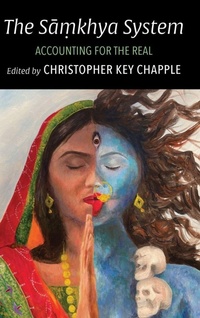
The Sa?khya System
Accounting for the Real
Published on 1. August 2024
Book
Hardback
298 pages
978-1-4384-9836-2 (ISBN)
Description
Explores the Sa?khya system and the delicate relationship it articulates between witness consciousness (Puru?a) and manifest realities (Prak?ti), providing a path to freedom through knowledge.
The Sa?khya System brings new life to an ancient Hindu system of thought. Sa?khya spans the fields of philosophy, physics, metaphysics, psychology, and ethics. Although notably not theological, its key premises can be found in virtually all religious traditions that originate from India. Sa?khya espouses a reciprocity between Prak?ti, the realm of activity, and Puru?a, the silent witness. It also delineates the phenomenal experiences that arise from Prak?ti, including the operations of the human body, the five great elements, and the eight mental states. Sa?khya proclaims that knowledge of world and self can lead to freedom.
This book presents a new translation of Isvarak???a's Sa?khya Karika, with grammatical analysis. It includes interpretive essays that explore the philosophical aspects of the Sa?khya system by Geoffrey Ashton, Ana Funes Maderey, Mikel Burley, Christopher Key Chapple, and Srivatsa Ramaswami, as well as its sociological and psychological applications as delineated by Marzenna Jakubczak, McKim Marriott, and Alfred Collins.
The Sa?khya System brings new life to an ancient Hindu system of thought. Sa?khya spans the fields of philosophy, physics, metaphysics, psychology, and ethics. Although notably not theological, its key premises can be found in virtually all religious traditions that originate from India. Sa?khya espouses a reciprocity between Prak?ti, the realm of activity, and Puru?a, the silent witness. It also delineates the phenomenal experiences that arise from Prak?ti, including the operations of the human body, the five great elements, and the eight mental states. Sa?khya proclaims that knowledge of world and self can lead to freedom.
This book presents a new translation of Isvarak???a's Sa?khya Karika, with grammatical analysis. It includes interpretive essays that explore the philosophical aspects of the Sa?khya system by Geoffrey Ashton, Ana Funes Maderey, Mikel Burley, Christopher Key Chapple, and Srivatsa Ramaswami, as well as its sociological and psychological applications as delineated by Marzenna Jakubczak, McKim Marriott, and Alfred Collins.
Reviews / Votes
"This book offers a fresh look at Sa?khya, treating it as a living philosophical tradition worthy of sustained attention. In addition, the new translation of the Sa?khya Karika at the beginning of this work, plus the in-depth grammatical analysis in the appendix, will be invaluable to students of Sa?khya looking for an accessible version of the text." - Andrew J. Nicholson, author of Lord Siva's Song: The Isvara Gita"Sa?khya is a fascinating and profound philosophy that deserves much more scholarly attention. This book takes a multifaceted approach to the tradition, engaging with several different academic disciplines-philology, philosophy, history, sociology, anthropology, and textual studies. The contributors do an excellent job of firmly locating Sa?khya as a living religious philosophy that in many respects permeates all of Indian culture." - D. E. Osto, Massey University of New Zealand
More details
Series
Language
English
Place of publication
Albany, NY
United States
Target group
Professional and scholarly
US School Grade: College Graduate Student and over
Illustrations
5 Figures; 5 Tables, black and white
Dimensions
Height: 235 mm
Width: 157 mm
Thickness: 22 mm
Weight
640 gr
ISBN-13
978-1-4384-9836-2 (9781438498362)
Copyright in bibliographic data and cover images is held by Nielsen Book Services Limited or by the publishers or by their respective licensors: all rights reserved.
Schweitzer Classification
Other editions
Additional editions
E-Book
08/2024
1st Edition
State University of New York Press
from
€84.99
Available for download
Person
Christopher Key Chapple is Doshi Professor of Indic and Comparative Theology, Loyola Marymount University. His previous books include Yoga and the Luminous: Patanjali's Spiritual Path to Freedom and Living Landscapes: Meditations on the Five Elements in Hindu, Buddhist, and Jain Yogas, both published by SUNY Press.
Content
Regarding Ardhanarisvara
Gayatri Sehgal
Preface
Introduction
Christopher Key Chapple
Sa?khya Karika of Isvarak???a
Part I: Philosophical and Textual Approaches to the Sa?khya Karika
1. What Is the Ground of Manifest Reality in the Sa?khya Karika? An Existential Phenomenological Theory of Vyaktaprak?ti as the Self-Manifesting of Sa?yoga
Geoff Ashton
2. The Role of Vitality (Pra?a) in the Sa?khya Quest for Freedom
Ana Laura Funes Maderey
3. The Place of Meditative Soteriological Practice in Sa?khya Philosophy
Mikel Burley
4. The Determinative Nature of the Gu?as and Bhavas in the Sa?khya Karika
Christopher Key Chapple
5. Pratyaya: State of Mind in Yoga and Sa?khya
Srivatsa Ramaswami
Part II: Living Expressions of Sa?khya
6. Kapil Ma?h: A Contemporary Living Tradition of Sa?khyayoga
Marzenna Jakubczak
7. Observing Sa?khya Categories in a Mid-Twentieth-Century Village
McKim Marriott
8. Sa?khya/Yoga as Culture and Release
Alfred Collins
Appendix: Sa?khya Karika Grammatical Analysis
Rob Zabel
Bibliography
Contributors
Index
Gayatri Sehgal
Preface
Introduction
Christopher Key Chapple
Sa?khya Karika of Isvarak???a
Part I: Philosophical and Textual Approaches to the Sa?khya Karika
1. What Is the Ground of Manifest Reality in the Sa?khya Karika? An Existential Phenomenological Theory of Vyaktaprak?ti as the Self-Manifesting of Sa?yoga
Geoff Ashton
2. The Role of Vitality (Pra?a) in the Sa?khya Quest for Freedom
Ana Laura Funes Maderey
3. The Place of Meditative Soteriological Practice in Sa?khya Philosophy
Mikel Burley
4. The Determinative Nature of the Gu?as and Bhavas in the Sa?khya Karika
Christopher Key Chapple
5. Pratyaya: State of Mind in Yoga and Sa?khya
Srivatsa Ramaswami
Part II: Living Expressions of Sa?khya
6. Kapil Ma?h: A Contemporary Living Tradition of Sa?khyayoga
Marzenna Jakubczak
7. Observing Sa?khya Categories in a Mid-Twentieth-Century Village
McKim Marriott
8. Sa?khya/Yoga as Culture and Release
Alfred Collins
Appendix: Sa?khya Karika Grammatical Analysis
Rob Zabel
Bibliography
Contributors
Index