

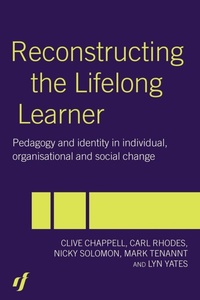
Reconstructing the Lifelong Learner
Pedagogy and Identity in Individual, Organisational and Social Change
1st Edition
Published on 2. October 2003
Book
Paperback/Softback
204 pages
978-0-415-26348-1 (ISBN)
Description
How is adult learning used to produce personal, organisational and social change?
This interesting examination of adult learning for change illustrates through diverse case studies and theoretical perspectives that personal change is inextricably linked to broader organisational and social change. The authors explore how theorising education as a vehicle for self-change is relevant to the practices of educators, learning specialists and others concerned with promoting learning for change.
The book examines the relationship between pedagogy, identity and change, and illustrates this through a range of case studies focusing on the following:
* Self-help books
* Work-based learning
* Corporate culture training
* AIDS education
* Gender education
* Sex offender education.
A concluding chapter discusses how writing an academic text is itself a pedagogical practice contributing to the identities of authors. This unique text will be of interest to students of education, sociology, cultural studies and change management as well as teachers, educators and professionals involved in lifelong learning or change management in any way.
This interesting examination of adult learning for change illustrates through diverse case studies and theoretical perspectives that personal change is inextricably linked to broader organisational and social change. The authors explore how theorising education as a vehicle for self-change is relevant to the practices of educators, learning specialists and others concerned with promoting learning for change.
The book examines the relationship between pedagogy, identity and change, and illustrates this through a range of case studies focusing on the following:
* Self-help books
* Work-based learning
* Corporate culture training
* AIDS education
* Gender education
* Sex offender education.
A concluding chapter discusses how writing an academic text is itself a pedagogical practice contributing to the identities of authors. This unique text will be of interest to students of education, sociology, cultural studies and change management as well as teachers, educators and professionals involved in lifelong learning or change management in any way.
More details
Language
English
Place of publication
London
United Kingdom
Publishing group
Taylor & Francis Ltd
Target group
College/higher education
Professional and scholarly
Postgraduate and Professional
Dimensions
Height: 234 mm
Width: 156 mm
Thickness: 11 mm
Weight
324 gr
ISBN-13
978-0-415-26348-1 (9780415263481)
Copyright in bibliographic data and cover images is held by Nielsen Book Services Limited or by the publishers or by their respective licensors: all rights reserved.
Schweitzer Classification
Other editions
Additional editions
Clive Chappell | Carl Rhodes | Nicky Solomon
Reconstructing the Lifelong Learner
Pedagogy and Identity in Individual, Organisational and Social Change
E-Book
12/2003
Routledge
€68.49
Available for download
Clive Chappell | Carl Rhodes | Nicky Solomon
Reconstructing the Lifelong Learner
Pedagogy and Identity in Individual, Organisational and Social Change
E-Book
12/2003
Routledge
€68.49
Available for download
Clive Chappell | Carl Rhodes | Nicky Solomon
Reconstructing the Lifelong Learner
Pedagogy and Identity in Individual, Organisational and Social Change
Book
10/2003
1st Edition
Routledge
€206.10
Shipment within 15-20 days
Persons
Clive Chappell, Carl Rhodes, Nicky Solomon, Mark Tennant, Lyn Yates
Content
1. Education as a site for self-work 2. Theorising identity 3. Understanding identity as narrative 4. Pedagogies for personal change in self-help literature: Helping oneself 5. Writing portfolios in work-based learning programs: Textually producing oneself 6. Pedagogy as a tool for corporate culture: Working for oneself 7. Games as a pedagogy in HIV/AIDS education: Protecting oneself 8. Social movements and programs of gender change: Interrupting oneself 9. Educational programs for sex offenders: Correcting oneself 10. Pedagogy, identity, reflexivity