

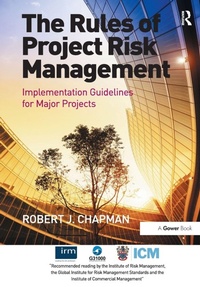
The Rules of Project Risk Management
Implementation Guidelines for Major Projects
1st Edition
Published on 27. February 2017
Book
Paperback/Softback
264 pages
978-1-138-24798-7 (ISBN)
Description
The evidence continues to grow that the effective management of risk is the very kernel of successful project management. Its absence frequently leaves project sponsors lamenting missed objectives and shareholders coming to terms with an organisation's poor bottom line performance. Dr Robert Chapman's The Rules of Project Risk Management stands out from other risk management texts because it provides very practical guidance, supported by numerous mini case studies, many of which have attracted considerable publicity. The book brings to life both the benefits of project risk management when effectively applied and the ramifications when it is misunderstood or receives scant attention. The structure of the book is based on International Standard ISO 31000 seen through the lens of general systems theory - where projects are undertaken by organisations which have an external context and internal sub-systems. A project system is seen to be composed of seven key subject areas. Practical short 'rules' or implementation guidelines, written in an engaging style, are offered to support each of these subject areas and aid quick assimilation of key risk management messages. Each rule focuses on a specific aspect of effective risk management which warrants attention in its own right. Taken together the rules will provide those implementing projects with the building blocks to secure a project's objectives. They have been drawn from a wealth of experience gained from applying risk management practices across multiple industries from Europe to Africa, the Middle East and Asia.
Reviews / Votes
'This is a well-researched and authoritative book on managing risks in projects. It is written by an acknowledged expert who has devoted his lifetime career to the study and application of risk management. Its approach is aligned with the international standard, "Risk Management Principles and Guidelines", ISO 31000, and it presents key principles for managing project risks. However, the unique feature is its structure, based on 22 practical guidelines, called rules?. The author suggests that, as an alternative to reading the book cover to cover, the reader might prefer to peruse individual rules when time permits. Anyone involved in project or risk management should read this book.' Mike Nichols, Founder and Chairman of The Nichols Group, Chairman of the Association for Project Management and Board Member of the Major Projects Association 'Rob Chapman's book is highly unusual but completely invaluable in taking a case study based approach to a subject that often is confused by an excess of jargon and process. Dr Chapman draws on an extensive international range of real projects to demonstrate how things can so easily go wrong, and what project managers can learn from high profile failures. I thoroughly recommend this book to anyone involved in project and programme management.' Steve Fowler, CEO, The Institute of Risk Management, UK 'A unique combination of the foundations of project management and the latest trend in risk management standardisation with clear alignment with the ISO 31000 risk management standard.' Alex Dali, President, The Global Institute for Risk Management Standards, France 'More than ever, larger, more complex and more expensive projects are required in a severely constrained global economy. The Rules of Project Risk Management is essential reading, not merely for the project management professional but for all stakeholders who have a keen interest in leveraging better results from project investments. Whether aMore details
Language
English
Place of publication
London
United Kingdom
Publishing group
Taylor & Francis Ltd
Target group
Professional and scholarly
Professional Practice & Development
Product notice
Paperback (trade)
Unsewn / adhesive bound
Dimensions
Height: 244 mm
Width: 170 mm
Thickness: 14 mm
Weight
465 gr
ISBN-13
978-1-138-24798-7 (9781138247987)
Copyright in bibliographic data and cover images is held by Nielsen Book Services Limited or by the publishers or by their respective licensors: all rights reserved.
Schweitzer Classification
Other editions
Additional editions
Robert James Chapman
The Rules of Project Risk Management
Implementation Guidelines for Major Projects
Book
12/2013
1st Edition
Ashgate Publishing Limited
€90.55
Withdrawn from sale
Person
Robert Chapman is currently the Head of Risk Management on the Klang Valley MRT project in Malaysia. He is a qualified architect and he holds both a PhD in Risk Management and, an MSc in Construction Management. He was elected, and is a Fellow of the UK IRM, APM and ICM for his contribution to the field of risk management. Robert has worked in the construction industry for over 35 years, initially as an Architect, subsequently as a Project Manager and finally as a Risk Specialist - which has been his occupation for the last 12 years. He has worked in Europe, The Middle East and Asia. He is author of Simple Tools and Techniques for Enterprise Risk Management, Second Edition, published by John Wiley and Sons Limited and Retaining Design Team Members: A Risk Management Approach, published by RIBA Enterprises Limited.
Content
List of Figures xi List of Tables xiii List of Case Studies xv About the Author xvii Foreword xix Preface xxi Acknowledgements xxv Audience xxvii How to Read this Book xxix 1 Structure of the Book, 2 Environment, 3 External Project Stakeholders, 4 Organisation, 5 Leadership 69, 6 Internal Stakeholders 75, 7 Risk Resources, 8 Systems 109 Appendix A: The EFQM Excellence Model, Appendix B: Systems Thinking, Appendix C: Causes of Project Failure, Appendix D: Observations on the Standard, Appendix E: Drivers for Project Success, Appendix F: Mitchell, Bradley and Wood's Stakeholder Typology, Appendix G: The Power/Predictability Matrix, Appendix H: Maturity Model Descriptions, Appendix I: Recording Lessons Learned, Appendix J: The Procurement Process, Appendix K: Cybersecurity CMM, Index