

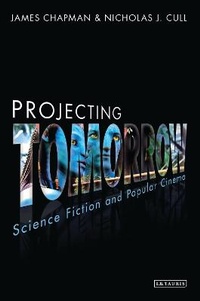
Projecting Tomorrow
Science Fiction and Popular Cinema
Published on 30. January 2013
Book
Paperback/Softback
256 pages
978-1-78076-410-8 (ISBN)
Description
Cinema and science fiction were made for each other. Science fiction has been at the cutting edge of film technology and the genre has produced some of the most ambitious, imaginative and visually spectacular films ever made. Yet science fiction cinema is about more than just state-of-the-art special effects. It has also provided a vehicle for film-makers and writers to comment on their own societies and cultures. In this new study of the genre, James Chapman and Nicholas Cull examine a series of landmark science fiction films from the 1930s to the present. They include genre classics, including 'Things to Come', 'Forbidden Planet', 'Planet of the Apes' and '2001: A Space Odyssey', alongside modern blockbusters 'Star Wars' and 'Avatar'. They consider both screen originals and adaptations of the work of major science fiction authors such as H.G. Wells and Arthur C. Clarke. They range widely across the genre from pulp adventure and space opera to political allegory and speculative documentary- there is even a science fiction musical.
Chapman and Cull explore the contexts and document the production histories of each film to show how they made their way to the screen- and why they turned out the way they did. Informed throughout by extensive original research in US and British archives, Projecting Tomorrow will be essential reading for all students and fans of science fiction cinema.
Chapman and Cull explore the contexts and document the production histories of each film to show how they made their way to the screen- and why they turned out the way they did. Informed throughout by extensive original research in US and British archives, Projecting Tomorrow will be essential reading for all students and fans of science fiction cinema.
Reviews / Votes
'I very much enjoyed the background that Chapman and Cull produced on these films. I managed to learn something new in every chapter. The authors did a masterful job in the selection of examples- a mix of the essential and the surprising- which nevertheless manage to cover many of the key periods in the genre's evolution on the screen. They make a strong case for why SF films need to be considered in their own right, and not simply as an extension of the literary version of the genre. All told, I suspect this book is going to be well received by fans and academics alike.' Henry Jenkins, co-author, Spreadable Media: Creating Value and Meaning in a Networked Culture.More details
Series
Language
English
Place of publication
United Kingdom
Publishing group
Bloomsbury Publishing PLC
Illustrations
24 bw integrated
Dimensions
Height: 228 mm
Width: 154 mm
Thickness: 22 mm
Weight
460 gr
ISBN-13
978-1-78076-410-8 (9781780764108)
Copyright in bibliographic data and cover images is held by Nielsen Book Services Limited or by the publishers or by their respective licensors: all rights reserved.
Schweitzer Classification
Other editions
Additional editions
E-Book
01/2013
1st Edition
I.B. Tauris
€29.99
Available for download
Persons
James Chapman is Professor of Film Studies at the University of Leicester, UK. His previous books include The British at War: Cinema, State and Propaganda, 1939-1945(1998), and Licence To Thrill: A Cultural History of the James Bond Films (2nd edn 2007), both from I.B.Tauris. He is editor of the Historical Journal of Film, Radio and Television. Nicholas J. Cull is Professor of Public Diplomacy in the Annenberg School for Communication and Journalism at the University of Southern California in Los Angeles. His previous books include The Cold War and the United States Information Agency: American Propaganda and Public Diplomacy, 1945-1989(2008) and (with James Chapman), Projecting Empire: Imperialism and Popular Cinema (I.B.Tauris, 2009). He is president of the International Association for Media and History.
Content
Acknowledgements
List of Illustrations
Introduction
Dry Future: Just Imagine (1930)
The Prophet and the Showman: Things to Come (1936)
Screening Wells for Cold War America: The War of the Worlds (1953)
The British Invasions: The Quatermass Experiment (1955), Quatermass 2 (1957) and Quatermass and the Pit (1967)
Sex and the Single Robot: Forbidden Planet (1956)
The Watershed: 2001: A Space Odyssey (1968)
Monkey Business: Planet of the Apes (1968)
Stretching the Genre: The Hellstrom Chronicle (1971)
Future Imperfect: Logan's Run (1976)
No Time for Sorrows: Star Wars (1977)
Rustbelt Messiah: RoboCop (1987)
The Image as Hero: Avatar (2009)
Afterword
Filmography
Index
List of Illustrations
Introduction
Dry Future: Just Imagine (1930)
The Prophet and the Showman: Things to Come (1936)
Screening Wells for Cold War America: The War of the Worlds (1953)
The British Invasions: The Quatermass Experiment (1955), Quatermass 2 (1957) and Quatermass and the Pit (1967)
Sex and the Single Robot: Forbidden Planet (1956)
The Watershed: 2001: A Space Odyssey (1968)
Monkey Business: Planet of the Apes (1968)
Stretching the Genre: The Hellstrom Chronicle (1971)
Future Imperfect: Logan's Run (1976)
No Time for Sorrows: Star Wars (1977)
Rustbelt Messiah: RoboCop (1987)
The Image as Hero: Avatar (2009)
Afterword
Filmography
Index