

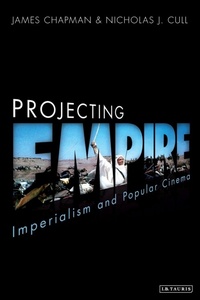
Projecting Empire
Imperialism and Popular Cinema
Published on 17. June 2009
Book
Paperback/Softback
256 pages
978-1-84511-940-9 (ISBN)
Description
Popular cinema is saturated with images and narratives of empire. With "Projecting Empire", Chapman and Cull have written the first major study of imperialism and cinema for over thirty years. This welcome text maps the history of empire cinema in both Hollywood and Britain through a serious of case studies of popular films including biopics, adventures, literary adaptations, melodramas, comedies and documentaries, from the 1930s and "The Four Feathers" to the present, with "Indiana Jones" and "Three Kings". The authors consider industry-wide trends and place the films in their wider cultural and historical contexts. Using primary sources that include private papers, they look at the presence of particular auteurs in the cinema of Imperialism, including Korda, Lean, Huston and Attenborough, as well as the actors who brought the stories to life, such as Elizabeth Taylor and George Clooney. At a time when imperialism has a new significance in the world, this book will fulfil the needs of students and interested filmgoers alike.
More details
Language
English
Place of publication
United Kingdom
Publishing group
Bloomsbury Publishing PLC
Illustrations
25 b/w integrated
Dimensions
Height: 234 mm
Width: 156 mm
Thickness: 14 mm
Weight
398 gr
ISBN-13
978-1-84511-940-9 (9781845119409)
Copyright in bibliographic data and cover images is held by Nielsen Book Services Limited or by the publishers or by their respective licensors: all rights reserved.
Schweitzer Classification
Other editions
Additional editions
E-Book
06/2009
1st Edition
I.B. Tauris
€27.49
Available for download
E-Book
06/2009
1st Edition
I.B. Tauris
€27.49
Available for download
Persons
James Chapman is Professor of Film at the University of Leicester. His previous books include 'Licence To Thrill: A Cultural History of the James Bond Films' (second edition, 2007) and 'Past and Present: National Identity and the British Historical Film' (2005). Nicholas J. Cull is Professor of Public Diplomacy at the Annenberg School for Communications/USC School of International Relations, University of Southern California. His previous books include 'Selling War: The British Propaganda Campaign Against American 'Neutrality' in World War II' (1995) and 'The Cold War and the United States Information Agency: American Propaganda and Public Diplomacy, 1945-1989' (2008).
Content
Illustrations
Abbreviations
Chapter 1. Imperialism and Popular Cinema: A Survey
Chapter 2. Technicolor Empire: The Four Feathers (1939)
Chapter 3. America's Kipling: Gunga Din (1939)
Chapter 4. The British Empire at War: Burma Victory (1945)
Chapter 5. Facing the Stampede of Decolonization: Elephant Walk (1954)
Chapter 6. The Watershed: Lawrence of Arabia (1962)
Chapter 7. Pursuing Respect: The Naked Prey (1966)
Chapter 8. Camping in the Empire: Follow That Camel (1967), Carry On Up the Khyber (1968) and Carry On Up the Jungle (1970)
Chapter 9. The Imperial Trap: The Man Who Would Be King (1975)
Chapter 10. Calling Dr Jones: Raiders of the Lost Ark (1981)
Chapter 11. The Raj Revival: Gandhi (1982)
Chapter 12. Imperial Adventure Redux: Three Kings (1999)
Afterword
Filmography
Abbreviations
Chapter 1. Imperialism and Popular Cinema: A Survey
Chapter 2. Technicolor Empire: The Four Feathers (1939)
Chapter 3. America's Kipling: Gunga Din (1939)
Chapter 4. The British Empire at War: Burma Victory (1945)
Chapter 5. Facing the Stampede of Decolonization: Elephant Walk (1954)
Chapter 6. The Watershed: Lawrence of Arabia (1962)
Chapter 7. Pursuing Respect: The Naked Prey (1966)
Chapter 8. Camping in the Empire: Follow That Camel (1967), Carry On Up the Khyber (1968) and Carry On Up the Jungle (1970)
Chapter 9. The Imperial Trap: The Man Who Would Be King (1975)
Chapter 10. Calling Dr Jones: Raiders of the Lost Ark (1981)
Chapter 11. The Raj Revival: Gandhi (1982)
Chapter 12. Imperial Adventure Redux: Three Kings (1999)
Afterword
Filmography