

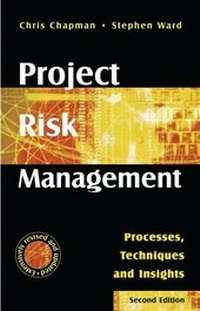
Project Risk Management
Processes, Techniques and Insights
2nd Edition
Published on 26. September 2003
Book
Hardback
408 pages
978-0-470-85355-9 (ISBN)
Description
Based on sound conceptual foundations yet developed to meet practical concerns, Project Risk Management has become recognized as a standard work on its subject. It sets out the key issues and concepts involved in effective risk and uncertainty management in a clear and accessible way, providing a comprehensive discussion of risk management processes set firmly in the context of the project management task as a whole and focused on improving performance. The Second Edition has been extensively revised and updated to meet the new challenges of the field, and offers methodologies and techniques that are applicable to all kinds and all sizes of project.
More details
Edition
2. Auflage
Language
English
Place of publication
Chichester
United Kingdom
Publishing group
John Wiley and Sons Ltd
Target group
Professional and scholarly
Edition type
New edition
Dimensions
Height: 25 cm
Width: 17.1 cm
Thickness: 2.7 cm
Weight
810 gr
ISBN-13
978-0-470-85355-9 (9780470853559)
Schweitzer Classification
Other editions
New editions
Stephen Ward | Chris Chapman
How to Manage Project Opportunity and Risk
Why Uncertainty Management can be a Much Better Approach than Risk Management
Book
11/2011
3rd Edition
Wiley
€76.50
Available immediately
Persons
Chris Chapman, is a Professor of Management Science in the School of Management of the University of Southampton. He was the founding chair of the Association for Project Management Specific Interest group on Project Risk Management. He is a past president of the Operational Research Society and the current chai r of the Committee of Professors in Operational Research. He is an Honourary Fellow of the Institute of Actuaries. For more tha n 25 years his research interest has focused on risk and uncertainty management. Like Stephen, his research is largely consultancy based, and he writes from a practical but conceptually rigorous perspective. He has published extensively, including joint authorship of Management for Engineers, (Wiley 1987), Risk Analysis for Large Projects: Models, Methods and Cases, (Wiley 1987), Project Risk Management: Processes, Techniques and Insights, (Wiley, 1997) and Managing Project Risk and Uncertainty: A Constructively Simple Approach to Decision Making, (Wiley 2002).
Stephen Ward is a Senior Lecturer in the School of Management of the University of Southampton. Much of his research is consultancy based, giving him a broad spectrum of practical experience across a wide range of organizations over several decades. He combines this practical perspective with a thorough conceptual understanding from which to write. He has published widely, including contributions to Management for Engineers (Wiley 1987), joint authorship of Project Risk Management: Processes, Techniques and Insights, (Wiley, 1997), and joint authorship of Managing Project Risk and Uncertainty: A Constructively Simple Approach to Decision Making, (Wiley 2002). He is the founding director of Southampton's MSc in Risk Management.
Stephen Ward is a Senior Lecturer in the School of Management of the University of Southampton. Much of his research is consultancy based, giving him a broad spectrum of practical experience across a wide range of organizations over several decades. He combines this practical perspective with a thorough conceptual understanding from which to write. He has published widely, including contributions to Management for Engineers (Wiley 1987), joint authorship of Project Risk Management: Processes, Techniques and Insights, (Wiley, 1997), and joint authorship of Managing Project Risk and Uncertainty: A Constructively Simple Approach to Decision Making, (Wiley 2002). He is the founding director of Southampton's MSc in Risk Management.
Content
Foreword to the first edition.
Foreword to the second edition.
Preface.
Acknowledgements.
Part I: Setting the scene.
1. Uncertainty, risk, and their management.
2. The project life cycle.
3. Motives for formal risk management processes.
4. An overview of generic risk management processes.
Part II: Elaborating the generic process framework.
5. Define the project.
6. Focus the process.
7. Identify the issues.
8. Structure the issues.
9. Clarify ownership.
10. Estimate variability.
11. Evaluate overall implications.
12. Harness the plans.
13. Manage implementation.
Part III: Closing the loop.
14. Risk management initiated at different stages in the project life cycle.
15. Effective and efficient risk management.
16. Ownership issues: a contractor perspective.
17. Organizing for risk management.
References.
Index.
Foreword to the second edition.
Preface.
Acknowledgements.
Part I: Setting the scene.
1. Uncertainty, risk, and their management.
2. The project life cycle.
3. Motives for formal risk management processes.
4. An overview of generic risk management processes.
Part II: Elaborating the generic process framework.
5. Define the project.
6. Focus the process.
7. Identify the issues.
8. Structure the issues.
9. Clarify ownership.
10. Estimate variability.
11. Evaluate overall implications.
12. Harness the plans.
13. Manage implementation.
Part III: Closing the loop.
14. Risk management initiated at different stages in the project life cycle.
15. Effective and efficient risk management.
16. Ownership issues: a contractor perspective.
17. Organizing for risk management.
References.
Index.