

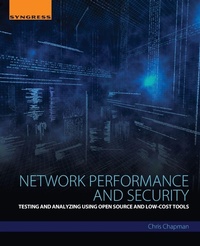
Network Performance and Security
Testing and Analyzing Using Open Source and Low-Cost Tools
Published on 9. March 2016
Book
Paperback/Softback
380 pages
978-0-12-803584-9 (ISBN)
Description
Network Performance Security: Testing and Analyzing Using Open Source and Low-Cost Tools gives mid-level IT engineers the practical tips and tricks they need to use the best open source or low cost tools available to harden their IT infrastructure. The book details how to use the tools and how to interpret them. Network Performance Security: Testing and Analyzing Using Open Source and Low-Cost Tools begins with an overview of best practices for testing security and performance across devices and the network. It then shows how to document assets-such as servers, switches, hypervisor hosts, routers, and firewalls-using publicly available tools for network inventory.
The book explores security zoning the network, with an emphasis on isolated entry points for various classes of access. It shows how to use open source tools to test network configurations for malware attacks, DDoS, botnet, rootkit and worm attacks, and concludes with tactics on how to prepare and execute a mediation schedule of the who, what, where, when, and how, when an attack hits.
Network security is a requirement for any modern IT infrastructure. Using Network Performance Security: Testing and Analyzing Using Open Source and Low-Cost Tools makes the network stronger by using a layered approach of practical advice and good testing practices.
The book explores security zoning the network, with an emphasis on isolated entry points for various classes of access. It shows how to use open source tools to test network configurations for malware attacks, DDoS, botnet, rootkit and worm attacks, and concludes with tactics on how to prepare and execute a mediation schedule of the who, what, where, when, and how, when an attack hits.
Network security is a requirement for any modern IT infrastructure. Using Network Performance Security: Testing and Analyzing Using Open Source and Low-Cost Tools makes the network stronger by using a layered approach of practical advice and good testing practices.
More details
Language
English
Place of publication
Rockland, MA
United States
Target group
Professional and scholarly
Product notice
Paperback (trade)
Dimensions
Height: 236 mm
Width: 192 mm
Thickness: 27 mm
Weight
783 gr
ISBN-13
978-0-12-803584-9 (9780128035849)
Copyright in bibliographic data and cover images is held by Nielsen Book Services Limited or by the publishers or by their respective licensors: all rights reserved.
Schweitzer Classification
Other editions
Additional editions
Chris Chapman
Network Performance and Security
Testing and Analyzing Using Open Source and Low-Cost Tools
E-Book
03/2016
Syngress
€42.95
Available for download
Person
Chris Chapman is Senior Methodologist for Spirent Communications, a global leader in network design and development. Chris has more than 20 years of experience with multiprotocol and cloud networking technologies. He writes industry-leading tests and test methodologies for major service providers, network equipment manufacturers, and standards bodies, and he is an active blogger for InformationWeek and other publications. Previously Chris held key engineering positions at Apple, Netscape, CompuServe, and MCI.
Content
Introduction: Practical Security and Performance Testing
Ch. 1: Getting organized: Asset Inventory; knowing what you have
Ch. 2: Locking down Access: Internet, Wi-Fi, Wired Zones, and VPN
Ch. 3: Securing BYOD device access
Ch. 4: Hardening the Server
Ch. 5: Internal Security Threats and defending assets and zones
Ch. 6: How to test the Firewall and IPS/IDS Effectively
Ch. 7: Security Device Deployment Patterns
Ch. 8: Continuous Testing
Ch. 9: Defending against penetration attacks
Ch. 10: How to write and test a Request for Proposal
Ch. 11: Security "Fire drills"
Glossary
Ch. 1: Getting organized: Asset Inventory; knowing what you have
Ch. 2: Locking down Access: Internet, Wi-Fi, Wired Zones, and VPN
Ch. 3: Securing BYOD device access
Ch. 4: Hardening the Server
Ch. 5: Internal Security Threats and defending assets and zones
Ch. 6: How to test the Firewall and IPS/IDS Effectively
Ch. 7: Security Device Deployment Patterns
Ch. 8: Continuous Testing
Ch. 9: Defending against penetration attacks
Ch. 10: How to write and test a Request for Proposal
Ch. 11: Security "Fire drills"
Glossary