

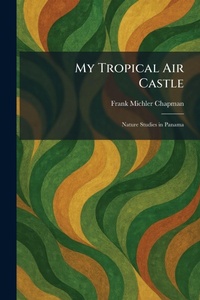
My Tropical Air Castle
Description
"My Tropical Air Castle: Nature Studies in Panama" is a captivating exploration of the rich biodiversity found within the lush landscapes of Panama, specifically centered on the biological laboratory of Barro Colorado Island. Written by the distinguished ornithologist Frank M. Chapman, this work serves as both a scientific record and a lyrical tribute to the wonders of the tropical jungle. Chapman describes his "air castle"-a sanctuary perched above the forest floor-where he meticulously observed the daily lives of the region's inhabitants.
The narrative provides vivid accounts of the diverse wildlife that populates the Canal Zone, from the vibrant plumage and complex songs of tropical birds to the intriguing behaviors of mammals like monkeys and coatis. Chapman's observations are grounded in a deep respect for the environment, offering readers a window into the delicate balance of a tropical ecosystem. His prose bridges the gap between technical study and engaging nature writing, making the complexities of tropical biology accessible to a broad audience.
Valued as a pioneering text in the field of tropical natural history, "My Tropical Air Castle: Nature Studies in Panama" remains an essential volume for naturalists, birders, and those interested in the history of ecological conservation in Central America.
This work has been selected by scholars as being culturally important, and is part of the knowledge base of civilization as we know it. This work was reproduced from the original artifact, and remains as true to the original work as possible. Therefore, you may see the original copyright references, library stamps (as most of these works have been housed in our most important libraries around the world), and other notations in the work.
This work is in the public domain in the United States of America, and possibly other nations. Within the United States, you may freely copy and distribute this work, as no entity (individual or corporate) has a copyright on the body of the work.
As a reproduction of a historical artifact, this work may contain missing or blurred pages, poor pictures, errant marks, etc. Scholars believe, and we concur, that this work is important enough to be preserved, reproduced, and made generally available to the public. We appreciate your support of the preservation process, and thank you for being an important part of keeping this knowledge alive and relevant.