

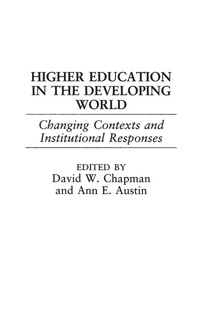
Higher Education in the Developing World
Changing Contexts and Institutional Responses
Published on 30. April 2002
Book
Hardback
288 pages
978-0-313-32016-3 (ISBN)
Description
Identifies five critical issues with which higher education institutions in the developing world must grapple as they respond to changing external contexts, offers examples of institutional responses to these issues, and considers these within a systems perspective which recognizes that each response impacts how institutions handle other critical issues.
Half of the students enrolled in higher education worldwide live in developing countries. Yet, in many developing countries, government and education leaders express serious concerns about the ability of their colleges and universities to effectively respond to the pressures posed by changing demographics, new communication technologies, shifts in national political environments, and the increasing interconnectedness of national economies. This book identifies five critical issues with which higher education institutions in the developing world must grapple as they respond to these changing contexts: seeking a new balance in government-university relationships; coping with autonomy; managing expansion while preserving equity, raising quality, and controlling costs; addressing new pressures for accountability; and supporting academic staff in new roles.
These papers offer examples of institutional responses and consider these within a systems perspective that recognizes that each response has a rippling effect impacting institutions' responses to other critical issues. Only as government and education leaders understand the interwoven nature of the problems now facing colleges and universities and the interconnections among the intended solutions they seek to implement can they offer effective leadership that strengthens the quality and improves the relevance of higher education in their countries.
Half of the students enrolled in higher education worldwide live in developing countries. Yet, in many developing countries, government and education leaders express serious concerns about the ability of their colleges and universities to effectively respond to the pressures posed by changing demographics, new communication technologies, shifts in national political environments, and the increasing interconnectedness of national economies. This book identifies five critical issues with which higher education institutions in the developing world must grapple as they respond to these changing contexts: seeking a new balance in government-university relationships; coping with autonomy; managing expansion while preserving equity, raising quality, and controlling costs; addressing new pressures for accountability; and supporting academic staff in new roles.
These papers offer examples of institutional responses and consider these within a systems perspective that recognizes that each response has a rippling effect impacting institutions' responses to other critical issues. Only as government and education leaders understand the interwoven nature of the problems now facing colleges and universities and the interconnections among the intended solutions they seek to implement can they offer effective leadership that strengthens the quality and improves the relevance of higher education in their countries.
More details
Language
English
Place of publication
United States
Publishing group
Bloomsbury Publishing Plc
Target group
College/higher education
Professional and scholarly
Dimensions
Height: 240 mm
Width: 161 mm
Thickness: 20 mm
Weight
602 gr
ISBN-13
978-0-313-32016-3 (9780313320163)
Copyright in bibliographic data and cover images is held by Nielsen Book Services Limited or by the publishers or by their respective licensors: all rights reserved.
Schweitzer Classification
Other editions
Additional editions
David W. Chapman | Ann E. Austin
Higher Education in the Developing World
Changing Contexts and Institutional Responses
E-Book
04/2002
1st Edition
Praeger Publishers Inc
€82.49
Available for download
Persons
DAVID W. CHAPMAN is Professor of Education in the Department of Educational Policy and Administration at the University of Minnesota.
ANN E. AUSTIN is Associate Professor of Higher, Adult, and Lifelong Education at Michigan State University, where she is also a member of the Core Faculty of the African Studies Center.
ANN E. AUSTIN is Associate Professor of Higher, Adult, and Lifelong Education at Michigan State University, where she is also a member of the Core Faculty of the African Studies Center.
Content
Introduction and Overview The Changing Context of Higher Education in the Developing World by David W. Chapman and Ann E. Austin Higher Education at a Turning Point by Jamil Salmi Seeking a New Balance in Government-University Relationships Universities in Transition: Privatization, Decentralization, and Institutional Autonomy as National Policy with Special Reference to the Russian Federation by Bruce Johnstone and Olga Bain Flight from Freedom: Resistance to Institutional Autonomy in Brazil's Federal Universities by David Plank and Robert Verhine When Goals Collide: Higher Education in Laos by David W. Chapman Coping with the Challenges of Greater Autonomy Current Challenges and Future Possibilities for the Revitalization of Higher Education in Africa by Jairam Reddy Higher Education and the State in Mongolia: Dilemmas of Democratic Transition by John Weidman and Regsurengiin Bat-Erdene From Marx to Markets: The Renovation of Teaching, Research, and Service in China's Universities by Gerard Postiglione Achieving Equity While Managing Expansion Equity Effects Resulting from Access, Choice, and Persistence Policies in Developing Countries by Darrell Lewis and Halil Dundar New Pressures and Forms of Accountability Quality Assurance for Higher Education: Shaping Effective Policy in Developing Countries by Elaine El-Khawas New Relationships with Academic Staff Context for Higher Education Reform in China: An Analysis of Faculty Issues by Yvonna Lincoln, et al. Academic Staff in Times of Transformation: Roles, Challenges, and Professional Development Needs by Ann E. Austin Conclusion, Lessons, and Directions Balancing Pressures, Forming Partnerships by Ann E. Austin and David W. Chapman