

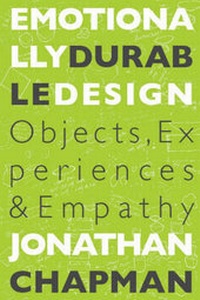
Emotionally Durable Design
Objects, Experiences and Empathy
Published on 3. June 2005
Book
Hardback
224 pages
978-1-84407-180-7 (ISBN)
Description
In today's unsustainable world of goods, where products are desired, purchased, briefly used and then promptly landfilled to make way for more, consumption and waste are rapidly spiralling out of control with truly devastating ecological consequences. Why do we, as a consumer society, have such short-lived and under-stimulating relationships with the objects that we invest such time, thought and money in acquiring, but that will soon be thoughtlessly discarded?
Emotionally Durable Design is a call to arms for professionals, students and academic creatives; proposing the emergence of a new genre of sustainable design that reduces consumption and waste by increasing the durability of relationships established between users and products. In this provocative text, Jonathan Chapman pioneers a radical design about-face to reduce the impact of modern consumption without compromising commercial viability or creative edge.
The author explores the essential question, why do users discard products that still work? It transports the reader beyond symptom-focused approaches to sustainable design such as design for recycling, biodegradeability and disassembly, to address the actual causes that underpin the environmental crisis we face. The result is a revealing exploration of consumer psychology and the deep motivations that fuel the human condition, and a rich resource of creative strategies and practical tools that will enable designers from a range of disciplines to explore new ways of thinking and of designing objects capable of supporting deeper and more meaningful relationships with their users.
This is fresh thinking for a brave new world of creative, durable and sustainable products, buildings, spaces and designed experiences.
Emotionally Durable Design is a call to arms for professionals, students and academic creatives; proposing the emergence of a new genre of sustainable design that reduces consumption and waste by increasing the durability of relationships established between users and products. In this provocative text, Jonathan Chapman pioneers a radical design about-face to reduce the impact of modern consumption without compromising commercial viability or creative edge.
The author explores the essential question, why do users discard products that still work? It transports the reader beyond symptom-focused approaches to sustainable design such as design for recycling, biodegradeability and disassembly, to address the actual causes that underpin the environmental crisis we face. The result is a revealing exploration of consumer psychology and the deep motivations that fuel the human condition, and a rich resource of creative strategies and practical tools that will enable designers from a range of disciplines to explore new ways of thinking and of designing objects capable of supporting deeper and more meaningful relationships with their users.
This is fresh thinking for a brave new world of creative, durable and sustainable products, buildings, spaces and designed experiences.
Reviews / Votes
'A novel contribution to the literature.'Charles Newman, Resource
'Fresh thinking for a brave new world.'
WordTrade.com
More details
Language
English
Place of publication
London
United Kingdom
Publishing group
Taylor & Francis Ltd
Target group
Professional and scholarly
Dimensions
Height: 229 mm
Width: 156 mm
Weight
453 gr
ISBN-13
978-1-84407-180-7 (9781844071807)
Copyright in bibliographic data and cover images is held by Nielsen Book Services Limited or by the publishers or by their respective licensors: all rights reserved.
Schweitzer Classification
Other editions
New editions
Book
05/2015
2nd Edition
Routledge
€246.50
Shipment within 15-20 days
Additional editions

Book
06/2005
Earthscan Ltd
€58.37
Article exhausted; check for reprint
Person
Jonathan Chapman is a Senior Lecturer in Three Dimensional Design at the University of Brighton, UK, and founder of sustainable design and research company Safehouse Creative.
Content
Introduction * The progress illusion * Consumer motivation * Attachments with objects * Authors of experience
* Sustaining narrative * De-fictioning utopia * Real world feasibility
* Sustaining narrative * De-fictioning utopia * Real world feasibility