

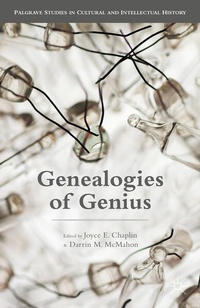
Genealogies of Genius
Published on 7. December 2015
Book
Paperback/Softback
IX, 191 pages
978-1-137-49764-2 (ISBN)
Description
The essays in this volume seek to examine the uses to which concepts of genius have been put in different cultures and times. Collectively, they are designed to make two new statements. First, seen in historical and comparative perspective, genius is not a natural fact and universal human constant that has been only recently identified by modern science, but instead a categorical mode of assessing human ability and merit. Second, as a concept with specific definitions and resonances, genius has performed specific cultural work within each of the societies in which it had a historical presence.
Reviews / Votes
More details
Series
Edition
1st ed. 2015
Language
English
Place of publication
New York
United States
Target group
Professional and scholarly
Product notice
Paperback (trade)
Unsewn / adhesive bound
Illustrations
IX, 191 p.
Dimensions
Height: 229 mm
Width: 152 mm
Thickness: 11 mm
Weight
281 gr
ISBN-13
978-1-137-49764-2 (9781137497642)
DOI
10.1057/9781137497673
Schweitzer Classification
Other editions
Additional editions
Joyce E. Chaplin | Darrin M. Mcmahon
Genealogies of Genius
Book
12/2015
Palgrave MacMillan
€53.49
Shipment within 10-20 days
Persons
Joyce E. Chaplin is the James Duncan Phillips Professor of Early American History at Harvard University, USA. She is the author of The First Scientific American: Benjamin Franklin and the Pursuit of Genius and co-author of The New Worlds of Thomas Robert Malthus.
Darrin M. McMahon is the Mary Brinsmead Wheelock Professor of History at Dartmouth College, USA. He is the author of Divine Fury: A History of Genius; Happiness: A History, and the co-editor of Rethinking Modern European Intellectual History.
Darrin M. McMahon is the Mary Brinsmead Wheelock Professor of History at Dartmouth College, USA. He is the author of Divine Fury: A History of Genius; Happiness: A History, and the co-editor of Rethinking Modern European Intellectual History.
Content
1. Introduction; Joyce E. Chaplin and Darrin M. McMahon
2. The Problem of Genius in the Age of Slavery; Joyce E. Chaplin
3. Genius vs Democracy: Excellence and Singularity in Post-Revolution France; Nathalie Heinich
4. Equality, Inequality, and Difference: Genius as Problem and Possibility in American Political/Scientific Discourse; John S. Carson
5. Genius and Obsession: Do You Have to Be Mad to Be Smart?; Lennard Davis
6. Inspiration to Perspiration: Francis Galton's Hereditary Genius in Victorian Context; Janet Browne
7. 'Genius must do the scullery work of the world': New Women, Feminists and Genius, circa 1880-1920; Lucy Delap
8. The Cult of the Genius in Germany and Austria at the Dawn of the Twentieth Century; Julia Barbara Köhne
9. Cultivating Genius in a Bolshevik Country; Irina Sirotkina
10. Insight in the Age of Automation; David Bates
11. Genius and Evil; Darrin M. McMahon
2. The Problem of Genius in the Age of Slavery; Joyce E. Chaplin
3. Genius vs Democracy: Excellence and Singularity in Post-Revolution France; Nathalie Heinich
4. Equality, Inequality, and Difference: Genius as Problem and Possibility in American Political/Scientific Discourse; John S. Carson
5. Genius and Obsession: Do You Have to Be Mad to Be Smart?; Lennard Davis
6. Inspiration to Perspiration: Francis Galton's Hereditary Genius in Victorian Context; Janet Browne
7. 'Genius must do the scullery work of the world': New Women, Feminists and Genius, circa 1880-1920; Lucy Delap
8. The Cult of the Genius in Germany and Austria at the Dawn of the Twentieth Century; Julia Barbara Köhne
9. Cultivating Genius in a Bolshevik Country; Irina Sirotkina
10. Insight in the Age of Automation; David Bates
11. Genius and Evil; Darrin M. McMahon