

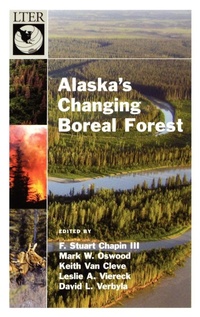
Alaska's Changing Boreal Forest
Published on 25. May 2006
Book
Hardback
368 pages
978-0-19-515431-3 (ISBN)
Description
The boreal forest is the northern-most woodland biome, whose natural history is rooted in the influence of low temperature and high-latitude. Alaska's boreal forest is now warming as rapidly as the rest of Earth, providing an unprecedented look at how this cold-adapted, fire-prone forest adjusts to change.
This volume synthesizes current understanding of the ecology of Alaska's boreal forests and describes their unique features in the context of circumpolar and global patterns. It tells how fire and climate contributed to the biome's current dynamics. As climate warms and permafrost (permanently frozen ground) thaws, the boreal forest may be on the cusp of a major change in state. The editors have gathered a remarkable set of contributors to discuss this swift environmental and biotic transformation. Their chapters cover the properties of the forest, the changes it is undergoing, and the challenges these alterations present to boreal forest managers.
In the first section, the reader can absorb the geographic and historical context for understanding the boreal forest. The book then delves into the dynamics of plant and animal communities inhabiting this forest, and the biogeochemical processes that link these organisms. In the last section the authors explore landscape phenomena that operate at larger temporal and spatial scales and integrates the processes described in earlier sections. Much of the research on which this book is based results from the Bonanza Creek Long-Term Ecological Research Program. Here is a synthesis of the substantial literature on Alaska's boreal forest that should be accessible to professional ecologists, students, and the interested public.
This volume synthesizes current understanding of the ecology of Alaska's boreal forests and describes their unique features in the context of circumpolar and global patterns. It tells how fire and climate contributed to the biome's current dynamics. As climate warms and permafrost (permanently frozen ground) thaws, the boreal forest may be on the cusp of a major change in state. The editors have gathered a remarkable set of contributors to discuss this swift environmental and biotic transformation. Their chapters cover the properties of the forest, the changes it is undergoing, and the challenges these alterations present to boreal forest managers.
In the first section, the reader can absorb the geographic and historical context for understanding the boreal forest. The book then delves into the dynamics of plant and animal communities inhabiting this forest, and the biogeochemical processes that link these organisms. In the last section the authors explore landscape phenomena that operate at larger temporal and spatial scales and integrates the processes described in earlier sections. Much of the research on which this book is based results from the Bonanza Creek Long-Term Ecological Research Program. Here is a synthesis of the substantial literature on Alaska's boreal forest that should be accessible to professional ecologists, students, and the interested public.
More details
Series
Language
English
Place of publication
New York
United States
Target group
Professional and scholarly
Illustrations
29 halftones, 65 line illus.
Dimensions
Height: 240 mm
Width: 161 mm
Thickness: 24 mm
Weight
719 gr
ISBN-13
978-0-19-515431-3 (9780195154313)
Copyright in bibliographic data and cover images is held by Nielsen Book Services Limited or by the publishers or by their respective licensors: all rights reserved.
Schweitzer Classification
Other editions
Additional editions
F. Stuart Chapin | Mark W. Oswood | Keith van Cleve
Alaska's Changing Boreal Forest
E-Book
01/2006
1st Edition
OUP eBook
€85.99
Available for download
F. Stuart Chapin | Mark W. Oswood | Keith van Cleve
Alaska's Changing Boreal Forest
E-Book
01/2006
1st Edition
OUP eBook
€85.99
Available for download
Persons
Edited by F. Stuart Chapin, Institute of Arctic Biology, Mark W. Oswood, Institute of Arctic Biology, Keith van Cleve, Forest Soils Laboratory, all at University of Alaska, Leslie A. Viereck, Institute of Northern Forestry, USDA Forest Service, and David L. Verbyla, Department of Forest Sciences, University of Alaska
Editor
Institute of Arctic BiologyInstitute of Arctic Biology
Institute of Arctic BiologyInstitute of Arctic Biology
Forest Soils LaboratoryForest Soils Laboratory, all at University of Alaska
, Institute of Northern Forestry, USDA Forest Service
Department of Forest SciencesDepartment of Forest Sciences, University of Alaska
Content
PART I: Alaska's Past and Present Environment
1: The Conceptual Basis of LTER Studies in the Alaskan Boreal Forest
2: Regional Overview of Interior Alaska
3: State Factor Control of Soil Formation in Interior Alaska
4: Climate and Permafrost Dynamics of the Alaskan Boreal Forest
5: Holocene Development of the Alaskan Boreal Forest
PART II: Forest Dynamics
6: Floristic Diversity and Distribution in the Alaskan Boreal Forest
7: Successional Processes in the Alaskan Boreal Forest
8: Mammalian Herbivore Population Dynamics in the Alaskan Boreal Forest
9: Dynamics of Phytophagous Insects and Their Pathogens in Alaskan Boreal Forests
10: Running Waters of the Alaskan Boreal Forest
PART III: Ecosystem Dynamics
11: Controls over Forest Production in Interior Alaska
12: The Role of Fine Roots in the Functioning of Alaskan Boreal Forests
13: Mammalian Herbivory, Ecosystem Engineering and Ecological Cascades in Alaskan Boreal Forests
14: Microbial Processes in the Alaskan Boreal Forest
15: Patterns of Biogeochemistry in Alaskan Boreal Forests
PART IV: Changing Regional Processes
16: Watershed Hydrology and Chemistry in the Alaskan Boreal Forest: The Central Role of Permafrost
17: Fire Trends in the Alaskan Boreal Forest
18: Timber Harvest in Interior Alaska
19: Climate Feedbacks in the Alaskan Boreal Forest
20: Communication of Alaskan Boreal Science with Broader Communities
21: Summary and Synthesis: Past and Future Changes in the Alaskan Boreal Forest
1: The Conceptual Basis of LTER Studies in the Alaskan Boreal Forest
2: Regional Overview of Interior Alaska
3: State Factor Control of Soil Formation in Interior Alaska
4: Climate and Permafrost Dynamics of the Alaskan Boreal Forest
5: Holocene Development of the Alaskan Boreal Forest
PART II: Forest Dynamics
6: Floristic Diversity and Distribution in the Alaskan Boreal Forest
7: Successional Processes in the Alaskan Boreal Forest
8: Mammalian Herbivore Population Dynamics in the Alaskan Boreal Forest
9: Dynamics of Phytophagous Insects and Their Pathogens in Alaskan Boreal Forests
10: Running Waters of the Alaskan Boreal Forest
PART III: Ecosystem Dynamics
11: Controls over Forest Production in Interior Alaska
12: The Role of Fine Roots in the Functioning of Alaskan Boreal Forests
13: Mammalian Herbivory, Ecosystem Engineering and Ecological Cascades in Alaskan Boreal Forests
14: Microbial Processes in the Alaskan Boreal Forest
15: Patterns of Biogeochemistry in Alaskan Boreal Forests
PART IV: Changing Regional Processes
16: Watershed Hydrology and Chemistry in the Alaskan Boreal Forest: The Central Role of Permafrost
17: Fire Trends in the Alaskan Boreal Forest
18: Timber Harvest in Interior Alaska
19: Climate Feedbacks in the Alaskan Boreal Forest
20: Communication of Alaskan Boreal Science with Broader Communities
21: Summary and Synthesis: Past and Future Changes in the Alaskan Boreal Forest