

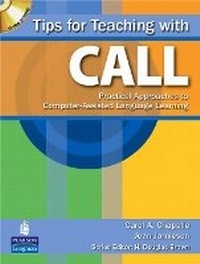
Tips for Teaching with CALL
Practical Approaches for Computer-Assisted Language Learning
Published on 6. May 2008
Book
Paperback/Softback
256 pages
978-0-13-240428-0 (ISBN)
Description
Tips for Teaching with CALL: Practical Approaches to Computer-Assisted Language Learning, introduces English language teachers to computer-assisted language learning, or CALL. This practical reference book links specific techniques for using CALL with contemporary CALL research. The book and companion CD-ROM clearly demonstrate why and how to use CALL to teach vocabulary, grammar, reading, writing, listening, speaking, communication skills, and content-based language.
Features of the Book:
Color screenshots of authentic CALL software, along with descriptions, level information, and notes, illustrate more than 100 real examples
Concrete tips at the beginning of each chapter help teachers get students working productively with electronic texts
What the research says and What the teacher can do sections link pedagogical research with classroom techniques
Specific topics covered in different chapters includeVocabulary, Grammar, Reading, Writing,Listening, Speaking, Communication Skills, and Content-Based Language
Focus questions at the end of each chapter guide teachers in selecting appropriate CALL activities for their students' needs
Features of the CD-ROM:
Interactive video clips show application of tips from each chapter
Demonstration tips show students using authentic CALL software
Simulation tips guide teachers through using authentic CALL programs
System Requirements:
Windows(R) 2000/XP/Vista or Mac OSX (10.3 or higher)
Microsoft Internet Explorer(R) 6.x, SafariTM 1.x, Firefox(R) 1.x, Mozilla(R) 1.x, NetscapeTM 7.x or later
256 MB RAM minimum (512+ MB recommended)
500 MB available hard drive space
Monitor resolution of 1024 x 768 or higher
Sound card and speakers*CD-ROM drive (10x or faster)
Adobe(R) Flash(R) 8 plug-in or higher (Note: If your computer does not have this plug-in, and Internet connection is required for installation.)
Features of the Book:
Color screenshots of authentic CALL software, along with descriptions, level information, and notes, illustrate more than 100 real examples
Concrete tips at the beginning of each chapter help teachers get students working productively with electronic texts
What the research says and What the teacher can do sections link pedagogical research with classroom techniques
Specific topics covered in different chapters includeVocabulary, Grammar, Reading, Writing,Listening, Speaking, Communication Skills, and Content-Based Language
Focus questions at the end of each chapter guide teachers in selecting appropriate CALL activities for their students' needs
Features of the CD-ROM:
Interactive video clips show application of tips from each chapter
Demonstration tips show students using authentic CALL software
Simulation tips guide teachers through using authentic CALL programs
System Requirements:
Windows(R) 2000/XP/Vista or Mac OSX (10.3 or higher)
Microsoft Internet Explorer(R) 6.x, SafariTM 1.x, Firefox(R) 1.x, Mozilla(R) 1.x, NetscapeTM 7.x or later
256 MB RAM minimum (512+ MB recommended)
500 MB available hard drive space
Monitor resolution of 1024 x 768 or higher
Sound card and speakers*CD-ROM drive (10x or faster)
Adobe(R) Flash(R) 8 plug-in or higher (Note: If your computer does not have this plug-in, and Internet connection is required for installation.)
More details
Language
English
Place of publication
Upper Saddle River
United States
Target group
ELT/ESL
Dimensions
Height: 232 mm
Width: 178 mm
Thickness: 10 mm
Weight
360 gr
ISBN-13
978-0-13-240428-0 (9780132404280)
Copyright in bibliographic data and cover images is held by Nielsen Book Services Limited or by the publishers or by their respective licensors: all rights reserved.
Schweitzer Classification
Persons
Joan Jamieson (Ph.D. in Second Language Acquisition and Teacher Education, University of Illinois) is Professor of English/Applied Linguistics at Northern Arizona University. In the MA-TESL program and the doctoral program in Applied Linguistics, she teaches classes in CALL, second language testing, and research design and statistics for applied linguistics. Joan has been involved in several research and development projects in these areas, as reflected in her publications.
Carol A. Chapelle (Ph.D. in Second Language Acquisition and Teacher Education, University of Illinois) is Professor of TESL/Applied Linguistics at Iowa State University. She teaches classes in CALL, second language testing, and second language acquisition in an MA program in TESL/Applied Linguistics with specialization in CALL and in a Ph.D. program in Applied Linguistics & Technology. Carol has published widely in these areas. She has served as editor of TESOL Quarterly, and she is second vice president of the American Association for Applied Linguistics.
Carol A. Chapelle (Ph.D. in Second Language Acquisition and Teacher Education, University of Illinois) is Professor of TESL/Applied Linguistics at Iowa State University. She teaches classes in CALL, second language testing, and second language acquisition in an MA program in TESL/Applied Linguistics with specialization in CALL and in a Ph.D. program in Applied Linguistics & Technology. Carol has published widely in these areas. She has served as editor of TESOL Quarterly, and she is second vice president of the American Association for Applied Linguistics.
Content
INTRODUCTION: What is CALL?
CHAPTER 1: Vocabulary
CHAPTER 2: Grammar
CHAPTER 3: Reading
CHAPTER 4: Writing
CHAPTER 5: Listening
CHAPTER 6: Speaking
CHAPTER 7: Communication Skills
CHAPTER 8: Content-Based Language
CONCLUSION: After Class
Bibliography
Name Index
Subject Index
CHAPTER 1: Vocabulary
CHAPTER 2: Grammar
CHAPTER 3: Reading
CHAPTER 4: Writing
CHAPTER 5: Listening
CHAPTER 6: Speaking
CHAPTER 7: Communication Skills
CHAPTER 8: Content-Based Language
CONCLUSION: After Class
Bibliography
Name Index
Subject Index