

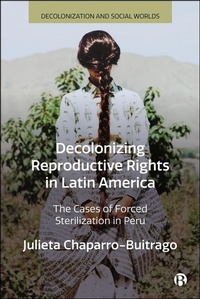
Decolonizing Reproductive Rights in Latin America
The Cases of Forced Sterilization in Peru
1st Edition
Published on 22. October 2025
Book
Hardback
240 pages
978-1-5292-3605-7 (ISBN)
Description
Based on ethnographic fieldwork in Peru, this book analyses how Indigenous peasant women who have experienced reproductive violence describe the harms of forced sterilization and the complexities of using human and reproductive rights frameworks to make their experiences visible through law and activism. The author argues that the focus on individual choice and fertility creates dissonances and hierarchies of discourse that ultimately displace women's embodied experiences of reproductive violence that do not fit within a repronormative framework.
Introducing dissonance as a decolonial feminist methodology, the book explores how colonial, racialized, and gendered histories shape legal and experiential incommensurability. As the first ethnography on sterilization cases in Peru, it contributes to social studies of reproduction, Latin American studies, and decolonial feminisms.
Introducing dissonance as a decolonial feminist methodology, the book explores how colonial, racialized, and gendered histories shape legal and experiential incommensurability. As the first ethnography on sterilization cases in Peru, it contributes to social studies of reproduction, Latin American studies, and decolonial feminisms.
Reviews / Votes
'Such a timely and humanizing offering to counter the current repressive historical moment in Peru and beyond! This impressively nuanced and multi-sited ethnography uplifts Indigenous peasant women's understandings of their varied experiences with forced sterilization, thereby expanding the coloniality of gender critique to include reproduction.' Pascha Bueno-Hansen, University of Delaware 'A necessary book about a shameful and unpunished event. The book not only provides a critique of human and reproductive rights but also brings us closer to the feelings and thoughts of the victims, recognizing their agency.' Margara Millan, National Autonomous University of Mexico 'This pathbreaking study of Peru's unprecedented sterilization campaign offers a bold new take on the intersection of reproductive violence, feminist activism and the reproductive justice movement. Introducing the concept of reproductive grammars to structure her brilliantly insightful ethnographic account, Chaparro-Buitrago has produced a truly transformative and vital account of contemporary reproductive politics.' Sarah Franklin, University of CambridgeMore details
Series
Edition
First Edition
Language
English
Place of publication
Bristol
United Kingdom
Target group
Professional and scholarly
Illustrations
17 s/w Abbildungen, 1 s/w Tabelle
1 Tables, black and white; 17 Illustrations, black and white
Dimensions
Height: 161 mm
Width: 242 mm
Thickness: 20 mm
Weight
500 gr
ISBN-13
978-1-5292-3605-7 (9781529236057)
Copyright in bibliographic data and cover images is held by Nielsen Book Services Limited or by the publishers or by their respective licensors: all rights reserved.
Schweitzer Classification
Other editions
Additional editions
Julieta Chaparro-Buitrago
Decolonizing Reproductive Rights in Latin America
The Cases of Forced Sterilization in Peru
E-Book
10/2025
1st Edition
Bristol University Press
€40.99
Available for download
Person
Julieta Chaparro-Buitrago is Research Fellow in the Department of Anthropology at the University of Amsterdam.
Content
Introduction: Towards a Decolonial Critique of Reproductive Rights
1. 'Masters of Their Own Destiny': Women's Rights and Forced Sterilizations in Peru
2. The Grammar of Reproductive Violence: Ya No Tenemos Fuerza and Debilitating Lifeworlds
3. The Grammar of Reproductive Violence: Alteraciones, Animal Analogies, and the Reconstitution of Lifeworlds
4. Performing Memory, Reproducing Invisibility: Feminist Reproductive Activism
5. The Bureaucratization of Harm: Non- Performativity and the Peruvian State's Response to Forced Sterilization
Conclusion: Current Reverberations of the Coloniality of Reproduction
1. 'Masters of Their Own Destiny': Women's Rights and Forced Sterilizations in Peru
2. The Grammar of Reproductive Violence: Ya No Tenemos Fuerza and Debilitating Lifeworlds
3. The Grammar of Reproductive Violence: Alteraciones, Animal Analogies, and the Reconstitution of Lifeworlds
4. Performing Memory, Reproducing Invisibility: Feminist Reproductive Activism
5. The Bureaucratization of Harm: Non- Performativity and the Peruvian State's Response to Forced Sterilization
Conclusion: Current Reverberations of the Coloniality of Reproduction