

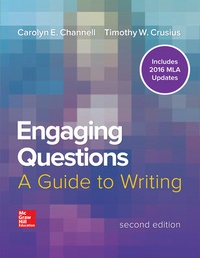
Engaging Questions 2e MLA 2016 UPDATE
2nd Edition
Published on 24. February 2017
Book
Paperback/Softback
480 pages
978-1-259-98828-8 (ISBN)
Description
Engaging Questions: A Guide to Writing takes a practical approach to composing, with a view that good writing occurs in the context of critical thinking. By using a consistent methodology that prompts students to learn and practice "the art of questioning," Engaging Questions: A Guide to Writing presents writing as one essential part of the critical thinking whole, ultimately empowering students to become skilled thinkers and confident writers.
Connect Composition supports instruction across multiple semesters and courses with interactive exercises, online learning videos, enriched ebook materials, annotation and writing tools, and much more!
* LearnSmart Achieve - a continuously adaptive learning system that pinpoints students' individual strengths and weaknesses and provides personalized support to help them master key topics and material. LearnSmart Achieve provides foundational support on key course areas such as the writing process, critical reading, the research process, reasoning and argument, grammar and common sentence problems,punctuation and mechanics, style and word choice, and multilingual writer support.
* Power of Process - a critical reading and writing tool that guides students through instructor-chosen strategies and helps them engage directly with a text through highlighting, annotation, and short answer questions.
* Analytics - Progress dashboards that quickly show how you are performing on your assignments and tips for improvement.
Connect Composition supports instruction across multiple semesters and courses with interactive exercises, online learning videos, enriched ebook materials, annotation and writing tools, and much more!
* LearnSmart Achieve - a continuously adaptive learning system that pinpoints students' individual strengths and weaknesses and provides personalized support to help them master key topics and material. LearnSmart Achieve provides foundational support on key course areas such as the writing process, critical reading, the research process, reasoning and argument, grammar and common sentence problems,punctuation and mechanics, style and word choice, and multilingual writer support.
* Power of Process - a critical reading and writing tool that guides students through instructor-chosen strategies and helps them engage directly with a text through highlighting, annotation, and short answer questions.
* Analytics - Progress dashboards that quickly show how you are performing on your assignments and tips for improvement.
More details
Edition
2nd edition
Language
English
Place of publication
OH
United States
Target group
College/higher education
Dimensions
Height: 234 mm
Width: 191 mm
Thickness: 17 mm
Weight
619 gr
ISBN-13
978-1-259-98828-8 (9781259988288)
Copyright in bibliographic data and cover images is held by Nielsen Book Services Limited or by the publishers or by their respective licensors: all rights reserved.
Schweitzer Classification
Content
PART I Exploring Writing and Reading
Chapter 1: Critical Thinking and the Art of QuestioningChapter 2: Reading Critically and the Art of QuestioningChapter 3: Writing and the Art of Questioning
PART IIPracticing Writing
Chapter 4: Claiming VoiceChapter 5: Interpreting ExperiencesChapter 6: Creating ProfilesChapter 7: Presenting InformationChapter 8: Exploring a ConceptChapter 9: Comparing PerspectivesChapter 10: Critiquing an ArgumentChapter 11: Making a CaseChapter 12: Appealing for ActionChapter 13: Writing an EvaluationChapter 14: Editing Fundamentals
PART IIIResearching Writing
Chapter 15: Planning a Research ProjectChapter 16: Finding SourcesChapter 17: Evaluating SourcesChapter 18: Incorporating Source MaterialsChapter 19: Using Sources ResponsiblyChapter 20: Documenting Your Sources: MLAChapter 21: Documenting Your Sources: APA
Chapters 22-39 are optional chapters available online within McGraw-Hill's Connect platform or for addition to your text, please contact your learning technology representative for additional information.
Chapter 22: Choosing Strategies of DevelopmentChapter 23: Designing Documents and Using GraphicsChapter 24: Writing PortfoliosChapter 25: Mastering Essay ExamsChapter 26: Giving Oral PresentationsChapter 27: How Do I Write a Rhetorical Analysis?Chapter 28: How Do I Write a Blog?Chapter 29: How Do I Write a Reflection?Chapter 30: How Do I Write a Visual Analysis?Chapter 31: How Do I Write a Review?Chapter 32: How Do I Write an Editorial or Opinion Column?Chapter 33: How Do I Write a Proposal?Chapter 34: How Do I Write a Research Proposal?Chapter 35: How Do I Write an Annotated Bibliography?Chapter 36: How Do I Write a Prospectus?Chapter 37: How Do I Write a Lab Report?Chapter 38: How Do I Write Instructions?Chapter 39: How Do I Write an Abstract?
Chapter 1: Critical Thinking and the Art of QuestioningChapter 2: Reading Critically and the Art of QuestioningChapter 3: Writing and the Art of Questioning
PART IIPracticing Writing
Chapter 4: Claiming VoiceChapter 5: Interpreting ExperiencesChapter 6: Creating ProfilesChapter 7: Presenting InformationChapter 8: Exploring a ConceptChapter 9: Comparing PerspectivesChapter 10: Critiquing an ArgumentChapter 11: Making a CaseChapter 12: Appealing for ActionChapter 13: Writing an EvaluationChapter 14: Editing Fundamentals
PART IIIResearching Writing
Chapter 15: Planning a Research ProjectChapter 16: Finding SourcesChapter 17: Evaluating SourcesChapter 18: Incorporating Source MaterialsChapter 19: Using Sources ResponsiblyChapter 20: Documenting Your Sources: MLAChapter 21: Documenting Your Sources: APA
Chapters 22-39 are optional chapters available online within McGraw-Hill's Connect platform or for addition to your text, please contact your learning technology representative for additional information.
Chapter 22: Choosing Strategies of DevelopmentChapter 23: Designing Documents and Using GraphicsChapter 24: Writing PortfoliosChapter 25: Mastering Essay ExamsChapter 26: Giving Oral PresentationsChapter 27: How Do I Write a Rhetorical Analysis?Chapter 28: How Do I Write a Blog?Chapter 29: How Do I Write a Reflection?Chapter 30: How Do I Write a Visual Analysis?Chapter 31: How Do I Write a Review?Chapter 32: How Do I Write an Editorial or Opinion Column?Chapter 33: How Do I Write a Proposal?Chapter 34: How Do I Write a Research Proposal?Chapter 35: How Do I Write an Annotated Bibliography?Chapter 36: How Do I Write a Prospectus?Chapter 37: How Do I Write a Lab Report?Chapter 38: How Do I Write Instructions?Chapter 39: How Do I Write an Abstract?