

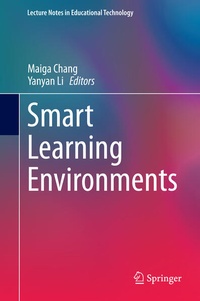
Smart Learning Environments
Published on 19. September 2014
Book
Hardback
XII, 219 pages
978-3-662-44446-7 (ISBN)
Description
This book addresses main issues concerned with the future learning, learning and academic analytics, virtual world and smart user interface, and mobile learning. This book gathers the newest research results of smart learning environments from the aspects of learning, pedagogies, and technologies in learning. It examines the advances in technology development and changes in the field of education that has been affecting and reshaping the learning environment. Then, it proposes that under the changed technological situations, smart learning systems, no matter what platforms (i.e., personal computers, smart phones, and tablets) they are running at, should be aware of the preferences and needs that their users (i.e., the learners and teachers) have, be capable of providing their users with the most appropriate services, helps to enhance the users' learning experiences, and to make the learning efficient.
More details
Series
Language
English
Place of publication
Berlin
Germany
Publishing group
Springer Berlin
Target group
Professional and scholarly
Research
Illustrations
61 s/w Abbildungen
XII, 219 p. 61 illus.
Dimensions
Height: 241 mm
Width: 160 mm
Thickness: 19 mm
Weight
518 gr
ISBN-13
978-3-662-44446-7 (9783662444467)
DOI
10.1007/978-3-662-44447-4
Schweitzer Classification
Other editions
Additional editions
Maiga Chang | Yanyan Li
Smart Learning Environments
Book
08/2016
Springer
€106.99
Shipment within 7-9 days
Maiga Chang | Yanyan Li
Smart Learning Environments
E-Book
09/2014
1st Edition
Springer
€96.29
Available for download
Content
A. Learning Analytics.- Analyzing Learner Characteristics and Courses based on Cognitive Abilities, Learning Styles and Context.- An Approach to Measure Coding Competency Evolution - Towards Learning Analytics.- Semantic Similarity Enhanced Topic Models for Document Analysis.- Social Context Analysis for Topic-specific Expertise Finding in Online Learning Communities.- B. Ambient Design.- Context-aware Geography Fieldtrip with EagleEye: Teachers' First Experience.- Note-taking in Pupil's Textbook: Features and Influence Factors.- Effects of Clicker and Peer Discussion on Learning Performance in a Secondary Biology Course.- C. Smart Pedagogy.- Smart Learner Support through Semi-automatic Feedback.- Interactive Physical Games: Improving Balance in Older Adults.- Story-based Virtual Experiments Environment.- Development of Handheld Augmented Reality X-ray for K-12 Settings.