

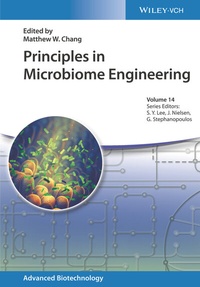
Principles in Microbiome Engineering
1st Edition
Published on 22. June 2022
Book
Hardback
336 pages
978-3-527-34725-4 (ISBN)
Description
This book not only introduces the reader to the necessary tools to understand microbiome but also discusses many relevant areas of current research and applications of microbiome engineering, ranging from human diseases to husbandry, food and beverage applications.
More details
Series
Edition
1. Auflage
Language
English
Place of publication
Berlin
Germany
Target group
Professional and scholarly
Illustrations
150
100 s/w Abbildungen, 50 farbige Abbildungen
Dimensions
Height: 24.4 cm
Width: 17 cm
Thickness: 2.2 cm
Weight
782 gr
ISBN-13
978-3-527-34725-4 (9783527347254)
Schweitzer Classification
Other editions
Additional editions
Matthew Chang
Principles in Microbiome Engineering
E-Book
05/2022
1st Edition
Wiley-VCH
€138.99
Available for download
Matthew Chang
Principles in Microbiome Engineering
E-Book
04/2022
1st Edition
Wiley-VCH
€138.99
Available for download
Persons
Matthew Chang is Associate Professor in Biochemistry in the Yong Loo Lin School of Medicine at the National University of Singapore (NUS), and Director of the Singapore Consortium for Synthetic Biology (SINERGY), Wilmar-NUS Corporate Laboratory (Wil-NUS) and NUS Synthetic Biology for Clinical and Technological Innovation (SynCTI). His research interests lie in the development of biological systems that perform programmable functions. In particular, he has pioneered the development of microbial cells programmed to perform targeted therapeutic functionalities. His scientific contributions have been recognized with international honours and awards, including the Scientific and Technological Achievement Award from U.S. Environmental Protection Agency, and featured in leading media outlets worldwide. He serves as an editor and an editorial board member for a number of journals including Cell Systems, Metabolic Engineering, Biotechnology for Biofuels, ACS Synthetic Biology, and Critical Reviews in Microbiology. He serves on the advisory committee of key international research programs such as the Synthetic Biology Open Language (SBOL) and CSIRO Future Science Platform.
Content
Section I: Advancing understanding of microbiome
Chapter 1: Systems biology and microbiome
Chapter 2: Synthetic biology and microbiome
Chapter 3: Computational modelling of microbiome and host-microbiome interactions
Chapter 4: Machine learning of the microbiome big data
Section II: Microbiome engineering
Chapter 5: Human microbiome engineering against pathogen infections
Chapter 6: Human microbiome engineering against cancer
Chapter 7: Human microbiome engineering against diabetes
Chapter 8: Human microbiome engineering against obesity
Chapter 9: Human microbiome engineering against mental disorders
Chapter 10: Human microbiome engineering against autoimmune and inflammatory disorders
Chapter 11: Husbandry microbiome engineering
Chapter 12: Plant-soil microbiome engineering
Chapter 13: Food microbiome engineering
Chapter 14: Beverage microbiome engineering
Section III: Perspectives on microbiome engineering
Chapter 15: Future perspectives on Microbiome and its applications
Chapter 1: Systems biology and microbiome
Chapter 2: Synthetic biology and microbiome
Chapter 3: Computational modelling of microbiome and host-microbiome interactions
Chapter 4: Machine learning of the microbiome big data
Section II: Microbiome engineering
Chapter 5: Human microbiome engineering against pathogen infections
Chapter 6: Human microbiome engineering against cancer
Chapter 7: Human microbiome engineering against diabetes
Chapter 8: Human microbiome engineering against obesity
Chapter 9: Human microbiome engineering against mental disorders
Chapter 10: Human microbiome engineering against autoimmune and inflammatory disorders
Chapter 11: Husbandry microbiome engineering
Chapter 12: Plant-soil microbiome engineering
Chapter 13: Food microbiome engineering
Chapter 14: Beverage microbiome engineering
Section III: Perspectives on microbiome engineering
Chapter 15: Future perspectives on Microbiome and its applications