

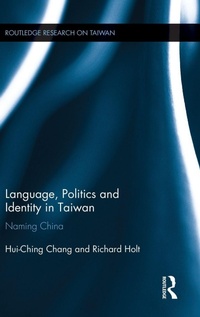
Language, Politics and Identity in Taiwan
Naming China
1st Edition
Published on 18. November 2014
Book
Hardback
222 pages
978-0-415-83601-2 (ISBN)
Description
Following the move by Chiang Kai-shek and the Chinese Nationalist Party Kuomingtang (KMT) to Taiwan after losing the Chinese civil war to the Chinese Communist Party (CCP) in the late 1940s, and Chiang's subsequent lifelong vow to reclaim the mainland, "China " has occupied-if not monopolized-the gaze of Taiwan, where its projected images are reflected. Whether mirror image, shadow, or ideal contrast, China has been, and will continue to be, a key reference point in Taiwan's convoluted effort to find its identity.
Language, Politics and Identity in Taiwan traces the intertwined paths of five sets of names Taiwan has used to name China since the KMT came to Taiwan in 1949: the derogatory "Communist bandits"; the ideologically focused "Chinese Communists"; the seemingly neutral geographical designators "mainland" and "opposite shore/both shores"; and the ethnic and national label "China," with the official designation, "People's Republic of China." In doing so, it explores how Taiwanese identities are constituted and reconstituted in the shifting and switching of names for China; in the application of these names to alternative domains of Taiwanese life; in the waning or waxing of names following tides of history and polity; and in the increasingly contested meaning of names. Through textual analyses of historical archives and other mediated texts and artifacts, the chapters chart Taiwan's identity negotiation over the past half century and critically evaluate key interconnections between language and politics.
This unique book will be of great interest to students and scholars of Taiwan studies, Chinese politics, communication studies and linguistics.
Language, Politics and Identity in Taiwan traces the intertwined paths of five sets of names Taiwan has used to name China since the KMT came to Taiwan in 1949: the derogatory "Communist bandits"; the ideologically focused "Chinese Communists"; the seemingly neutral geographical designators "mainland" and "opposite shore/both shores"; and the ethnic and national label "China," with the official designation, "People's Republic of China." In doing so, it explores how Taiwanese identities are constituted and reconstituted in the shifting and switching of names for China; in the application of these names to alternative domains of Taiwanese life; in the waning or waxing of names following tides of history and polity; and in the increasingly contested meaning of names. Through textual analyses of historical archives and other mediated texts and artifacts, the chapters chart Taiwan's identity negotiation over the past half century and critically evaluate key interconnections between language and politics.
This unique book will be of great interest to students and scholars of Taiwan studies, Chinese politics, communication studies and linguistics.
More details
Series
Language
English
Place of publication
London
United Kingdom
Publishing group
Taylor & Francis Ltd
Target group
College/higher education
Dimensions
Height: 240 mm
Width: 161 mm
Thickness: 17 mm
Weight
520 gr
ISBN-13
978-0-415-83601-2 (9780415836012)
Copyright in bibliographic data and cover images is held by Nielsen Book Services Limited or by the publishers or by their respective licensors: all rights reserved.
Schweitzer Classification
Other editions
Additional editions
Book
05/2017
1st Edition
Routledge
€76.80
Shipment within 10-20 days
E-Book
11/2014
1st Edition
Routledge
€69.99
Available for download
E-Book
11/2014
1st Edition
Routledge
€69.99
Available for download
Persons
Hui-Ching Chang is Associate Professor in the Department of Communication Studies and Associate Dean for the Honors College at the University of Illinois at Chicago, USA.
Richard Holt is Professor of Communication Studies at Northern Illinois University, USA.
Richard Holt is Professor of Communication Studies at Northern Illinois University, USA.
Content
1.Naming China-Political Art as Challenges 2. Communist Bandits (Gongfei, ??)-the Evil Enemy 3. Chinese Communists (zhonggong, ??)-the Ideological Identifier 4. The Mainland (Dalu, ??)-the Nostalgic Never-Land 5. Opposite Shore (duian) and "Both Shores" (liangan)-the Separated Partner 6. China (zhongguo, ??) and The PRC (zhonghuarenmingongheguo, ???????): "Us" or "Them"? 7. Further Thoughts