

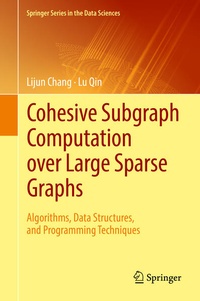
Cohesive Subgraph Computation over Large Sparse Graphs
Algorithms, Data Structures, and Programming Techniques
Published on 7. January 2019
Book
Hardback
XII, 107 pages
978-3-030-03598-3 (ISBN)
Description
This book is considered the first extended survey on algorithms and techniques for efficient cohesive subgraph computation. With rapid development of information technology, huge volumes of graph data are accumulated. An availability of rich graph data not only brings great opportunities for realizing big values of data to serve key applications, but also brings great challenges in computation. Using a consistent terminology, the book gives an excellent introduction to the models and algorithms for the problem of cohesive subgraph computation. The materials of this book are well organized from introductory content to more advanced topics while also providing well-designed source codes for most algorithms described in the book. This is a timely book for researchers who are interested in this topic and efficient data structure design for large sparse graph processing. It is also a guideline book for new researchers to get to know the area of cohesive subgraph computation.
More details
Product info
Book
Series
Edition
2018
Language
English
Place of publication
Cham
Switzerland
Publishing group
Springer International Publishing
Target group
Professional and scholarly
Illustrations
20 s/w Abbildungen, 1 farbige Abbildung, 1 farbige Tabelle
19 schwarz-weiße und 2 farbige Abbildungen, 1 farbige Tabellen, Bibliographie
Dimensions
Height: 241 mm
Width: 160 mm
Thickness: 13 mm
Weight
354 gr
ISBN-13
978-3-030-03598-3 (9783030035983)
DOI
10.1007/978-3-030-03599-0
Schweitzer Classification
Other editions
Additional editions
Lijun Chang | Lu Qin
Cohesive Subgraph Computation over Large Sparse Graphs
Algorithms, Data Structures, and Programming Techniques
E-Book
12/2018
1st Edition
Springer
€53.49
Available for download
Content
Introduction.- Linear Heap Data Structures.- Minimum Degree-based Core Decomposition.- Average Degree-based Densest Subgraph Computation.- Higher-order Structure-based Graph Decomposition.- Edge Connectivity-based Graph Decomposition.