

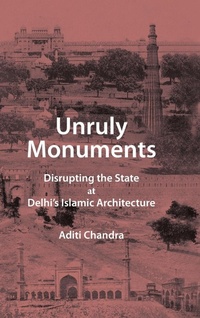
Unruly Monuments
Disrupting the State at Delhi's Islamic Architecture
Published on 10. July 2025
Book
Hardback
418 pages
978-1-009-34517-0 (ISBN)
Description
It examines how Delhi's Sultanate and Mughal architecture, dating from the twelfth to the seventeenth centuries, became modern monuments and were assimilated and ordered into public consciousness as spaces for tourism, leisure, and intellectual contemplation during the colonial and early postcolonial eras (1828-1963). It examines the resistance that challenges this ordering, rendering monuments unruly and unassimilable despite state efforts to control their narrative. This exposes the nation's contradictory claims of inclusivity while marginalizing subaltern groups. It guides readers through picturesque landscapes, museums, imperial displays, postcards, travel experiences, Partition refugee camps, and cinema. Analyzing these forms reveals how the archive of Indo-Islamic monuments was shaped through presences and absences. Each chapter examines everyday life, untangles knowable public transcripts, illuminates strategic excisions and hidden transcripts, juxtaposes evidence that has not yet been analyzed in conjunction, reads archival material against the grain, and finds archival layers in unfamiliar places.
More details
Language
English
Place of publication
Cambridge
United Kingdom
Illustrations
Worked examples or Exercises
Dimensions
Height: 235 mm
Width: 157 mm
Thickness: 29 mm
Weight
826 gr
ISBN-13
978-1-009-34517-0 (9781009345170)
Copyright in bibliographic data and cover images is held by Nielsen Book Services Limited or by the publishers or by their respective licensors: all rights reserved.
Schweitzer Classification
Person
Aditi Chandra is Associate Professor art history at UC Merced. She has held fellowships from the Doris Duke Foundation for Islamic Art (2013) and the UC President's Office (2019-20). She has curated exhibitions of travel visual culture: 'Imperial Post: Views of Colonial Delhi' and 'Waterscapes and Wet Bodies through the Colonial Eye: West Africa, Hawai'i, and India' and published in International Journal of Islamic Architecture, Journal of South Asian Popular Culture, Third Text Forum, and Art History Pedagogy and Practice. She has also coedited The Nation and Its Margins: Rethinking Community (2019).
Content
Introduction: Unruly Monuments; 1. Qutb Becomes a Monument: On the Picturesque and Its Discontents; 2. Museum-ization Narrates the Lal Qila; 3. The Traveler's Archive: Postcards as Partial Souvenirs; 4. The 'Un-exchangeable' Monument: Delhi's Purana Qila as a Partition Refugee Camp; 5. Absence of the 'Un-exchangeable' Monument: Cinema, Nations, and the 'Long Partition'; Epilogue: Dwelling with Unruliness.