

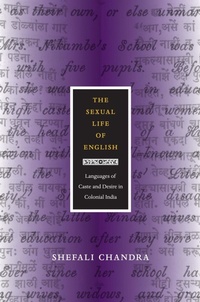
The Sexual Life of English
Languages of Caste and Desire in Colonial India
Will be published approx. on 2. May 2012
Book
Hardback
288 pages
978-0-8223-5260-0 (ISBN)
Description
In The Sexual Life of English, Shefali Chandra examines how English became an Indian language. She rejects the idea that English was fully formed before its life in India or that it was imposed from without. Rather, by drawing attention to sexuality and power, Chandra argues that the English language was produced through conflicts over caste, religion, and class. Sentiments and experiences of desire, respectability, conjugality, status, consumption, and fashion came together to create the Indian history of English. The language was shaped by the sexual experiences of Indians and by native attempts to discipline the normative sexual subject. Focusing on the years between 1850 and 1930, Chandra scrutinizes the English-education project as Indians gained the power to direct it themselves. She delves into the history of schools, the composition of the student bodies, and disagreements about curricula; the way that English-educated subjects wrote about English; and debates in English and Marathi popular culture. Chandra shows how concerns over linguistic change were popularly voiced in a sexual idiom, how English and the vernacular were separated through the vocabulary of sexual difference, and how the demand for matrimony naturalized the social location of the English language.
Reviews / Votes
"This book is an indispensable reference for those interested in challenging the traditional discourse of national, imperial, and postcolonial histories. This engaging interrogation of the seductive efficiencies of the English language in India, from a postcolonial feminist perspective, turns the way we conceive of the language of the colonizer, in effect, inside out." - Kristin Hutchins, Women's Studies "The Sexual Life of English poses a significant challenge to modern Indian history, which has tended to take the links between language and culture and the gendered colonial self for granted, when engaging the latter at all. From now on, it will be impossible to grapple with liberalism, education, women, domesticity, class and caste, conjugality, nationalism, sexuality, and so much more without reckoning with Shefali Chandra's cogent, subversive arguments."-Antoinette Burton, author of Empire in Question: Reading, Writing, and Teaching British Imperialism "Shefali Chandra's rethinking of cultural theory and modern Indian history is remarkable. Her major thesis, that Indian English has a brutal and loving social history of sexualization, will set a model for analogous studies in other national traditions. Her breakthrough argument is that English acquisition produced male cultural authority through the installation of biosexual difference. The point, then, is not the phallogocentrism of English as English but rather the installation of a 'native' phallogocentric power in the processes of colonization and postcolonization. All those who have found wanting the orthodox position in the historiography of subaltern studies will find The Sexual Life of English an exhilarating read."-Tani E. Barlow, author of The Question of Women in Chinese FeminismMore details
Series
Language
English
Place of publication
North Carolina
United States
Target group
College/higher education
Product notice
Cloth over boards
Dimensions
Height: 236 mm
Width: 160 mm
Thickness: 23 mm
Weight
590 gr
ISBN-13
978-0-8223-5260-0 (9780822352600)
Copyright in bibliographic data and cover images is held by Nielsen Book Services Limited or by the publishers or by their respective licensors: all rights reserved.
Schweitzer Classification
Other editions
Additional editions
E-Book
05/2012
1st Edition
De Gruyter
€198.99
Available for download
Person
Shefali Chandra is Assistant Professor in the Department of History, the International and Area Studies Program, and the Women, Gender, and Sexuality Studies Program at Washington University in St. Louis.
Content
Note on Transliteration and Spelling ix
Part One
1. Learning Gender, Knowing English: An Introduction 3
2. "The Prudent and Cautious Engrafting of English Upon Our Female Population": Pedagogy and Performativity 29
3. "The Language of the Bedroom": Mimicry, Masculinity, and the Sexual Power of English 57
4. "A New Generation of Hipless and Breastless Women . . . To the Forefront in Europe and America": Literature, Social Class, and the Wider World of English 83
Part Two
5. "I Shall Read Pretty English Stories to My Mother and Translate Them into Marathi for Her": Widowhood, Virtue, and the Secularization of Caste 117
6. "Why Had I Ever Begun to Learn English?": Desire, Labor, and the Transregional Orientation of Caste 137
7. Dosebai Jessawalla and the "March of Advancement in the Face of Obloquy" 157
8. Epilogue: "I Am an Indian. I Have No Language": Parvatibai Athavale and the Limits to English 175
Salaams 191
Notes 195
Bibliography 245
Index 267
Part One
1. Learning Gender, Knowing English: An Introduction 3
2. "The Prudent and Cautious Engrafting of English Upon Our Female Population": Pedagogy and Performativity 29
3. "The Language of the Bedroom": Mimicry, Masculinity, and the Sexual Power of English 57
4. "A New Generation of Hipless and Breastless Women . . . To the Forefront in Europe and America": Literature, Social Class, and the Wider World of English 83
Part Two
5. "I Shall Read Pretty English Stories to My Mother and Translate Them into Marathi for Her": Widowhood, Virtue, and the Secularization of Caste 117
6. "Why Had I Ever Begun to Learn English?": Desire, Labor, and the Transregional Orientation of Caste 137
7. Dosebai Jessawalla and the "March of Advancement in the Face of Obloquy" 157
8. Epilogue: "I Am an Indian. I Have No Language": Parvatibai Athavale and the Limits to English 175
Salaams 191
Notes 195
Bibliography 245
Index 267