

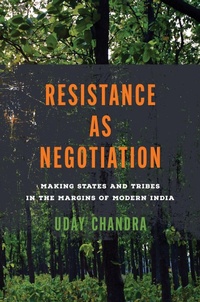
Resistance As Negotiation
Making States and Tribes in the Margins of Modern India
Published on 18. June 2024
Book
Hardback
340 pages
978-1-5036-3811-2 (ISBN)
Description
"Tribes" appear worldwide today as vestiges of a pre-modern past at odds with the workings of modern states. Acts of resistance and rebellion by groups designated as "tribal" have fascinated as well as perplexed administrators and scholars in South Asia and beyond. Tribal resistance and rebellion are held to be tragic yet heroic political acts by "subaltern" groups confronting omnipotent states. By contrast, this book draws on fifteen years of archival and ethnographic research to argue that statemaking is intertwined inextricably with the politics of tribal resistance in the margins of modern India.
Uday Chandra demonstrates how the modern Indian state and its tribal or adivasi subjects have made and remade each other throughout the colonial and postcolonial eras, historical processes of modern statemaking shaping and being shaped by myriad forms of resistance by tribal subjects. Accordingly, tribal resistance, whether peaceful or violent, is better understood vis-a-vis negotiations with the modern state, rather than its negation, over the past two centuries. How certain people and places came to be seen as "tribal" in modern India is, therefore, tied intimately to how "tribal" subjects remade their customs and community in the course of negotiations with colonial and postcolonial states. Ultimately, the empirical material unearthed in this book requires rethinking and rewriting the political history of modern India from its "tribal" margins.
Uday Chandra demonstrates how the modern Indian state and its tribal or adivasi subjects have made and remade each other throughout the colonial and postcolonial eras, historical processes of modern statemaking shaping and being shaped by myriad forms of resistance by tribal subjects. Accordingly, tribal resistance, whether peaceful or violent, is better understood vis-a-vis negotiations with the modern state, rather than its negation, over the past two centuries. How certain people and places came to be seen as "tribal" in modern India is, therefore, tied intimately to how "tribal" subjects remade their customs and community in the course of negotiations with colonial and postcolonial states. Ultimately, the empirical material unearthed in this book requires rethinking and rewriting the political history of modern India from its "tribal" margins.
Reviews / Votes
"An illuminating and engaging longue duree account of everyday resistance and state-making in the Chotanagpur plateau of Jharkhand. This ambitious book takes on the tropes that have shaped the conventional understanding of the pasts and the present of peoples labeled as 'adivasi' or 'tribal' in India."-Sanjib Baruah, Asian University for Women "This theoretically ambitious historical ethnography neatly displaces many of the central analytic categories by which indigenous people have been seen by state officials, scholars, politicians, and development workers, portraying them instead as modern subjects who co-produce the state on its margins and who co-author its policies and projects. Expertly crisscrossing history, politics, anthropology, and sociology, this generative and controversial book will make enduring contributions to all of these disciplines. A magnificent achievement!"
-Akhil Gupta, University of California, Los Angeles "[Resistance as Negotiation] makes a valuable contribution to scholarship on Adivasi societies and broader concepts of state-formation. Recommended."-A. M. Wainwright, CHOICE
More details
Series
Edition
New edition
Language
English
Place of publication
Palo Alto
United States
Target group
Professional and scholarly
Edition type
New edition
Product notice
Cloth
Illustrations
3 tables, 1 figure, 10 halftones, 1 map
Dimensions
Height: 229 mm
Width: 152 mm
Thickness: 26 mm
Weight
658 gr
ISBN-13
978-1-5036-3811-2 (9781503638112)
Copyright in bibliographic data and cover images is held by Nielsen Book Services Limited or by the publishers or by their respective licensors: all rights reserved.
Schweitzer Classification
Other editions
Additional editions
E-Book
06/2024
Stanford University Press
from
€149.99
Available for download
Person
Uday Chandra is Assistant Professor of Government at Georgetown University, Qatar.
Content
Maps, Tables, and Figures
Acknowledgments
Introduction
1. The Ancien Regime, or When Margins Were Not Margins
2. Colonial Paternalism and the Making of the Modern Tribal Subject
3. Tribal Resistance and Rebellion
4. Reconstituting Tribal Margins in Colonial India
5. From the Colonial to the Postcolonial
6. The Postcolonial Developmental State and the Modern Tribal Subject
7. Tribal Resistance and Rebellion Revisited
8. Remaking the Postcolonial State from Above and Below
Conclusion
Notes
References
Index
Acknowledgments
Introduction
1. The Ancien Regime, or When Margins Were Not Margins
2. Colonial Paternalism and the Making of the Modern Tribal Subject
3. Tribal Resistance and Rebellion
4. Reconstituting Tribal Margins in Colonial India
5. From the Colonial to the Postcolonial
6. The Postcolonial Developmental State and the Modern Tribal Subject
7. Tribal Resistance and Rebellion Revisited
8. Remaking the Postcolonial State from Above and Below
Conclusion
Notes
References
Index