

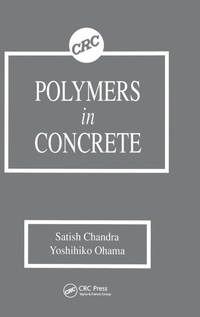
Polymers in Concrete
1st Edition
Published on 5. May 1994
Book
Hardback
220 pages
978-0-8493-4815-0 (ISBN)
Description
This broad-based, introductory reference provides excellent discussions regarding the hydration of Portland cement, durability problems in concrete, mechanisms of concrete deterioration, and interaction of polymers in concrete. It also covers properties of concrete with added polymers and practical applications of polymers in concrete. The historic background of polymers in building materials is examined, and a comprehensive comparison of natural vs. synthetic polymers is provided and conveniently summarized in a tabular format.
More details
Language
English
Place of publication
Bosa Roca
United States
Publishing group
Taylor & Francis Inc
Target group
Professional and scholarly
Professional
Illustrations
28 s/w Photographien bzw. Rasterbilder, 24 s/w Tabellen
36 figs., 24 tabs.
Dimensions
Height: 240 mm
Width: 161 mm
Thickness: 17 mm
Weight
502 gr
ISBN-13
978-0-8493-4815-0 (9780849348150)
Schweitzer Classification
Other editions
Additional editions
Satish Chandra | Yoshihiko Ohama
Polymers in Concrete
E-Book
08/2020
1st Edition
CRC Press
€555.99
Available for download
Satish Chandra | Yoshihiko Ohama
Polymers in Concrete
E-Book
08/2020
1st Edition
CRC Press
€555.99
Available for download
Persons
Satish Chandra, Yoshihiko Ohama
Content
L INTRODUCTION -- 2. NATURAL AND SYNTHETIC POLYMERS -- 2.1 Natural Polymers -- 2.1.1 The Oldest Natural Polymer, Bitumen -- 2.1.2 Use of Asphalt as an Impregnation Material -- 2.1.3 Materials Used in the Great Wall of China -- 2.1.4 Materials Used in India -- 2.1.5 Materials Used in Other Places -- 2.2 Synthetic Polymers -- 2.2.1 Soil Stabilization with Synthetic Polymers -- 2.2.2 Early Use of Synthetic Polymers in Concrete -- 2.2.3 Thermoplastics, Thermosets, and Elastomers -- 2.2.4 Water-Soluble Polymers -- 2.3 Concluding Remarks -- 3. DURABILITY PROBLEMS IN CONCRETE -- 3.1 Chemical Additives -- 3.2 Carbonation -- 3.3 Industrial Gases -- 3.4 Alkali-Aggregate Reaction -- 3.5 Water as an Agent of Deterioration -- 3.6 Need for Long-Term Research -- 3.7 Choice of Building Site -- 3.8 Errors in Design and Poor Workmanship -- 3.9 Some Cases -- 3.9.1 Bridges -- 3.9.2 Concrete Balconies -- 3.10 Reinforced Concrete Chimneys -- 3.11 Poor-Quality Aggregates -- 3.12 Corrosion of Steel Reinforcement -- 3.13 Freeze-Thaw Resistance -- 3.14 Concluding Remarks -- 4. MECHANISMS OF CONCRETE DETERIORATION -- 4.1 Carbonation of Concrete -- 4.1.1 Chemical Reaction -- 4.1.2 pH Profile -- 4.1.3 Shrinkage-Humidity Relationship -- 4.1.4 Effects of Cracks -- 4.2 Chloride-Induced Corrosion -- 4.3 Alkali-Aggregate Reaction -- 4.3.1 Alkali-Silica Reaction -- 4.3.2 Alkali-Carbonate Reaction -- 4.3.3 Alkali-Silicate Reaction -- 4.4 Freeze-Thaw Attack -- 4.4.1 Hydraulic Pressure -- 4.4.2 Osmotic Pressure -- 4.4.3 Chemical Interactions -- 4.5 Erosion and Cavitation -- 4.6 Chemical Attacks -- 4.6.1 Pollution and Acid Attack -- 4.6.2 Sulfate Attack -- 4.6.3 Ammonium Salts Attack -- 4.6.3.1 Ammonium Sulfate Action -- 4.6.3.2 Ammonium Chloride Action -- 4.6.3.3 Ammonium Nitrate Action -- 4.7 Efflorescence -- 4.8 Concluding Remarks -- 5. CLASSIFICATION OF CONCRETE-POLYMER COMPOSITES -- 5.1 Polymer-Modified (or Cement) Mortar and Concrete -- 5.1.1 Definition -- 5.1.2 Principles of Polymer Modification -- 5.1.2.1 Latex Modification -- 5.1.2.2 Modification with Redispersible Polymer Powders -- 5.1.2.3 Modification with Water-Soluble Polymers -- 5.1.2.4 Modification with Liquid Resins -- 5.1.2.5 Modification with Monomers -- 5.1.3 Process Technology -- 5.1.3.1 Materials -- 5.1.3.2 Mix Proportioning -- 5.1.3.3 Mixing -- 5.1.3.4 Placing and Curing -- 5.2 Polymer Mortar and Concrete -- 5.2.1 Definition -- 5.2.2 Principle of Polymer Replacement -- 5.2.3 Process Technology -- 5.2.3.1 Materials -- 5.2.3.2 Mix Proportioning -- 5.2.3.3 Mixing -- 5.2.3.4 Placing and Curing -- 5.3 Polymer-Impregnated Mortar and Concrete -- 5.3.1 Definition -- 5.3.2 Principle of Polymer Impregnation -- 5.3.3 Process Technology -- 5.3.3.1 Materials., -- 5.3.3.2 Manufacturing Process for Precast Products . -- 5.3.3.3 Field Polymer Impregnation Process. -- PROPERTIES OF CONCRETE-POLYMER COMPOSITES -- 6.1 Properties of Polymer-Modified Mortar and Concrete -- 6.1.1 Properties of Fresh Mortar and Concrete Using -- Polymer Latexes -- 6.1.1.1 Workability -- 6.1.1.2 Air Entrainment -- 6.1.1.3 Water Retention -- 6.1.1.4 Bleeding and Segregation -- 6.1.1.5 Setting Behavior. . -- 6.1.2 Properties of Hardened Mortar and Concrete -- Using Polymer Latexes -- 6.1.2.1 Strength -- 6.1.2.2 Deformability, Modulus of Elasticity, -- and Poisson's Ratio -- 6.1.2.3 Shrinkage, Creep, and Thermal Expansion -- 6.1.2.4 Waterproofness and Water Resistance -- 6.1.2.5 Resistance to Chloride Ion Penetration and Carbonation -- 6.1.2.6 Pore Size Distribution and Oxygen Diffusion Resistance -- 6.1.2.7 Adhesion . . . -- 6.1.2.8 Impact Resistance -- 6.1.2.9 Abrasion Resistance -- 6.1.2.10 Chemical Resistance -- 6.1.2.11 Thermal Resistance and Fire Resistance -- 6.1.2.12 Freeze-Thaw Durability and Weatherability -- 6.1.3 Properties of Redispersible Polymer Powder-Modified Systems -- 6.1.4 Properties of Water-Soluble Polymer-Modified Systems -- 6.1.5 Properties of Liquid Resin-Modified Systems -- 6.2 Properties of Polymer Mortar and Concrete -- 6.2.1 Properties of Fresh Mortar and Concrete -- 6.2.1.1 Workability -- 6.2.1.2 Working Life and Hardening Time -- 6.2.1.3 Bleeding and Segregation -- 6.2.1.4 Setting or Hardening Shrinkage -- 6.2.2 Properties of Hardened Mortar and Concrete -- 6.2.2.1 Strength -- 6.2.2.2 Deformability, Elastic Modulus and Creep . -- 6.2.2.3 Watertightness, Gas-Tightness, Freeze-Thaw Durability, and Water Resistance -- 6.2.2.4 Adhesion or Bond -- 6.2.2.5 Chemical Resistance. . -- 6.2.2.6 Abrasion Resistance, Impact Resistance, and Electrical Insulating Properties -- 6.2.2.1 Incombustibility and Fire Resistance -- 6.2.2.8 Weatherability or Weather Resistance -- 6.3 Properties of Polymer-Impregnated Concrete and Mortar -- 7. MECHANISMS OF CONCRETE-POLYMER INTERACTIONS -- 7.1 Hydration of Portland Cement -- 7.1.1 Hydration of Tricalcium Silicate -- 7.1.1.1 Initial Period of Reactivity -- 7.1.1.2 Induction or Dormant Period -- 7.1.1.3 Acceleration Period. -- 7.1.1.4 Final Stage -- 7.1.2 Hydration of Tricalcium Aluminate -- 7.2 Interaction -- 7.2.1 Polymer-Impregnated Concrete -- 7.2.2 Polymers Mixed in Concrete -- 7.2.3 Accelerators and Retarders -- 7.3 Natural Polymers -- 7.4 Synthetic Polymers -- 7.4.1 Interaction between Calcium Hydroxide and -- Polymer Dispersion -- 7.4.2 Interaction between Calcium Silicates and Polymer -- 7.4.3 Interaction between Tricalcium Aluminate -- and Polymers -- 7.4.4 Interaction with Portland Cement -- 7.5 Concluding Remarks -- 8. PRACTICAL APPLICATIONS OF CONCRETE-POLYMER -- COMPOSITES -- 8.1 Applications of Polymer-Modified Mortar and Concrete -- 8.2 Applications of Polymer Mortar and Concrete -- 8.3 Applications of Polymer-Impregnated Mortar and Concrete -- INDEX.