

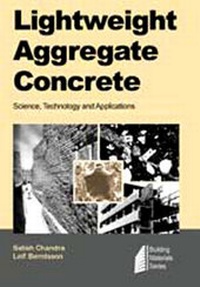
Lightweight Aggregate Concrete
Published on 28. October 2002
Book
Hardback
450 pages
978-0-8155-1486-2 (ISBN)
Description
In spite of the increasing use and demand for lightweight aggregate concrete (LWAC), there is still a lack of adequate explanations to understand the mechanisms responsible for the strength and durability properties of LWAC. This book is written to give an overall picture of LWAC, from the historical background, aggregate production, proportioning and production of concrete, to applications in structures. Physical properties and chemical durability are described in detail. The physical properties include density, strength, shrinkage, and elasticity. Chemical durability includes resistance to acids, chloride ingress, carbonation, and freeze-thaw resistance. Fire resistance is also included, which is seldom considered, but is a very important aspect of the safety of the structure. Microstructure development and its relation to the durability properties of LWAC generally are not highlighted in the literature. The development of bonds, the microstructure with different binder systems, and different types of lightweight aggregates are explained. They show how lightweight aggregate concrete differs from normal weight concrete. The chapters on chloride ingress and freeze-thaw resistance are detailed because of the use of LWAC in offshore construction. The economical aspects of using LWAC are also reviewed. Emphasis is placed on the fact that although the cost of LWAC is high, the total cost of construction has to be considered, including the cost of transport, reinforcement, etc. When these are considered then LWAC becomes cheaper and attractive. The life cycle cost of the concrete is another consideration for calculating long-term savings on maintenance costs.
More details
Language
English
Place of publication
Norwich
United States
Target group
Professional and scholarly
Scientists, researchers, engineers and technicians in the concrete industry. Also useful for architects and materials engineers.
Dimensions
Height: 229 mm
Width: 152 mm
Weight
840 gr
ISBN-13
978-0-8155-1486-2 (9780815514862)
Copyright in bibliographic data and cover images is held by Nielsen Book Services Limited or by the publishers or by their respective licensors: all rights reserved.
Schweitzer Classification
Other editions
Additional editions
E-Book
10/2002
William Andrew
€190.00
Available for download
Content
Historical Background of Lighweight Aggregate Concrete Production of Lightweight Aggregates and Its Properties Supplementary Cementing Materials Concluding Remarks Production Techniques Lightweight Aggregate Concrete Microstructures Physical Properties of Lightweight Aggregate Concrete Durability of Lightweight Aggregate Concrete to Chemical Attack Fire Resistance of Lightweight Aggregate Concrete Freeze-Thaw Resistance of Lightweight Aggregate Concrete Applications of Lightweight Aggregate Concrete Glossary Index