

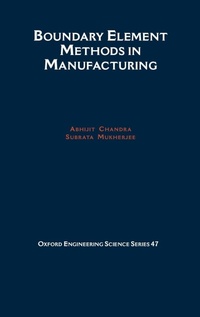
Boundary Element Methods in Manufacturing
Published on 12. June 1997
Book
Hardback
528 pages
978-0-19-507921-0 (ISBN)
Description
Manufacturing processes have existed, in some form, since the dawn of civilization. Modelling and numerical simulation of mechanics of such processes, however, are of fairly recent vintage; made possible, mainly by improved understanding of the fundamental mechanics and physics of these processes as well as by the availability of ever more powerful computers. Our capabilities of designing manufacturing processes, however, significantly lag behind our abilities in simulating such processes. In fact, research in the area of design of manufacturing processes is barely a decade old.
Analysis of manufacturing processes, and its integration into the design cycle of these processes, are the dual themes of this book. The boundary element method (BEM) is the computational method of choice. This versatile and powerful method has enjoyed extensive development during the last two decades and has been applied to virtually all areas of engieering mechanics (both linear and nonlinear) as well as in other areas.
The BEM infra-structure is presented in Chapters 2, 3, and 4. Chapters 2 and 3, respectively provide reviews of the fundamentals of nonlinear and thermal problems. Material and geometric nonlinearities are ubiquitous in manufacturing processes such as forming and machining while thermal issues play significant roles in casting and machining processes. Chapter 4 discusses design sensitivity analysis, and provides an avenue for utilizing insights gained from analysis toward design synthesis of manufacturing processes. Chapters 5 through 9 are devoted to detailed discussions of a broad range of manufacturing processes - forming, solidification, machining, and ceramic grinding.
The unique features of this book are its emphasis on numerical simulation as well as on design of manufacturing processes, and the use of the boundary element method as the computational method of choice.
Analysis of manufacturing processes, and its integration into the design cycle of these processes, are the dual themes of this book. The boundary element method (BEM) is the computational method of choice. This versatile and powerful method has enjoyed extensive development during the last two decades and has been applied to virtually all areas of engieering mechanics (both linear and nonlinear) as well as in other areas.
The BEM infra-structure is presented in Chapters 2, 3, and 4. Chapters 2 and 3, respectively provide reviews of the fundamentals of nonlinear and thermal problems. Material and geometric nonlinearities are ubiquitous in manufacturing processes such as forming and machining while thermal issues play significant roles in casting and machining processes. Chapter 4 discusses design sensitivity analysis, and provides an avenue for utilizing insights gained from analysis toward design synthesis of manufacturing processes. Chapters 5 through 9 are devoted to detailed discussions of a broad range of manufacturing processes - forming, solidification, machining, and ceramic grinding.
The unique features of this book are its emphasis on numerical simulation as well as on design of manufacturing processes, and the use of the boundary element method as the computational method of choice.
Reviews / Votes
"This work can be used as a reference book in a graduate course in boundary element methods applied to manufacturing. Boundary Element Methods in Manufacturing, which is written by experts in the field and is full of original current research, should be of immense interest to researchers, engineers, scientists, and graduate and postgraduate students who are interested in computational solid mechanics and heat transfer as applied tomanufacturing."--Applied Mechanics Review
"This work can be used as a reference book in a graduate course in boundary element methods applied to manufacturing. Boundary Element Methods in Manufacturing, which is written by experts in the field and is full of original current research, should be of immense interest to researchers, engineers, scientists, and graduate and postgraduate students who are interested in computational solid mechanics and heat transfer as applied to
manufacturing."--Applied Mechanics Review
More details
Series
Language
English
Place of publication
New York
United States
Target group
Professional and scholarly
Illustrations
numerous line figures, tables
Dimensions
Height: 240 mm
Width: 161 mm
Thickness: 33 mm
Weight
951 gr
ISBN-13
978-0-19-507921-0 (9780195079210)
Copyright in bibliographic data and cover images is held by Nielsen Book Services Limited or by the publishers or by their respective licensors: all rights reserved.
Schweitzer Classification
Other editions
Additional editions
Abhijit Chandra | Subrata Mukherjee
Boundary Element Methods in Manufacturing
E-Book
04/1997
OUP eBook
€108.99
Available for download
Persons
Author
Professor, Department of Mechanical Engineering and Engineering MechanicsProfessor, Department of Mechanical Engineering and Engineering Mechanics, Michigan Technological University
Professor, Department of Theoretical and Applied MechanicsProfessor, Department of Theoretical and Applied Mechanics, Cornell University, USA
Content
1. Introduction ; 2. Problems Involving Large Strains and Rotations ; 3. Thermal Problems ; 4. Design Sensitivities and Optimization ; 5. Planar Forming Processes ; 6. Axisymmetric Forming Processes ; 7. Solidification Processes ; 8. Machining Processes ; 9. Integral Equations for Ceramic Grinding Processes