

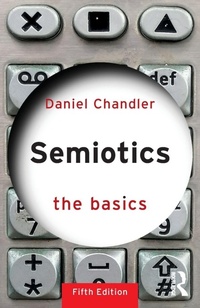
Semiotics: The Basics
5th Edition
Published on 8. August 2025
Book
Paperback/Softback
398 pages
978-1-041-01611-3 (ISBN)
Description
This fifth edition of the bestselling textbook is a major new revision, continuing to provide a concise introduction to the key concepts of semiotics in accessible and jargon-free language.
Demystifying what is a complex, highly interdisciplinary field, key questions covered include: What are signs and codes? What can semiotics teach us about representation and reality? What tools does it offer for analysing texts and cultural practices? Semiotics: The Basics focuses on its application to communication and cultural studies. The latest edition features a greatly extended treatment of core concepts, in particular traditional historical models of the sign, the semiotic triangle, and distinctions between 'natural' and conventional signs. There is also a greater emphasis on 'the social life of signs'.
With an extensive index, a comprehensive glossary, suggestions for review and for further reading, and a list of online resources, this must-have guide is both the ideal introductory text and an essential reference for students of language, communication, media, and cultural studies at both undergraduate and postgraduate levels.
Demystifying what is a complex, highly interdisciplinary field, key questions covered include: What are signs and codes? What can semiotics teach us about representation and reality? What tools does it offer for analysing texts and cultural practices? Semiotics: The Basics focuses on its application to communication and cultural studies. The latest edition features a greatly extended treatment of core concepts, in particular traditional historical models of the sign, the semiotic triangle, and distinctions between 'natural' and conventional signs. There is also a greater emphasis on 'the social life of signs'.
With an extensive index, a comprehensive glossary, suggestions for review and for further reading, and a list of online resources, this must-have guide is both the ideal introductory text and an essential reference for students of language, communication, media, and cultural studies at both undergraduate and postgraduate levels.
Reviews / Votes
Praise for the fifth edition:'The successive editions of Daniel Chandler's Semiotics since 2002 show a depth of vision and commitment that make these clear, precise, and well-documented works a real contribution to world research.'
Anne Henault, Professor emerita, Sorbonne University
Praise for previous editions:
'A very useful book, not only for those who wish to find out about semiotics, but also for those interested in finding out how language or any other sign system is far from being a neutral medium of communication.'
Juan A. Prieto-Pablos, University of Seville, Spain
'The book is well written and up-to-date, without unnecessary verbosity or jargon, and yet reflects the complexity of the field and its problems.'
Journal of Pragmatics
'It is no small task to present semiotics in a manner that makes it accessible to the beginning student, and Chandler achieves this, describing difficult concepts clearly and thoroughly.'
Donald J. Cunningham, Indiana University, USA
'This book is, at once, highly accessible, extremely interesting, encyclopedic in scope, and authoritative. Highly recommended for all courses involving semiotics and its applications to media, culture and society.'
Arthur Asa Berger, San Francisco State University, USA
'Daniel Chandler's Semiotics is thorough, well organized, and well written. Provocative and informative, its range, depth, and erudition should make it of interest, not only to philosophers and theorists of art, language, and culture, but to anyone interested in the relation of signs to mind and reality and the relation of reality and mind to signs.'
Jeffrey Strayer, Purdue University Fort Wayne, USA
More details
Series
Edition
5th edition
Language
English
Place of publication
London
United Kingdom
Publishing group
Taylor & Francis Ltd
Target group
College/higher education
Postgraduate and Undergraduate Advanced
Illustrations
10 s/w Tabellen, 4 s/w Photographien bzw. Rasterbilder, 47 s/w Zeichnungen, 51 s/w Abbildungen
10 Tables, black and white; 47 Line drawings, black and white; 4 Halftones, black and white; 51 Illustrations, black and white
Dimensions
Height: 198 mm
Width: 129 mm
Thickness: 22 mm
Weight
442 gr
ISBN-13
978-1-041-01611-3 (9781041016113)
Copyright in bibliographic data and cover images is held by Nielsen Book Services Limited or by the publishers or by their respective licensors: all rights reserved.
Schweitzer Classification
Other editions
Additional editions
Daniel Chandler
Semiotics: The Basics
E-Book
08/2025
5th Edition
Routledge
€27.49
Available for download
Daniel Chandler
Semiotics: The Basics
E-Book
08/2025
5th Edition
Routledge
€27.49
Available for download

Daniel Chandler
Semiotics: The Basics
Book
08/2025
5th Edition
Routledge
€208.30
Shipment within 15-20 days
Previous edition
Book
05/2022
4th Edition
Routledge
€33.00
Shipment within 15-20 days
Person
Daniel Chandler is an emeritus faculty member at Aberystwyth University, UK, and a consultant in marketing semiotics. He is also the senior compiler of A Dictionary of Media and Communication (3rd edition, Oxford University Press, 2020) and A Dictionary of Social Media (Oxford University Press, 2016).
Content
List of illustrations
Preface
Acknowledgements
Introduction
Definitions
Relation to philosophy and linguistics
Structuralism
Why study semiotics?
1 Models
The semiotic triangle
Natural vs. conventional signs
The Saussurean model
The arbitrariness of the linguistic sign
The relational system
The Peircean model
Jakobson's model
Sign relations
Symbolic relations
Iconic relations
Indexical relations
The case of photography
Mixed modes
Types and tokens
Rematerializing the sign
Hjelmslev's model
Reflections
Further reading
2 Realities
Categorization
Language, thought, and reality
Referentiality
Referentiality
Modality
The sign is not the thing
Empty signifiers
Reflections
Further reading
3 Structures
Horizontal and vertical axes
The paradigmatic dimension
The commutation test
Oppositions
Markedness
Deconstruction
Conceptual alignment
The semiotic square
The syntagmatic dimension
Spatial relations
Sequential relations
Structural reduction
Langue and parole
Reflections
Further reading
4 Codes
The language model
Digital and analogue codes
Typologies
Social codes
Textual codes
Genre
Aesthetic realisms
Invisible editing
Interpretive codes
Ways of reading
Codification
Limitations
Reflections
Further reading
5 Ways of meaning
Rhetorical tropes
Metaphor
Metonymy
Synecdoche
Irony
Master tropes
Denotation and connotation
Myth
Reflections
Further reading
6 Interactions
Models of communication
Context and relevance
Communicative functions
The positioning of the subject
Modes of address
Intertextuality
Problematizing authorship
No text is an island
Intratextuality
Textual framing
Reflections
Further reading
7 Perspectives
Structuralist semiotics
Poststructuralist semiotics
The return of Saussure
Social semiotics
Cognitive semiotics
Cartesian dualism
Semiotic stances
Mental representation
Embodiment
Methodologies
An ecological and multimodal approach
Reflections
Further reading
Going further
Glossary
References
Index
Preface
Acknowledgements
Introduction
Definitions
Relation to philosophy and linguistics
Structuralism
Why study semiotics?
1 Models
The semiotic triangle
Natural vs. conventional signs
The Saussurean model
The arbitrariness of the linguistic sign
The relational system
The Peircean model
Jakobson's model
Sign relations
Symbolic relations
Iconic relations
Indexical relations
The case of photography
Mixed modes
Types and tokens
Rematerializing the sign
Hjelmslev's model
Reflections
Further reading
2 Realities
Categorization
Language, thought, and reality
Referentiality
Referentiality
Modality
The sign is not the thing
Empty signifiers
Reflections
Further reading
3 Structures
Horizontal and vertical axes
The paradigmatic dimension
The commutation test
Oppositions
Markedness
Deconstruction
Conceptual alignment
The semiotic square
The syntagmatic dimension
Spatial relations
Sequential relations
Structural reduction
Langue and parole
Reflections
Further reading
4 Codes
The language model
Digital and analogue codes
Typologies
Social codes
Textual codes
Genre
Aesthetic realisms
Invisible editing
Interpretive codes
Ways of reading
Codification
Limitations
Reflections
Further reading
5 Ways of meaning
Rhetorical tropes
Metaphor
Metonymy
Synecdoche
Irony
Master tropes
Denotation and connotation
Myth
Reflections
Further reading
6 Interactions
Models of communication
Context and relevance
Communicative functions
The positioning of the subject
Modes of address
Intertextuality
Problematizing authorship
No text is an island
Intratextuality
Textual framing
Reflections
Further reading
7 Perspectives
Structuralist semiotics
Poststructuralist semiotics
The return of Saussure
Social semiotics
Cognitive semiotics
Cartesian dualism
Semiotic stances
Mental representation
Embodiment
Methodologies
An ecological and multimodal approach
Reflections
Further reading
Going further
Glossary
References
Index