

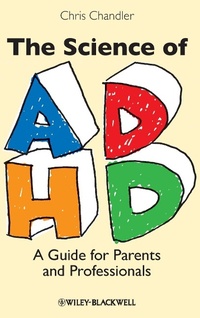
The Science of ADHD
A Guide for Parents and Professionals
1st Edition
Published on 1. October 2010
Book
Hardback
346 pages
978-1-4051-6234-0 (ISBN)
Description
The Science of ADHD addresses the scientific status of Attention-Deficit Hyperactivity Disorder in an informed and accessible way, without recourse to emotional or biased viewpoints. The author utilises the very latest studies to present a reasoned account of ADHD and its treatment.
Provides an up-to-date account of the neuroscience of ADHD, and the limitations of such research
Addresses the scientific status of ADHD from an objective and evidence-based standpoint without recourse to emotional and uninformed argument
Describes and discusses the ever increasing scientific evidence
As a parent of a child with ADHD, the author has first-hand experience of the subject matter, and a unique understanding of the information parents require on the subject
Provides an up-to-date account of the neuroscience of ADHD, and the limitations of such research
Addresses the scientific status of ADHD from an objective and evidence-based standpoint without recourse to emotional and uninformed argument
Describes and discusses the ever increasing scientific evidence
As a parent of a child with ADHD, the author has first-hand experience of the subject matter, and a unique understanding of the information parents require on the subject
Reviews / Votes
"This is a really useful book and covers just about everything you want to know about ADHD." (Young Minds Magazine, 21 March 2013)"The book is a masterful summary of the extant literature on ADHD, sophisticated enough for professionals and accessible enough for parents and other laypeople. It deserves to be read by anyone with a personal or professional interest in ADHD. Parents should read it to become inoculated against the many myths and simplistic ideas about ADHD that they will encounter. Professionals should read it as a stimulus to examining recent and classic primary source documents on the topic. For either audience, the subtitle's description of the book as a "guide" is true in the fullest sense of the word." (Metapsychology, 9 August 2011)
"Overall the book provides an excellent platform, and the impressive list of references means that the reader can explore much farther in their area of interest." (The Psychologist, 1 July 2011)
More details
Language
English
Place of publication
Hoboken
United Kingdom
Publishing group
John Wiley and Sons Ltd
Target group
Professional and scholarly
Product notice
sewn/stitched
Paper over boards
Dimensions
Height: 235 mm
Width: 157 mm
Thickness: 23 mm
Weight
654 gr
ISBN-13
978-1-4051-6234-0 (9781405162340)
Copyright in bibliographic data and cover images is held by Nielsen Book Services Limited or by the publishers or by their respective licensors: all rights reserved.
Schweitzer Classification
Other editions
Additional editions
E-Book
03/2011
Wiley-Blackwell
€22.99
Available for download
Book
10/2010
Wiley
€25.90
Article exhausted; check for reprint
E-Book
07/2010
Wiley-Blackwell
€22.99
Available for download
Person
Chris Chandler is Principal Lecturer in Psychobiology at London Metropolitan University. Chandler's research interests have previously centred on the role of dopamine in behaviour. He is currently involved in projects researching the addiction and changes that can occur in information processing. He teaches on the biological aspects of behaviour, including ADHD and addiction.
Content
Acknowledgments. Preface.
1. What is ADHD?
2. Diagnosis, Epidemiology and Comorbidity.
3. Causality and the environmental hypotheses of ADHD.
4. Psychological theories of ADHD.
5. The Genetics of ADHD.
6. The Neuroscience of ADHD.
7. Psychostimulant Treatment of ADHD.
8. Non-stimulant Medication and Non-pharmacological Treatment.
9. Addiction, Reward and ADHD.
10. The Past, Present and Future Science of ADHD.
Glossary.
References.
Index.
1. What is ADHD?
2. Diagnosis, Epidemiology and Comorbidity.
3. Causality and the environmental hypotheses of ADHD.
4. Psychological theories of ADHD.
5. The Genetics of ADHD.
6. The Neuroscience of ADHD.
7. Psychostimulant Treatment of ADHD.
8. Non-stimulant Medication and Non-pharmacological Treatment.
9. Addiction, Reward and ADHD.
10. The Past, Present and Future Science of ADHD.
Glossary.
References.
Index.