

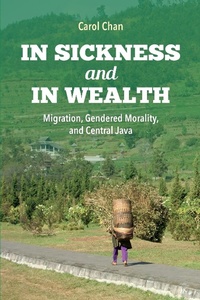
In Sickness and in Wealth
Migration, Gendered Morality, and Central Java
Published on 10. August 2018
Book
Paperback/Softback
234 pages
978-0-253-03706-0 (ISBN)
Description
Villagers in Indonesia hear a steady stream of stories about the injuries, abuses, and even deaths suffered by those who migrate in search of work. So why do hundreds of thousands of Indonesian workers continue to migrate every year? Carol Chan explores this question from the perspective of the origin community and provides a fascinating look at how gender, faith, and shame shape these decisions to migrate. Villagers evaluate men's and women's migrations differently, leading to different ideas about which kinds of human or financial flows should be encouraged and which should be discouraged or even criminalized. Despite routine and well-documented instances of exploitation of Indonesian migrant workers, some villagers still emphasize that a migrant's success or failure ultimately depends on that individual's morality, fate, and destiny. Indonesian villagers construct strategies for avoiding migration-related risks that are closely linked to faith and belief in supernatural agency. These strategies shape the flow of migration from the country and help to ensure the continued confidence Indonesian people have in migration as an act of promise and hope.
Reviews / Votes
In Sickness and in Wealth is a precious contribution in the expanding anthropological literature on morality, perhaps peculiarly salient in its bouncing off different perspectives. Thanks to its elegant and accessible style, furthermore, it makes for an engaging read also for those interested in the Indonesian and Southeast Asian scholarship at large.- Roberto Rizzo (Social Anthropology) This book is essential reading for students wishing to learn about the cultural constitution of one specific mobility system: Javanese women's transnational labor migration. It will be useful for those comparing the lives of other transnational migrants and overseas domestic workers from and within Asia. Studying migration from the vantage point of the "sending" communities-in this case, villages in Central Java-is less common than studying migrant experiences from the "receiving" countries' perspectives. Chan's research thus adds to a small but growing number of studies that have shown the importance of learning about the social context from which people leave, circulate, and return, as well as communicate, sustain relationships, and participate in social, political, and economic life transnationally.
- Emily Hertzman (Indonesia)
More details
Series
Language
English
Place of publication
Bloomington, IN
United States
Target group
Professional and scholarly
Product notice
Paperback (trade)
Dimensions
Height: 229 mm
Width: 152 mm
Thickness: 12 mm
Weight
346 gr
ISBN-13
978-0-253-03706-0 (9780253037060)
Copyright in bibliographic data and cover images is held by Nielsen Book Services Limited or by the publishers or by their respective licensors: all rights reserved.
Schweitzer Classification
Other editions
Additional editions
E-Book
12/2021
Indiana University Press
€18.18
Available for download
E-Book
08/2018
Indiana University Press
€14.49
Available for download
Person
Carol Chan is a postdoctoral fellow with the Interdisciplinary Program for Migration Studies (PRIEM) at Universidad Alberto Hurtado, Chile.
Content
Acknowledgements
Note on Names and Indonesian Currency
List of Abbreviations and Terms
Introduction: Faith in Migration
1. The Politics of Morality and Identity in Central Java
2. Mobilizing and Moralizing Indonesian Labor
3. Evaluating Migrant Success and Failure
4. Shame
5. Faith
6. Contesting the Terms of Belonging
Conclusion: Gendered Moral Economies of Migration
Bibliography
Index
Note on Names and Indonesian Currency
List of Abbreviations and Terms
Introduction: Faith in Migration
1. The Politics of Morality and Identity in Central Java
2. Mobilizing and Moralizing Indonesian Labor
3. Evaluating Migrant Success and Failure
4. Shame
5. Faith
6. Contesting the Terms of Belonging
Conclusion: Gendered Moral Economies of Migration
Bibliography
Index