

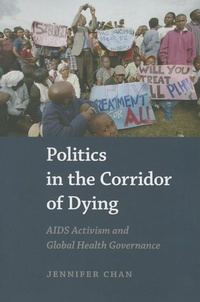
Politics in the Corridor of Dying
AIDS Activism and Global Health Governance
Will be published approx. on 26. April 2015
Book
Paperback/Softback
344 pages
978-1-4214-1597-0 (ISBN)
Description
Few diseases have provoked as many wild moralistic leaps or stringent attempts to measure, classify, and define risk and treatment standards as AIDS. In Politics in the Corridor of Dying, Jennifer Chan documents the emergence of a diverse range of community-based, nongovernmental, and civil society groups engaged in patient-focused AIDS advocacy worldwide. She also critically evaluates the evolving role of these groups in challenging authoritative global health governance schemes put in place by what she describes as overcontrolling or sanctimonious governments, scientists, religious figures, journalists, educators, and corporations. Drawing on more than 100 interviews conducted across eighteen countries, the book covers a broad spectrum of contemporary sociopolitical issues in AIDS activism, including the criminalization of HIV transmission, the fight against "big pharma," and the politics of the President's Emergency Plan for AIDS Relief. Chan argues that AIDS activism disrupts four contemporary regimes of power-scientific monopoly, market fundamentalism, governance statism, and community control-by elevating alternative knowledge production and human rights.
This multidisciplinary book is aimed at students and scholars of public health, sociology, and political science, as well as health practitioners and activists. Politics in the Corridor of Dying makes specific policy recommendations for the future while revealing how AIDS activism around the world has achieved much more than increased funding, better treatment, and more open clinical trial access: by forcing controlling entities to democratize, activists have changed the balance of power for the better and helped advance permanent social change.
This multidisciplinary book is aimed at students and scholars of public health, sociology, and political science, as well as health practitioners and activists. Politics in the Corridor of Dying makes specific policy recommendations for the future while revealing how AIDS activism around the world has achieved much more than increased funding, better treatment, and more open clinical trial access: by forcing controlling entities to democratize, activists have changed the balance of power for the better and helped advance permanent social change.
More details
Language
English
Place of publication
Baltimore, MD
United States
Target group
Professional and scholarly
Product notice
Paperback (trade)
Illustrations
7 s/w Photographien bzw. Rasterbilder, 1 s/w Zeichnung
1 Line drawings, black and white; 7 Halftones, black and white
Dimensions
Height: 226 mm
Width: 150 mm
Thickness: 25 mm
Weight
454 gr
ISBN-13
978-1-4214-1597-0 (9781421415970)
DOI
10.1353/book.38427
Copyright in bibliographic data and cover images is held by Nielsen Book Services Limited or by the publishers or by their respective licensors: all rights reserved.
Schweitzer Classification
Other editions
Additional editions
E-Book
04/2015
Johns Hopkins University Press
€29.99
Available for download
Person
Jennifer Chan is an associate professor in the Institute for Gender, Race, Sexuality, and Social Justice at the University of British Columbia. She is the editor of Another Japan Is Possible: New Social Movements and Global Citizenship Education and the author of Gender and Human Rights Politics in Japan: Global Norms and Domestic Networks.
Content
List of Tables and Figures
Acknowledgments
Abbreviations
1. Introduction
2. Against Science and the Stigmatization of the "At-Risk" Body
3. Against Pharma and the Intellectual Propertization of Life
4. Against Governance and the Oligopolization of Power
5. Against Community and the Expertization of Activism
6. Conclusion
Appendix
Notes
References
Index
Acknowledgments
Abbreviations
1. Introduction
2. Against Science and the Stigmatization of the "At-Risk" Body
3. Against Pharma and the Intellectual Propertization of Life
4. Against Governance and the Oligopolization of Power
5. Against Community and the Expertization of Activism
6. Conclusion
Appendix
Notes
References
Index