

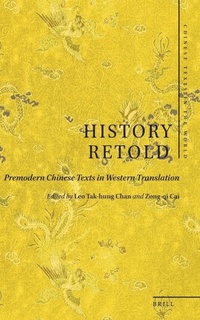
History Retold
Premodern Chinese Texts in Western Translation
Published on 29. September 2022
Book
Hardback
318 pages
978-90-04-52131-5 (ISBN)
Description
This collected volume focuses on the history of Western translation of premodern Chinese texts from the seventeenth to the twentieth century. Divided into three parts, nine chapters feature close readings of translated texts, micro-studies of how three translations came into being, and broad-based surveys that inquire into the causes of historical change. Among the specific questions addressed are: What stylistic, generic, and discursive permutations were undergone by Chinese texts as they crossed linguistic borders? Who were the main agents in this centuries-long effort to transmit Chinese culture to the West? How did readership considerations affect the form that particular translations take? More generally, the contributors are concerned with the relevance of current research paradigms, like those of World Literature, transcultural reception, and the rewriting of translation history.
More details
Series
Language
English
Place of publication
Leiden
Netherlands
Target group
Professional and scholarly
Product notice
sewn/stitched
Cloth over boards
Dimensions
Height: 234 mm
Width: 155 mm
Thickness: 19 mm
Weight
617 gr
ISBN-13
978-90-04-52131-5 (9789004521315)
Copyright in bibliographic data and cover images is held by Nielsen Book Services Limited or by the publishers or by their respective licensors: all rights reserved.
Schweitzer Classification
Persons
Leo Tak-hung Chan is Junwu Distinguished Professor, Guangxi University, China. Besides articles in Harvard Journal of Asiatic Studies, The Translator, and other journals, he has authored seven books-Western Theory in East Asian Contexts (2020), Readers, Reading and Reception of Translated Fiction in Chinese (2010), Twentieth-Century Chinese Translation Theory (2004), The Discourse on Foxes and Ghosts (1998), Translation in the Post-Babelian Era (2020), and Translation, Adaptation, and Reader Reception (2020) [the last two in Chinese]-and edited One into Many: Translation and the Dissemination of Classical Chinese Literature (2003). He was 2017 CETRA Chair Professor of Translation, University of Leuven, Belgium, and 2018 Humanities and Social Sciences Prestigious Fellow (Hong Kong Research Grants Council).
Zong-qi Cai teaches at Lingnan University of Hong Kong and the University of Illinois at Urbana-Champaign. He has published thirteen scholarly books in English and five in Chinese, most recent of which are his monograph Grammar and Poetic Visions ????? (2021), his edited volume How to Read Chinese Prose: A Guided Anthology (2022), and his co-authored volume (with Jie Cui and Liu Yucai), How to Read Chinese Prose in Chinese: A Course in Classical Chinese (2022) . He founded/cofounded and edits two Duke University Press journals, Prism: Theory and Modern Chinese Literature and The Journal of Chinese Literature and Culture (co-founded with Professor Yuan Xingpei), as well as the Chinese-language Lingnan Journal of Chinese Studies ????." He is also the general co-editor of the Brill book series Chinese Texts in the World, and as well as the Columbia book series How to Read Chinese Literature.
Zong-qi Cai teaches at Lingnan University of Hong Kong and the University of Illinois at Urbana-Champaign. He has published thirteen scholarly books in English and five in Chinese, most recent of which are his monograph Grammar and Poetic Visions ????? (2021), his edited volume How to Read Chinese Prose: A Guided Anthology (2022), and his co-authored volume (with Jie Cui and Liu Yucai), How to Read Chinese Prose in Chinese: A Course in Classical Chinese (2022) . He founded/cofounded and edits two Duke University Press journals, Prism: Theory and Modern Chinese Literature and The Journal of Chinese Literature and Culture (co-founded with Professor Yuan Xingpei), as well as the Chinese-language Lingnan Journal of Chinese Studies ????." He is also the general co-editor of the Brill book series Chinese Texts in the World, and as well as the Columbia book series How to Read Chinese Literature.
Content
Acknowledgements
Notes on Contributors
1 Introduction: Translation Histories, Micro and Macro
?Leo Tak-hung Chan and Zong-qi Cai
Part 1 Texts in History
2 The "Double Effect" of Translation in Jean-Pierre Abel-Remusat's Iu-Kiao-Li
?Daniel M. Youd
3 Peritextual Performance: Theodore Pavie's Histoire des Trois Royaumes
?Sarah Bramao-Ramos
4 From Scripture to Literature: Translations of the Shijing by James Legge and Arthur Waley
?Fusheng Wu
Part 2 Untold Microhistories
5 Sinological Positioning: The Giles-Waley Debate and the Inception of Arthur Waley's Chinese Translations, 1917-1922
?Lynn Qingyang Lin
6 Monkey's Peregrinations in the West: An Archival Study of Publishers' Reception of Arthur Waley's Translation of the Xiyouji
?Lintao Qi
7 The Making of a Book of Wisdom: Hermann Keyserling and Richard Wilhelm's I Ging
?Tze-ki Hon
Part 3 Toward the Macrohistorical
8 The Genesis of Dao Knowledge at the Beginning of Orientalism
?Sophie Ling-chia Wei
9 Dreams and Plums of World Literature: The Honglou meng and Jin Ping Mei in English (1827-1939)
?Andrew Schonebaum
Coda: Histoire Croisee and the Early European Translators: Missionaries, Scholars, Aesthetes
?Leo Tak-hung Chan
Index
Notes on Contributors
1 Introduction: Translation Histories, Micro and Macro
?Leo Tak-hung Chan and Zong-qi Cai
Part 1 Texts in History
2 The "Double Effect" of Translation in Jean-Pierre Abel-Remusat's Iu-Kiao-Li
?Daniel M. Youd
3 Peritextual Performance: Theodore Pavie's Histoire des Trois Royaumes
?Sarah Bramao-Ramos
4 From Scripture to Literature: Translations of the Shijing by James Legge and Arthur Waley
?Fusheng Wu
Part 2 Untold Microhistories
5 Sinological Positioning: The Giles-Waley Debate and the Inception of Arthur Waley's Chinese Translations, 1917-1922
?Lynn Qingyang Lin
6 Monkey's Peregrinations in the West: An Archival Study of Publishers' Reception of Arthur Waley's Translation of the Xiyouji
?Lintao Qi
7 The Making of a Book of Wisdom: Hermann Keyserling and Richard Wilhelm's I Ging
?Tze-ki Hon
Part 3 Toward the Macrohistorical
8 The Genesis of Dao Knowledge at the Beginning of Orientalism
?Sophie Ling-chia Wei
9 Dreams and Plums of World Literature: The Honglou meng and Jin Ping Mei in English (1827-1939)
?Andrew Schonebaum
Coda: Histoire Croisee and the Early European Translators: Missionaries, Scholars, Aesthetes
?Leo Tak-hung Chan
Index