

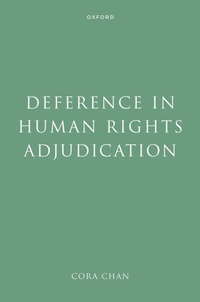
Deference in Human Rights Adjudication
Published on 25. July 2024
Book
Hardback
224 pages
978-0-19-892164-6 (ISBN)
Description
In human rights adjudication, courts sometimes face issues that they lack the expertise or constitutional legitimacy to resolve. One way of dealing with such issues is to 'defer', or accord a margin of appreciation, to the judgments of public authorities. This raises two important questions: what devices courts should use to exercise deference, and how deference can be made more workable for judges and predictable for litigants.
Combining in-depth conceptual analysis with practice in a broad range of jurisdictions, Deference in Human Rights Adjudication answers these questions. It introduces six devices for deference (namely, the burden of proof, standard of proof, standard of review, giving of weight, choice of interpretation, and choice of remedy), analyzes how courts should choose amongst them, and proposes techniques for rendering deference practicable. The book has two distinctive features. First, it engages with the jurisprudence of six common law jurisdictions that apply a structured proportionality test in rights adjudication, namely, Canada, Hong Kong, Ireland, Israel, New Zealand, and the United Kingdom. Second, it offers guidelines for judges who wish to apply its theoretical arguments. As such, Deference in Human Rights Adjudication will enable human rights adjudication to be more principled and in line with the rule of law and separation of powers.
Insightful and pioneering, this book will be an important reference for researchers, teachers, and students of constitutional theory, comparative constitutional law, and human rights law around the world. It will also assist practitioners, judges, and policymakers who have to grapple with issues of deference in adjudication.
Combining in-depth conceptual analysis with practice in a broad range of jurisdictions, Deference in Human Rights Adjudication answers these questions. It introduces six devices for deference (namely, the burden of proof, standard of proof, standard of review, giving of weight, choice of interpretation, and choice of remedy), analyzes how courts should choose amongst them, and proposes techniques for rendering deference practicable. The book has two distinctive features. First, it engages with the jurisprudence of six common law jurisdictions that apply a structured proportionality test in rights adjudication, namely, Canada, Hong Kong, Ireland, Israel, New Zealand, and the United Kingdom. Second, it offers guidelines for judges who wish to apply its theoretical arguments. As such, Deference in Human Rights Adjudication will enable human rights adjudication to be more principled and in line with the rule of law and separation of powers.
Insightful and pioneering, this book will be an important reference for researchers, teachers, and students of constitutional theory, comparative constitutional law, and human rights law around the world. It will also assist practitioners, judges, and policymakers who have to grapple with issues of deference in adjudication.
Reviews / Votes
Professor Chan's rich, rigorous comparative analysis of judicial deference is full of insight on every page. Her book takes a topic that is notoriously resistant to systemic analysis and constructs a bold yet careful framework for understanding it, based on caselaw from jurisdictions around the world. This is a must read for all judges, scholars, and students working on human rights adjudication, proportionality, and indeed adjudication in general. * David E. Landau, Mason Ladd Professor and Associate Dean for International Programs, Florida State University * This elegant book deserves recognition as a leading work on judicial deference. It maps the most common deferential techniques, analyses how and when they are used, and canvasses ways to enhance consistency and accountability in judicial recourse to deference. The primary focus of the work is experience with judicial deference in six broadly comparable common law jurisdictions: Canada, India, Hong Kong, New Zealand, South Africa, and the United Kingdom. The book also offers a wealth of insights for jurisdictions elsewhere, once appropriate allowance for context is made. * Cheryl Saunders, Laureate Professor Emeritus, University of Melbourne * The argument is forceful and clear. It is permeated by a refreshing emphasis on analytic distinctions and conceptual propositions in a subject often haunted by hazy ideas [The] book rewards careful study and will remain an enduring contribution to the deference scholarship, both within the human rights context and elsewhere. * Lia Lawton,Law Quarterly Review * Cora Chan's new book, Deference in Human Rights Adjudication, offers a tightly reasoned and extensive engagement with the premise of deference.... With careful analysis of several lines of caselaw, more analytical than strictly comparative, she presents a grid of guidance notes on the various postures that courts have adopted, in dealing with deference and human rights. The findings are telling, not just for the jurisdictions in question, but for the international and regional human rights tribunals now faced with questions of their own appropriate role, and for other courts supervising the extensive bills of rights and expressly justiciable complaints that have come with the last wave of constitution making and amendment.... This book justifies a close reading. * Katharine G. Young, Professor, Dean's Distinguished Scholar, Boston College Law School, JOTWELL * Chan's monograph succeeds remarkably in offering both theoretical and practical insights on deference. The arguments offered in the book are of broader relevance beyond human rights adjudication.... As such, this book is essential reading for all public law scholars, not just those interested in the topic of deference in human rights adjudication. It is also essential reading for judges involved in public law adjudication. * Kenny Chng, Associate Professor, Yong Pung How School of Law, Singapore Management University, Public Law *More details
Language
English
Place of publication
Oxford
United Kingdom
Target group
Professional and scholarly
Product notice
sewn/stitched
Cloth over boards
Dimensions
Height: 238 mm
Width: 164 mm
Thickness: 19 mm
Weight
503 gr
ISBN-13
978-0-19-892164-6 (9780198921646)
Copyright in bibliographic data and cover images is held by Nielsen Book Services Limited or by the publishers or by their respective licensors: all rights reserved.
Schweitzer Classification
Other editions
Additional editions
Cora Chan
Deference in Human Rights Adjudication
E-Book
09/2024
OUP eBook
€98.99
Available for download
Cora Chan
Deference in Human Rights Adjudication
E-Book
09/2024
1st Edition
OUP eBook
€98.99
Available for download
Person
Cora Chan is a Professor of Law at the University of Hong Kong. She specializes in constitutional law and has published on such topics as proportionality, deference, national security, and China-Hong Kong relations. Her research has been recognized by international, territory-wide, and university awards, including the Society of Legal Scholars Best Paper Prize, Hong Kong Research Grants Council Early Career Award, and inaugural Rosie Young 90 Medal for Outstanding Young Woman Scholar. She is the co-editor of China's National Security: Endangering Hong Kong's Rule of Law? (Hart, 2020). She was a Council member of the International Society of Public Law and a member of the law panel of Hong Kong's Research Assessment Exercise 2020.
Content
1: Introduction
2: Reasons for Deference
3: Devices for Deference
4: Choice of Device I: Types of Reasons
5: Choice of Device II: Strength of Reasons
6: Choice of Device III: Practicability
7: Conclusion
2: Reasons for Deference
3: Devices for Deference
4: Choice of Device I: Types of Reasons
5: Choice of Device II: Strength of Reasons
6: Choice of Device III: Practicability
7: Conclusion