

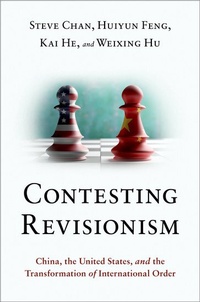
Contesting Revisionism
China, the United States, and the Transformation of International Order
Published on 10. August 2021
Book
Hardback
232 pages
978-0-19-758029-5 (ISBN)
Description
How can we know a country, such as the United States or China, is revisionist, that is, whether it intends to upset the international order?
What motivates states to act the way they do? Contesting Revisionism focuses on a particular kind of motivation inclining a state to challenge the existing norms, rules, and institutions of international order: revisionism. The authors offer a critique of the existing discourse on revisionism and investigate the origin and evolution of the foreign policy orientations of revisionist states in the past. Furthermore, they introduce an ensemble of indicators to discern and compare the extent of revisionist tendencies on the part of contemporary China and the United States. Questioning the facile assumption that past episodes will repeat in the future, they argue that "hard" revisionism relying on war and conquest is less viable and likely in today's world. Instead, "soft" revisionism seeking to promote institutional change is more relevant and likely. Focusing on contemporary Sino-American relations, they conclude that much of the current discourse based on power transition theory is problematic. A dominant power is not inevitably committed to the defense of international order, nor does a rising power always have a revisionist agenda to challenge this order. The transformation of international order does not necessarily require a power transition between China and the US., nor does a possible power transition necessarily augur war. After developing the concept of revisionism both theoretically and empirically, they conclude with a series of policy recommendations for enhancing international stability and diminishing tension in Sino-American relations.
What motivates states to act the way they do? Contesting Revisionism focuses on a particular kind of motivation inclining a state to challenge the existing norms, rules, and institutions of international order: revisionism. The authors offer a critique of the existing discourse on revisionism and investigate the origin and evolution of the foreign policy orientations of revisionist states in the past. Furthermore, they introduce an ensemble of indicators to discern and compare the extent of revisionist tendencies on the part of contemporary China and the United States. Questioning the facile assumption that past episodes will repeat in the future, they argue that "hard" revisionism relying on war and conquest is less viable and likely in today's world. Instead, "soft" revisionism seeking to promote institutional change is more relevant and likely. Focusing on contemporary Sino-American relations, they conclude that much of the current discourse based on power transition theory is problematic. A dominant power is not inevitably committed to the defense of international order, nor does a rising power always have a revisionist agenda to challenge this order. The transformation of international order does not necessarily require a power transition between China and the US., nor does a possible power transition necessarily augur war. After developing the concept of revisionism both theoretically and empirically, they conclude with a series of policy recommendations for enhancing international stability and diminishing tension in Sino-American relations.
Reviews / Votes
Overall, the main contribution of this important book is encapsulated by its title: Contesting Revisionism. In these uncertain times, when the future of the international order is widely debated by academics, it is important to take into account nuanced points of view, especially when forming conclusions on sensitive topics like US-China relations. * Martina Bernardini, International Affairs * This landmark study investigates many of the core concepts deployed in international relations scholarship as it has sought to grapple with the challenge that rising powers-and most notably ChinaLpose to international order. A rich, nuanced, and thought-provoking understanding of our contemporary condition. * Rosemary Foot, St.Antony's College, University of Oxford * This is one of the rare books that debunks the narrative in international relations that neatly distinguishes between revisionist and status quo powers. A must-read to understand the nuances of US-China rivalry as it is evolving today. * T.V. Paul, McGill University * It will help readers to better understand and be better prepared for the momentous change underway in world politics today. * Zheng Chen, China International Strategy Review *More details
Language
English
Place of publication
New York
United States
Target group
Professional and scholarly
Dimensions
Height: 159 mm
Width: 241 mm
Thickness: 18 mm
Weight
463 gr
ISBN-13
978-0-19-758029-5 (9780197580295)
Copyright in bibliographic data and cover images is held by Nielsen Book Services Limited or by the publishers or by their respective licensors: all rights reserved.
Schweitzer Classification
Other editions
Additional editions
Steve Chan | Huiyun Feng | Kai He
Contesting Revisionism
China, the United States, and the Transformation of International Order
Book
10/2021
Oxford University Press Inc
€41.70
Shipment within 15-20 days
Steve Chan | Huiyun Feng | Kai He
Contesting Revisionism
China, the United States, and the Transformation of International Order
E-Book
06/2021
OUP eBook
€17.49
Available for download
Steve Chan | Huiyun Feng | Kai He
Contesting Revisionism
China, the United States, and the Transformation of International Order
E-Book
06/2021
OUP eBook
€17.49
Available for download
Persons
Steve Chan is College Professor of Distinction, teaching political science at the University of Colorado, Boulder.
Huiyun Feng is Senior Lecturer of international relations at the School of Government and International Relations, Griffith University, Australia.
Kai He is Professor of international relations and Director, Centre for Governance and Public Policy, Griffith University, Australia.
Weixing Hu is UMDF Distinguished Professor and Dean, Faculty of Social Sciences, University of Macau.
Huiyun Feng is Senior Lecturer of international relations at the School of Government and International Relations, Griffith University, Australia.
Kai He is Professor of international relations and Director, Centre for Governance and Public Policy, Griffith University, Australia.
Weixing Hu is UMDF Distinguished Professor and Dean, Faculty of Social Sciences, University of Macau.
Author
Professor of Political ScienceProfessor of Political Science, University of Colorado, Boulder
Senior LecturerSenior Lecturer, School of Government and International Relations, Griffith University
Professor of International RelationsProfessor of International Relations, Griffith Asia Institute and Centre for Governance and Public Policy
Distinguished Professor of Politics and Public PolicyDistinguished Professor of Politics and Public Policy, University of Macau
Content
Preface
Chapter 1: Basic Rationale and Arguments
Chapter 2: The Origin and Evolution of Revisionism
Chapter 3: Meaning of International Order and Evidence on Revisionism
Chapter 4: Revisionist States' Strategies and Encounters with their Counterparts
Chapter 5: A Peaceful Transition of International Order?
Chapter 1: Basic Rationale and Arguments
Chapter 2: The Origin and Evolution of Revisionism
Chapter 3: Meaning of International Order and Evidence on Revisionism
Chapter 4: Revisionist States' Strategies and Encounters with their Counterparts
Chapter 5: A Peaceful Transition of International Order?