

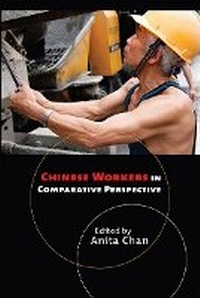
Chinese Workers in Comparative Perspective
Published on 21. May 2015
Book
Paperback/Softback
296 pages
978-0-8014-7993-9 (ISBN)
Description
As the "world's factory" China exerts an enormous pressure on workers around the world. Many nations have had to adjust to a new global political and economic reality, and so has China. Its workers and its official trade union federation have had to contend with rapid changes in industrial relations. Anita Chan argues that Chinese labor is too often viewed from a prism of exceptionalism and too rarely examined comparatively, even though valuable insights can be derived by analyzing China's workforce and labor relations side by side with the systems of other nations.
The contributors to Chinese Workers in Comparative Perspective compare labor issues in China with those in the United States, Australia, Japan, India, Pakistan, Germany, Russia, Vietnam, and Taiwan. They also draw contrasts among different types of workplaces within China. The chapters address labor regimes and standards, describe efforts to reshape industrial relations to improve the circumstances of workers, and compare historical and structural developments in China and other industrial relations systems.
The contributors to Chinese Workers in Comparative Perspective compare labor issues in China with those in the United States, Australia, Japan, India, Pakistan, Germany, Russia, Vietnam, and Taiwan. They also draw contrasts among different types of workplaces within China. The chapters address labor regimes and standards, describe efforts to reshape industrial relations to improve the circumstances of workers, and compare historical and structural developments in China and other industrial relations systems.
Reviews / Votes
Most academic research about the working conditions of Chinese factory workers has been focused on China itself, with little or no reference and comparison to workers and working conditions in other countries. However, this new book edited by Chan (China Research Center, Univ. of Technology, Sydney, Australia) attempts to convince readers that China is not exceptional and that it is critical to use a comparative perspective as an analytical tool to explain Chinas labor conditions.- R.M. Ramazani (Choice)
More details
Language
English
Place of publication
New York
United States
Publishing group
Cornell University Press
Target group
College/higher education
Professional and scholarly
Product notice
Paperback (trade)
Illustrations
12 tables, 9 charts - 12 Tables, unspecified
Dimensions
Height: 235 mm
Width: 155 mm
Thickness: 18 mm
Weight
454 gr
ISBN-13
978-0-8014-7993-9 (9780801479939)
Copyright in bibliographic data and cover images is held by Nielsen Book Services Limited or by the publishers or by their respective licensors: all rights reserved.
Schweitzer Classification
Other editions
Additional editions

Anita Chan
Chinese Workers in Comparative Perspective
E-Book
05/2015
ILR Press
€23.49
Available for download
Person
Anita Chan is a Research Professor at the Australia-China Relations Institute of the University of Technology, Sydney, and a visiting fellow at the Australian National University. She is the editor of Walmart in China, also from Cornell, the author of China's Workers under Assault: The Exploitation of Labor in a Globalizing Economy, and has published seven other books.
Content
Introduction: The Fallacy of Chinese Exceptionalism
by Anita ChanPart I. Historical and Structural Developments1. Exporting Corporatism? German and Japanese Transnationals' Regimes of Production in China
by Boy Luethje2. Globalization and Labor in China and the United States: Convergence and Divergence
by Mingwei Liu, Frederick Scott Bentley, Mary Huong Thi Evans, and Susan J. SchurmanPart II. Labor Standards3. Recomposing Chinese Migrant and State-Sector Workers
by Kevin Lin4. Industrial Upgrading and Work: The Impact of Industrial Transformation on Labor in Guangdong's Garment and IT Industries
by Florian Butollo5. The Working and Living Conditions of Garment Workers in China and Vietnam: A Comparative Study
by Kaxton Siu6. Race to the Bottom: The Soccer Ball Industry in China, Pakistan, and India
by Anita Chan, Hong Xue, Peter Lund-Thomsen, Khalid Nadvi, and Navjote KharaPart III. Trade Unions, Collective Bargaining, and the Right to Strike7. Labor NGOs under State Corporatism: Comparing China since the 1990s with Taiwan in the 1980s
by Chris King-chi Chan and Yu-bin Chiu8. One Step Forward: Collective Bargaining Experiments in Vietnam and China
by Katie Quan9. Creating a Right to Strike in China: Some Lessons from the Australian Experience
by Thomas Nice and Sean Cooney10. Trade Union Reform in Russia and China: Harmony, Partnership, and Power from Below
by Tim PringleNotes
Contributors
Index
by Anita ChanPart I. Historical and Structural Developments1. Exporting Corporatism? German and Japanese Transnationals' Regimes of Production in China
by Boy Luethje2. Globalization and Labor in China and the United States: Convergence and Divergence
by Mingwei Liu, Frederick Scott Bentley, Mary Huong Thi Evans, and Susan J. SchurmanPart II. Labor Standards3. Recomposing Chinese Migrant and State-Sector Workers
by Kevin Lin4. Industrial Upgrading and Work: The Impact of Industrial Transformation on Labor in Guangdong's Garment and IT Industries
by Florian Butollo5. The Working and Living Conditions of Garment Workers in China and Vietnam: A Comparative Study
by Kaxton Siu6. Race to the Bottom: The Soccer Ball Industry in China, Pakistan, and India
by Anita Chan, Hong Xue, Peter Lund-Thomsen, Khalid Nadvi, and Navjote KharaPart III. Trade Unions, Collective Bargaining, and the Right to Strike7. Labor NGOs under State Corporatism: Comparing China since the 1990s with Taiwan in the 1980s
by Chris King-chi Chan and Yu-bin Chiu8. One Step Forward: Collective Bargaining Experiments in Vietnam and China
by Katie Quan9. Creating a Right to Strike in China: Some Lessons from the Australian Experience
by Thomas Nice and Sean Cooney10. Trade Union Reform in Russia and China: Harmony, Partnership, and Power from Below
by Tim PringleNotes
Contributors
Index