

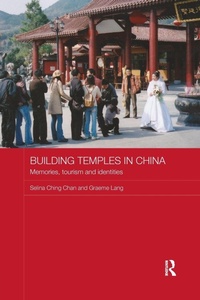
Building Temples in China
Memories, Tourism and Identities
1st Edition
Published on 24. May 2017
Book
Paperback/Softback
192 pages
978-1-138-29530-8 (ISBN)
Description
Much has been written on how temples are constructed or reconstructed for reviving local religious and communal life or for recycling tradition after the market reforms in China. The dynamics between the state and society that lie behind the revival of temples and religious practices initiated by the locals have been well-analysed. However, there is a gap in the literature when it comes to understanding religious revivals that were instead led by local governments.
This book examines the revival of worship of the Chinese Deity Huang Daxian and the building of many new temples to the god in mainland China over the last 20 years. It analyses the role of local governments in initiating temple construction projects in China, and how development-oriented temple-building activities in Mainland China reveal the forces of transnational ties, capital, markets and identities, as temples were built with the hope of developing tourism, boosting the local economy, and enhancing Chinese identities for Hong Kong worshippers and Taiwanese in response to the reunification of Hong Kong to China.
Including chapters on local religious memory awakening, pilgrimage as a form of tourism, women temple managers, entrepreneurialism and the religious economy, and based on extensive fieldwork, Chan and Lang have produced a truly interdisciplinary follow up to The Rise of a Refugee God which will appeal to students and scholars of Chinese religion, Chinese culture, Asian anthropology, cultural heritage and Daoism alike.
This book examines the revival of worship of the Chinese Deity Huang Daxian and the building of many new temples to the god in mainland China over the last 20 years. It analyses the role of local governments in initiating temple construction projects in China, and how development-oriented temple-building activities in Mainland China reveal the forces of transnational ties, capital, markets and identities, as temples were built with the hope of developing tourism, boosting the local economy, and enhancing Chinese identities for Hong Kong worshippers and Taiwanese in response to the reunification of Hong Kong to China.
Including chapters on local religious memory awakening, pilgrimage as a form of tourism, women temple managers, entrepreneurialism and the religious economy, and based on extensive fieldwork, Chan and Lang have produced a truly interdisciplinary follow up to The Rise of a Refugee God which will appeal to students and scholars of Chinese religion, Chinese culture, Asian anthropology, cultural heritage and Daoism alike.
More details
Series
Language
English
Place of publication
London
United Kingdom
Publishing group
Taylor & Francis Ltd
Target group
College/higher education
Illustrations
2 s/w Tabellen, 17 s/w Photographien bzw. Rasterbilder, 1 s/w Zeichnung, 18 s/w Abbildungen
2 Tables, black and white; 1 Line drawings, black and white; 17 Halftones, black and white; 18 Illustrations, black and white
Dimensions
Height: 234 mm
Width: 156 mm
Thickness: 11 mm
Weight
301 gr
ISBN-13
978-1-138-29530-8 (9781138295308)
Copyright in bibliographic data and cover images is held by Nielsen Book Services Limited or by the publishers or by their respective licensors: all rights reserved.
Schweitzer Classification
Other editions
Additional editions
Book
02/2015
1st Edition
Routledge
€231.30
Shipment within 15-20 days
E-Book
11/2014
1st Edition
Routledge
€69.99
Available for download
E-Book
11/2014
1st Edition
Routledge
€69.99
Available for download
Persons
Selina Ching Chan is Professor of Sociology and Associate Director of the Contemporary China Research Centre at Hong Kong Shue Yan University.
Graeme Lang was a Professor of Sociology in the Department of Asian and International Studies at City University of Hong Kong until his retirement in 2014.
Graeme Lang was a Professor of Sociology in the Department of Asian and International Studies at City University of Hong Kong until his retirement in 2014.
Content
1. Building Temples in China: Memories, Tourists and Identities 2. History of the worship of Huang Daxian 20 3. Making Religious Places: Memories and Transnational Ties 4. Heritage and Temples: Authenticity, Tourists, and Pilgrims 5. Two Grand Temples in Jinhua 6. A Female Temple Manager and the Popularization of a Temple 7. A Popular Temple in Guangzhou Built and Managed by a Secular Entrepreneur 8. Conclusion 9. Appendix: The Lives of a Saint: Compiling Stories about Huang Chuping